Recorded November 20, 2026
Neuroscience & MindReported finding
Stimulation in 13 people reveals Wernicke’s speech-production role
Stimulation in 13 people produced aphasia-like word errors, while recordings and tumor-surgery maps support the case that Wernicke’s area prepares speech rather than merely decoding it.
By Priya Raman5 min read949 words
In brief
- The study appeared in Science on Thursday, Nov. 19, 2026.
- In 28 epilepsy participants, cells in Wernicke’s area fired about 0.25 seconds before spoken words.
- Stimulation in 13 people caused word errors resembling Wernicke’s aphasia.
- Lesion maps from hundreds of temporal-lobe tumor surgeries supported a speech-production role.
- Researchers decoded attempted communication from two speech-paralysis patients.
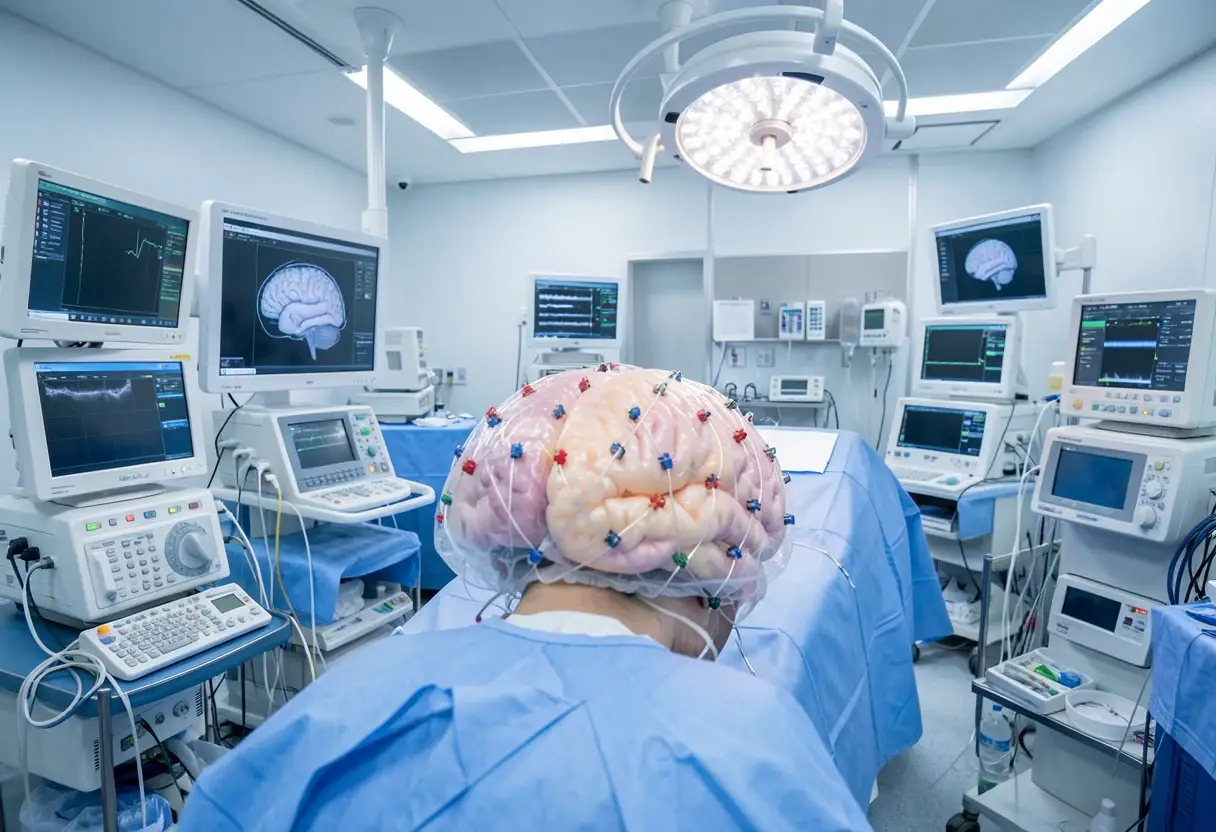
Electrical stimulation of Wernicke’s area before speech produced aphasia-like word errors in 13 people, according to a study published Thursday, Nov. 19, 2026, in Science.
Researchers delivered the current through electrodes already implanted on the brain’s surface. Their result revises a longstanding account of a region usually found in the left temporal lobe: it contributes to speech production rather than serving only to interpret other people’s words.
For more than 150 years, neuroscientists have treated Wernicke’s area as a decoder. German neuroanatomist Carl Wernicke, a scientist who studied brain structure, identified it in the 1860s. It usually lies in the left temporal lobe, a brain division associated with hearing and language. Damage makes it hard to understand what others say, a language impairment called Wernicke’s aphasia.
Wernicke’s aphasia affects speech production as well as understanding. Patients can preserve a normal speaking cadence, yet choose words that do not match their intention. They may substitute words related in meaning, turning “shoe” into “foot,” or confuse similar sounds, such as “leg” and “peg.” The resulting sentences can become nonsensical and undermine communication.
What had been unclear for 150 years?
These symptoms established that damage affected production, but not which cells caused the deficit or how the function arose. Alexander Silva, a neuroscientist at the University of California, San Francisco and a study co-author, said the question had remained a mystery for more than 150 years.
The team framed two possible explanations. One held that the region checked speech for errors and corrected them; the other proposed dedicated activity that generated upcoming speech. Silva and his colleagues combined several tests, recording brain activity while participants spoke.
Adeen Flinker, a neuroscientist at New York University who was not involved in the study, summarized the advance: “We already knew that damage to Wernicke’s area can lead to speech production errors, but this publication answers why.”
How did the team test the region?
They used electrocorticography, a method that records brain-cell activity through electrodes placed on the brain’s surface, allowing measurement of both where and when a signal arose. Such recordings could show that activity preceded speech, but not by themselves that the activity caused speech.
Twenty-eight participants with epilepsy already had surface electrodes for seizure monitoring. Within Wernicke’s area, the researchers identified a small group of cells that fired about a quarter of a second before participants spoke words aloud. The preparatory signal remained distinct from linked auditory signals—brain responses to the sound of those words after they were spoken.
To test whether the association mattered, the team mapped the brains of hundreds of people undergoing surgery to remove temporal-lobe tumors and assessed how each operation affected speech. Patients were much more likely to have speaking difficulties when surgery damaged Wernicke’s area, supporting a production role.
A further test involved 13 people with implanted electrodes and undamaged Wernicke’s areas. When researchers sent a wave of electricity through the speech-preparation area just before participants opened their mouths to talk, stimulation caused word errors resembling Wernicke’s aphasia.
Could Wernicke’s area power a speech interface?
The investigators next asked whether activity in this area could help people unable to speak through damaged motor pathways. A brain-computer interface, or BCI, translates brain activity into commands; speech versions of these devices interpret neural signals and spell out intended words on a screen.
Using additional electrode data, the team identified individual cells in Wernicke’s area linked to particular spoken words.
They then studied two patients with speech paralysis after strokes damaged the brainstem, the region connecting the brain with the spinal cord. In both, electrodes sent signals to speech devices that read activity from undamaged areas and displayed the words the patients tried to say.
Monitoring Wernicke’s area in these two patients allowed the researchers to decode what each person was attempting to communicate. The result suggests that speech interfaces might draw on language-related activity, not only movement signals, when the usual route from motor cortex to mouth muscles is unavailable.
Until now, BCI users have mainly had damage to pathways linking the motor cortex, the brain’s movement-control network, and the mouth muscles. Silva cited amyotrophic lateral sclerosis (ALS), a disease that damages motor neurons, as one example.
He said this group is small relative to the number of patients with aphasia caused by injury to the cortex, the brain’s outer layer. Flinker said people with vocal paralysis from that cortical damage cannot benefit from the same interfaces.
Silva said the findings rewrite the textbook on Wernicke’s area. The special speech-preparation site could become a new target for interfaces intended to help people with aphasia, potentially reaching patients who cannot use devices dependent on intact motor pathways.
What remains to be tested?
The findings do not establish a treatment. The stimulation experiment occurred in 13 people with undamaged Wernicke’s areas and produced errors, not restored speech; the team decoded attempted communication in only two patients. The evidence therefore supports Wernicke’s area as a source of speech preparation and a possible interface target, while clinical benefit remains unproven.
Against that caution, Silva said: “We really think that this is an area that could expand the number of people that could benefit from the technology in the near future.”
The paper, “A neural code for generative speech production in human Wernicke’s area,” appeared in Science, volume 394, issue 6826, with DOI 10.1126/science.aef8963.
The mechanism is clearer, but a clinical therapy remains to be built. This article is for informational purposes only and does not provide medical advice.
via livescience.com/feeds/news (Source)
More from Priya Raman
Show full bio
Senior reporter covering people, launches and day-to-day practice in general science news at SciBeat.
549 articles