Plate Nº 36 · recorded November 18, 2026
Biology & EvolutionReported finding
Sudden Heat Spikes Harm Honey Bees More Than Sustained Heat
A 2026 Washington State University study found that abrupt heat shocks altered honey bee physiology and gut microbes, raising mortality, while sustained heat became less harmful.
By Elena Vasquez4 min read742 words
In brief
- A 2026 Scientific Reports study found that sudden heat shocks harmed laboratory honey bees more than sustained heat.
- Sudden heat shock changed bee physiology and gut microbes and led to higher mortality.
- Researchers used newly emerged brood from six sister-queen colonies and randomly allocated 150 bees to each enclosure.
- Three temperature regimes were tested: constant ideal heat, constant elevated heat, and ideal heat followed by elevated heat after a few days.
- All groups received ample water and sugar syrup; half of each group also received a pollen patty.
By Elena Vasquez
In a 2026 laboratory study, sudden heat shocks raised honey bee mortality and changed their physiology, or body functions, and gut microbiome, while sustained heat caused less damage as the insects adapted. The Washington State University finding may help scientists better understand how bees respond to heat extremes produced by changing weather patterns.
Priya Chakrabarti Basu, an assistant professor in Washington State University’s Department of Entomology and the study’s lead author, said: “We know that bees have an ability to adapt physiologically. But we thought that sustained higher temperatures would have similar impacts to a sudden heat wave. That didn’t happen: The bees adapted to continuous heat stress.”
How did the experiment test heat and food?
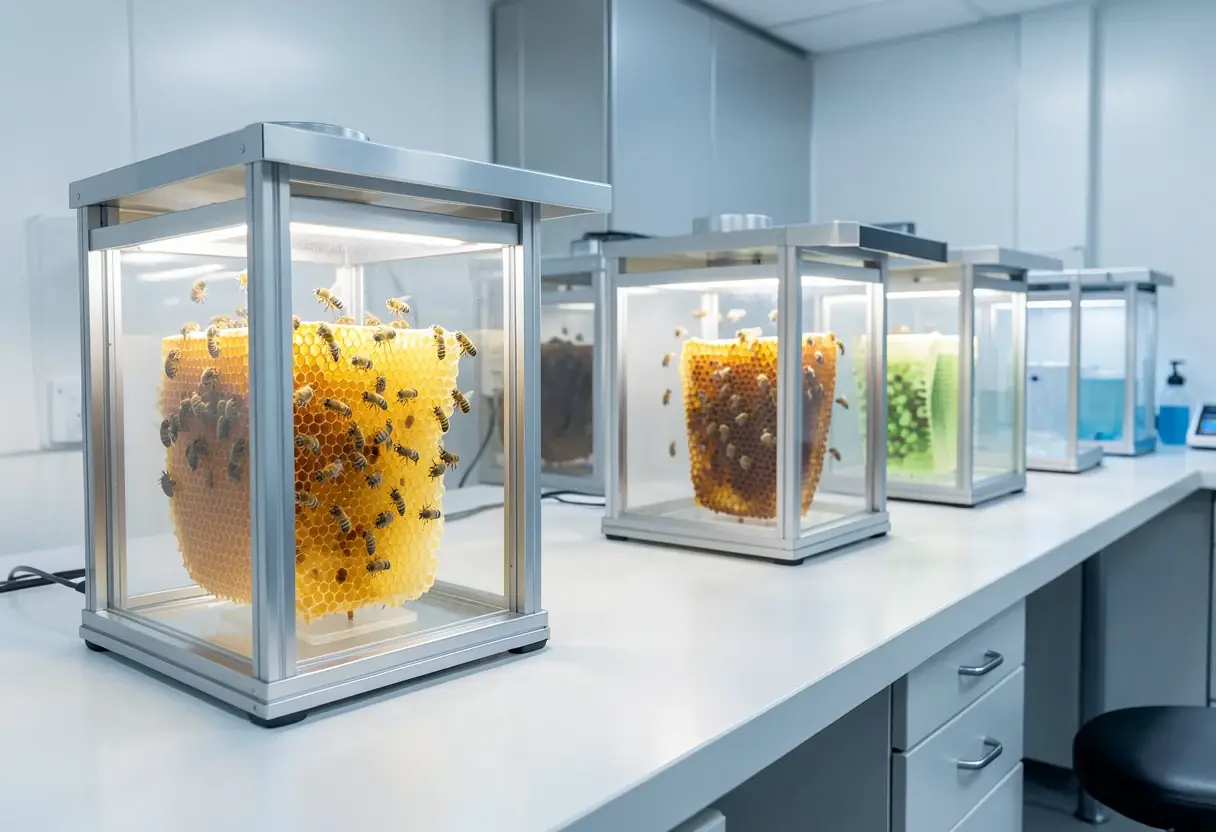
To limit natural genetic differences, the researchers used newly emerged brood from six colonies whose queens were sisters, aiming to rule out ordinary variation among bees as the cause of physiological changes. They randomly allocated 150 honey bees to each enclosure and tested three temperature paths:
- A consistent temperature described by the researchers as ideal.
- A consistently elevated temperature.
- An initial ideal temperature followed by elevated heat after a few days.
All groups received plenty of water and sugar syrup. Half of each group also received a pollen patty, a pollen-based food supplement. The diet split compared optimal diet supplementation with poorer nutrition because some bees may have access to more food than others. It also let the team examine how heat stress interacts with available food, or forage, and how multiple stressors combine.
Takeaway: The team tested steady heat, sudden heat and diet together under controlled conditions.
What changed in the bees’ gut?
Researchers were surprised by the gut microbiome result, meaning the community of microbes living inside a bee’s gut. Earlier studies showed that disrupting this community can increase susceptibility to certain pesticides and potentially worsen harmful physiological effects. Basu thinks its shifting composition during heat shock may allow environmental factors to cause damage, but further research must test that theory.
Basu explained: “Honey bees have a core gut biome. Some microbes help break down pollen, some help digest sugars, some help protect against diseases. If those processes shift, that can affect how they digest food or how their immune system responds to a threat.”
Takeaway: Heat shock disturbed gut microbes that support digestion, disease protection and immune responses.
Why did sudden heat cause more harm?
Basu proposed that timing helps explain the difference through hormesis, a stress effect in which the timing or level of stress can produce an effect opposite to what the stress usually causes. Here, a rapid jump into hotter surroundings had a different effect from consistently higher heat.
Animals can adapt quickly to environmental stress, Basu said, but bees that emerged into a stressed environment and remained there could adapt. Bees did not rapidly adapt to the shock of sudden heat. Basu presented hormesis as a plausible explanation, not a proven account of every step in the process.
Takeaway: Steady heat gave bees time to adjust; an abrupt jump did not.
What could this mean for solitary bees?
Basu said heat-related harm could fall more heavily on solitary bees in the wild than on bees living in colonies. In a hive, thousands of individuals share resources and collective support, which can buffer some environmental stressors. Solitary bees lack that safety net, so changes to food resources or health can affect survival and reproduction more directly.
That concern extends beyond the experiment: the researchers tested laboratory honey bees, not wild solitary species.
Takeaway: A colony can cushion some heat stress, while a solitary bee has fewer buffers.
What are the study’s limits?
The experiment used enclosures, controlled temperatures and controlled food. That design supports comparisons among the three heat patterns, but it does not reproduce the full conditions of a wild hive or a solitary bee’s habitat.
The available report gives no temperature settings, mortality percentages or separate results for pollen-fed and non-pollen-fed bees. It says the team examined interactions among heat and food, not that the diet split produced a particular result.
The paper, “Effects of heat stress on honey bee physiology and gut microbiome under laboratory conditions,” appeared in Scientific Reports in 2026 under DOI 10.1038/s41598-026-78330-7.
Takeaway: The laboratory comparison is clear, but the summary does not quantify mortality or show how large the risk is in the wild.
via phys.org/rss-feed/ (Source)
More from Elena Vasquez
Show full bio
Correspondent covering money, funding and market shifts around general science news at SciBeat.
505 articles