Plate Nº 48 · recorded November 10, 2026
Biology & EvolutionReported finding
Tree-rich landscapes help birds and bats nearly double Peru's cacao yields
In Peru's Amazon, cacao yields rose from 265 to about 1,000 kg per hectare yearly in tree-rich landscapes, as birds and bats delivered pest control worth $1,640 per hectare.
By Nathan Brooks3 min read584 words
In brief
- Cacao yields rose from 265 to about 1,000 kg per hectare per year in tree-rich vs. deforested landscapes.
- Birds and bats eating pest arthropods nearly doubled yields, worth an estimated US$1,640 per hectare per year.
- Researchers studied 28 organic cacao agroforests in the northern Peruvian Amazon.
- Recommended landscape mix: 30–35% forest, 40–45% tree-based habitats, 20–30% open areas.
- Study published in Communications Earth & Environment (2026), led by the University of Vienna.
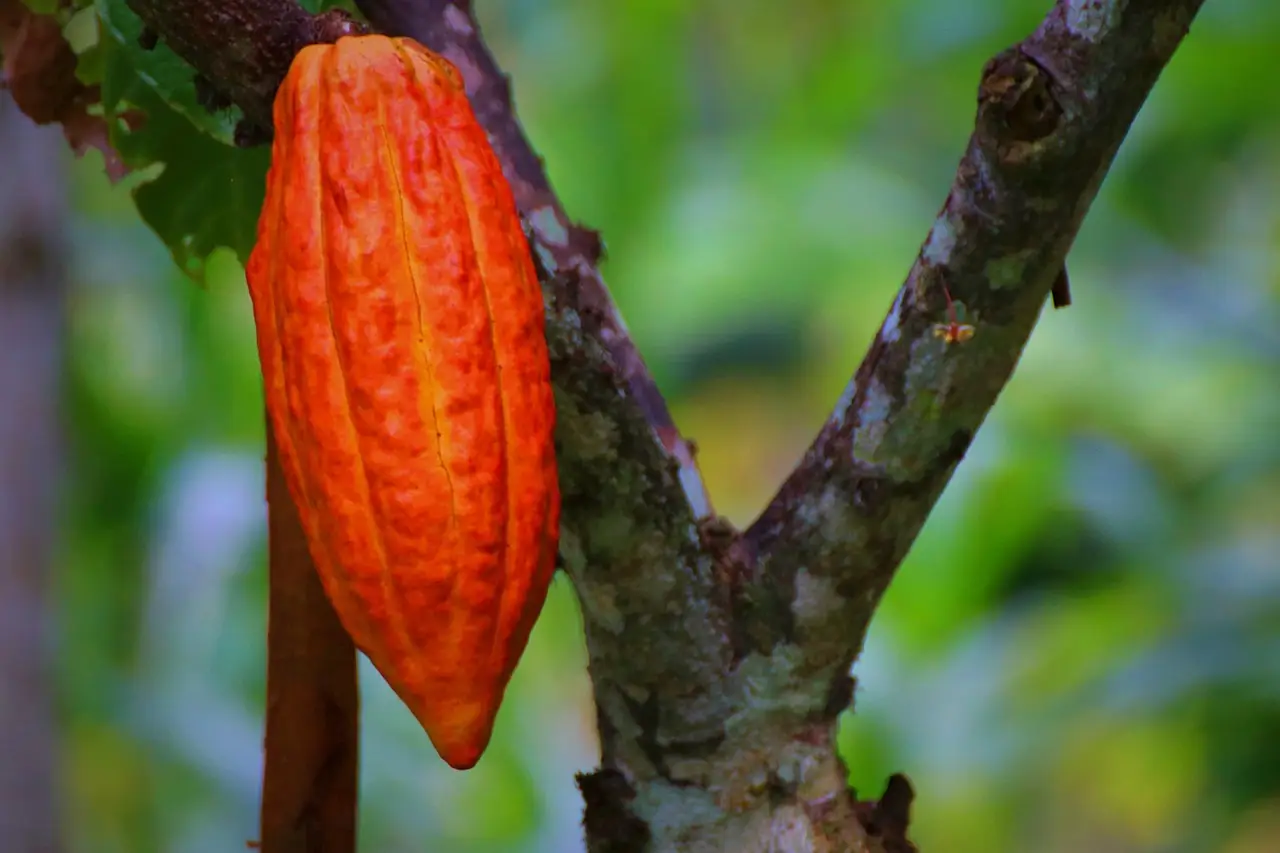
Cacao yields jumped from 265 kg to roughly 1,000 kg per hectare per year in northern Peru — a nearly fourfold increase — when farms sat in tree-rich landscapes rather than deforested ones. That's the headline finding of a new study in Communications Earth & Environment led by the University of Vienna, working with the universities of Göttingen and Würzburg and Bioversity International in Peru.
For American readers, that yield swing runs from 236 pounds per acre per year to about 892. The boost matters in a region that ranks among the most biodiverse on Earth, where farmers have long been told to pick between production and wildlife.
What did the researchers measure?
The team studied 28 organic cacao agroforests in the northern Peruvian Amazon. Agroforestry simply means growing crops under and alongside shade trees. Between the sites, researchers surveyed birds, bats and arthropods, and measured cacao yield, natural pest control, pollination, pest and disease incidence, soil fertility and microclimate. Drone and remote-sensing data let them link shade-tree structure inside each farm — and tree cover in the surrounding landscape — to those outcomes.
The mechanism behind the yield jump turned out to be hungry wildlife. Birds and bats fed on arthropods that damage cacao flowers and pods, delivering natural pest control that nearly doubled yields in tree-rich landscapes. The researchers put a dollar figure on it: an estimated US$1,640 per hectare per year in additional production value.
"Birds and bats can be powerful allies for cacao farmers, but only if the surrounding landscape provides enough habitat," said senior author Bea Maas of the University of Vienna. "If these landscapes become large monocultures, much of this natural pest-control benefit is lost."
Does more shade always help?
No — and this is where the study gets granular. Shade-tree cover benefited wildlife, soils and the microclimate, but very dense shade cut cacao yields sharply because less light reached the crop.
The researchers found a workaround: farms with a varied arrangement of tall and short shade trees supported greater biodiversity without the same yield losses.
"Our data show that cacao farms do not need uniform shade to support biodiversity. A mosaic of tall and short trees, tree clusters and open patches can create habitat for wildlife while maintaining production," said lead author Pablo Aycart-Lazo of the University of Vienna.
What should a landscape-level strategy look like?
The authors recommend, for a contiguous region:
- 30%–35% forest cover;
- another 40%–45% of tree-based habitats such as agroforests or orchards;
- an additional 20%–30% of open areas like annual crops.
That mix, they argue, could build multifunctional landscapes with high biodiversity while still supporting cacao production and farmer livelihoods.
The study's authors hedge against over-applying their recipe. "This is not a one-size-fits-all blueprint. Landscape strategies need to be adapted to local land availability and developed together with local communities," said co-senior author Carolina Ocampo-Ariza of the Technische Universität Darmstadt and the University of Göttingen.
The study covered 28 organic farms in one region of the Peruvian Amazon, so its numbers describe that setting rather than every cacao-growing zone. Still, the core message travels: sustainable cacao depends not just on what happens inside the farm, but on the landscape around it.
The paper is published as Pablo Aycart-Lazo et al., "Integrating local and landscape management promotes biodiversity, multifunctionality and yields in tropical agroforests," Communications Earth & Environment (2026), DOI: 10.1038/s43247-026-04141-3.
via phys.org/rss-feed/ (Source)
More from Nathan Brooks
Show full bio
Market editor covering companies, deals and strategy in general science news at SciBeat.
325 articles
Nearby plates
- Protecting Standing Amazon Forests Beats Restoration, Study Finds
- Black Pod Pathogen Breeds Across Colombia, Defying Andean Barriers
- Algerian Farms Lose a Third of Holdings to Endangered Macaque Raids
- Cambridge AI Maps Senegal's Smallholder Crops With 84% Accuracy
- Colombia's First National Bee Checklist Counts 738 Species