Plate Nº 14 · recorded November 11, 2026
Chemistry & MaterialsReported finding
Tweaked Enzyme Eats PET Plastic Nearly Ten Times Faster
Scientists boosted a plastic-eating enzyme's speed 9.2-fold with an ionic liquid and surface tweaks, keeping it active for seven days in lab tests on PET.
By Elena Vasquez4 min read766 words
In brief
- A modified cutinase enzyme broke down PET plastic 9.2 times faster while using ten times less enzyme.
- The modified enzyme stayed active at a steady rate for at least seven days; the unmodified version faded after about 36 hours.
- Researchers recovered 97.1% of the ionic liquid and isolated terephthalic acid as a pure powder.
- The study is published in ACS Sustainable Chemistry & Engineering (2026), DOI: 10.1021/acssuschemeng.6c08909.
- The process has been tested only at laboratory scale; industrial viability remains unproven.
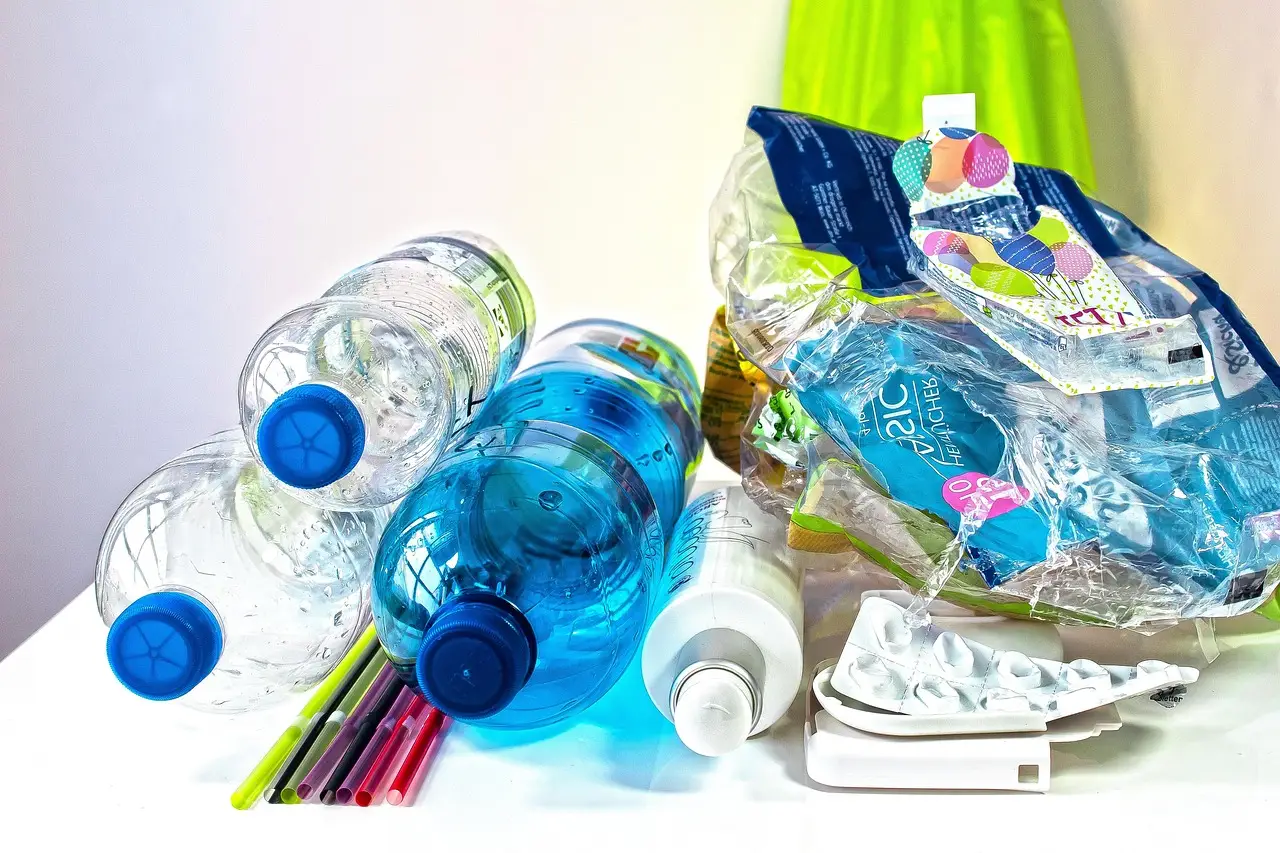
A modified enzyme breaks down PET plastic 9.2 times faster than the original — while using ten times less of it. Researchers from King's College London and Rutgers University achieved this not by redesigning the enzyme from scratch, but by changing the liquid it works in and making small chemical tweaks to its surface.
The findings, published in ACS Sustainable Chemistry & Engineering, offer a possible route to cheaper, more efficient recycling of one of the world's most common plastics. The catch: results so far come from laboratory tests only.
What exactly did the researchers do?
The team worked with cutinase, a naturally occurring enzyme — a protein that speeds up chemical reactions — capable of severing the chemical links holding PET together. They chemically modified the enzyme's surface so it could survive the heat and harsh chemical conditions of plastic breakdown.
Then they swapped water for an ionic liquid, a specially selected solvent that loosens PET's tightly packed structure. That makes the plastic's chemical links more accessible to the enzyme and lets the reaction run at high temperatures, where PET is easier to break apart.
The combo worked. Two changes, one result.
How long does the enzyme stay active?
That's the bigger story. In tests using PET powder, the modified enzyme kept degrading plastic at a steady rate for at least seven days. The unmodified enzyme in water began losing activity substantially after day one, holding on for roughly 36 hours before declining.
The modified system also carried out about 9.5 times as many chemical reactions over the course of the experiments. And the method worked on flakes cut from a used beverage bottle — no pre-heating or other preparation needed to soften the plastic first.
The takeaway: keeping enzymes alive longer means you need far less of them, and that cuts costs.
Can the ingredients be reused?
Partly. In one lab experiment, the team recovered 97.1% of the ionic liquid, meaning it could be reused almost continuously. They also isolated terephthalic acid — one of PET's main chemical building blocks — as a pure powder, which could go into making new plastic and reduce demand for virgin, fossil fuel–derived raw materials.
But there's a snag. The enzyme stopped working effectively after the recovery process. The researchers are now trying to improve enzyme recovery so both components can be reused, trimming the need for fresh materials.
Why not use the best enzymes available?
The team deliberately didn't. Earlier studies showed specially engineered PET-degrading enzymes can break down certain forms of the plastic to a high degree in about two days. Instead, the researchers used ordinary cutinase as a test case, asking whether tweaking an enzyme's chemistry and its surrounding liquid could improve performance at scale.
They estimate that applying the approach to those advanced enzymes could cut the time for near-complete PET breakdown from roughly two days to about five hours, and significantly reduce water use. Be careful with that number: it's an estimate based on previous studies, not on experiments in the current paper.
What are the limits?
Plenty, and the researchers say so themselves. The process remains untested at industrial scale. Enzyme recovery needs improvement, and the team still has to assess the method's energy demands along with its overall environmental and economic performance.
The context matters too. Most PET today is recycled by melting and reshaping, which degrades quality over cycles and can't handle all discarded plastic. Enzymatic recycling — breaking plastic back into its original building blocks — avoids that quality loss, but enzymes have struggled to work fast and keep working.
Dr. Alex Brogan, corresponding author and senior lecturer in chemistry at King's College London, said: "The research in my lab is aiming to provide new solutions to help us move away from an oil-based economy to a circular bio-based economy. Enzymatic plastic recycling is therefore very important to achieving those aims, and in this paper we have made an important step in sustainably recovering the building blocks of this important and commonly used plastic. We hope that in the future it will be applied to a variety of different enzymes and plastics."
The study appears as Jake H. Nicholson et al., "Accelerating Depolymerization of Poly(ethylene terephthalate) Using Chemically Modified Cutinase and Ionic Liquids," ACS Sustainable Chemistry & Engineering (2026), DOI: 10.1021/acssuschemeng.6c08909.
Bottom line: a simple solvent swap plus a surface tweak made a plastic-eating enzyme work nearly ten times harder for a full week — promising, but still confined to the lab.
via phys.org/rss-feed/ (Source)
More from Elena Vasquez
Show full bio
Correspondent covering money, funding and market shifts around general science news at SciBeat.
384 articles
Nearby plates
- One-Atom Swap Makes Plastic-Eating Enzymes Nearly Twice as Effective
- One 'Biodegradable' Plastic Hit 99.9% Breakdown in 17 Days. Another Stalled at 2.7% in 320
- New polystyrene is half plant-based and designed to fall apart for recycling
- Copper Catalyst Trick Balances Radical Chemistry for Hard Reactions
- Hemp waste cellulose boosts biodegradable film strength by 26%