Plate Nº 56 · recorded November 13, 2026
Earth & ClimateReported finding
Wood Stove Experiment Reveals How Wildfire Smoke Recycles Nitrogen Oxides
PSI lab experiments show brown carbon in wildfire smoke converts nitrate back into nitrogen oxides ten times faster than known photolysis, explaining persistent plume pollution.
By Priya Raman4 min read753 words
In brief
- PSI experiments show brown carbon accelerates sunlight-driven nitrogen oxide regeneration tenfold.
- Findings published in Science Advances (2026), first author Fengxia Bao, DOI 10.1126/sciadv.aeg9077.
- Canadian wildfire pollutants are detectable as far away as the Jungfraujoch in the Swiss Alps.
- Urban nitrogen oxide levels are many times higher than preindustrial times due to fossil fuel burning.
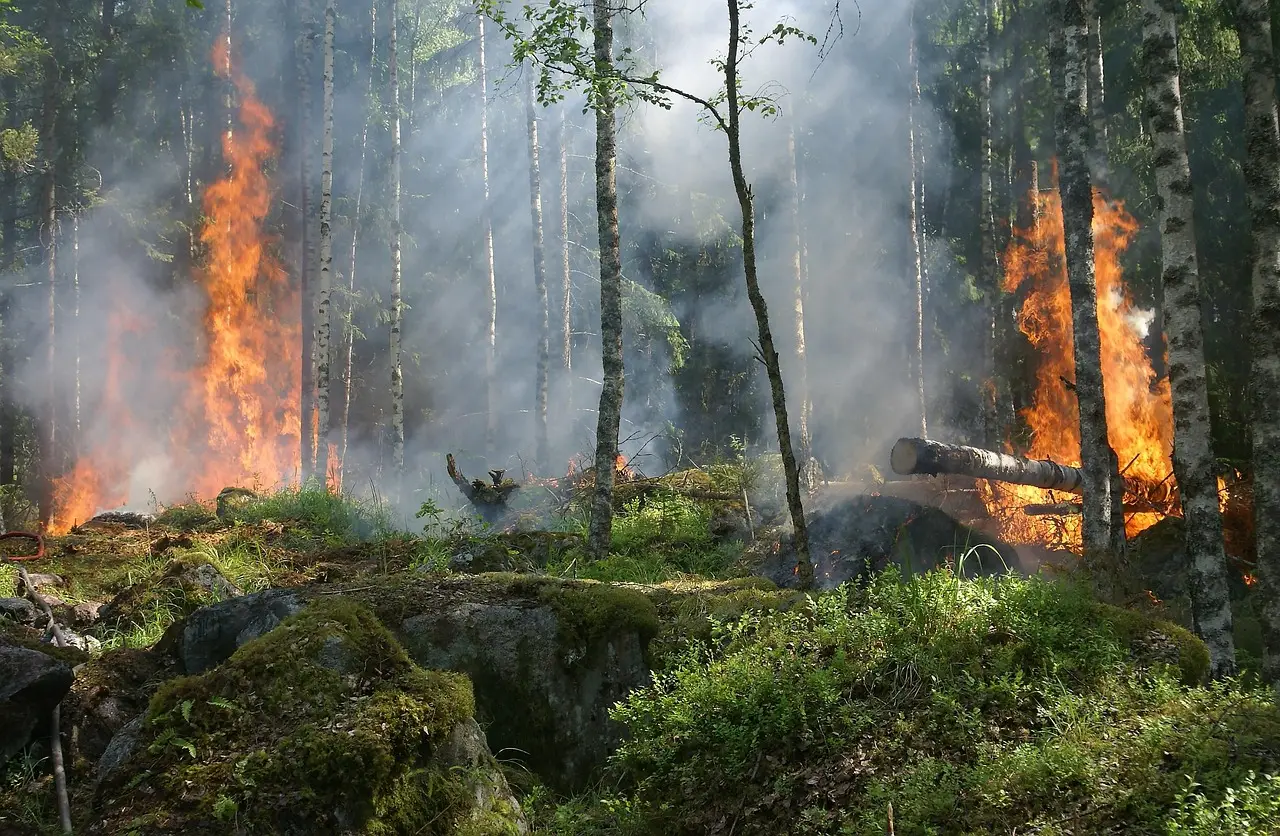
Wildfire smoke can regenerate nitrogen oxides ten times faster than the known atmospheric process allows, according to experiments conducted at the Paul Scherrer Institute and published in the journal Science Advances. The finding helps explain a long-standing puzzle: why elevated concentrations of nitrogen oxides persist in smoke plumes even after they have traveled across continents and oceans.
Smoke from wildfires in Canada, for example, can still be detected at the Jungfraujoch research station in the Swiss Alps. Pollutants carried in these plumes—particulate matter, carbon dioxide and nitrogen oxides—contribute to respiratory illness and, through the greenhouse effect, to climate change.
A team led by Markus Ammann at the PSI Center for Energy and Environmental Sciences traced the chemistry behind the persistent nitrogen oxides and identified a faster, previously suspected but undemonstrated pathway.
What happens to nitrogen oxides in the atmosphere?
Nitrogen oxides (NOₓ)—compounds made of one nitrogen atom and one or two oxygen atoms—form during combustion. Wildfires and lightning are natural sources; the burning of fossil fuels has raised urban nitrogen oxide levels to many times their preindustrial values.
In the lower atmosphere, nitrogen oxides drive the formation of ozone, a greenhouse gas and respiratory irritant. They also oxidize into nitric acid (HNO₃), which dissolves as nitrate inside tiny aerosol particles that serve as nuclei for cloud droplets. Rain eventually deposits the nitrate in soil.
This continuous conversion should steadily drain nitrogen oxides from the atmosphere, leaving far less of them than measurements actually show. A known reverse pathway exists: sunlight can split nitrate back into nitrogen oxide, a process called photolysis. "However, this process is far too slow to account for the observed amounts of nitrogen oxide," Ammann said.
A hypothesis in aerosol chemistry (the study of airborne particles) held that a second, faster photolysis process must exist—and that substances released by wildfires could play a role.
How do you simulate a wildfire in a laboratory?
Wildfires differ from other nitrogen oxide sources because they also emit large amounts of organic particulate matter, including soot, from the incomplete combustion of wood and other biomass. This organic particulate matter gives smoke its grayish-white color. Some of these organic compounds absorb visible light and are collectively known as brown carbon.
To test brown carbon's influence, the PSI team built a controlled experiment:
- They burned wood in a stove with a restricted air supply to produce more smoke—and more brown carbon, mimicking wildfire conditions.
- They collected the smoke on filters, dissolved the material in water and placed the solution in a temperature-stabilized glass tube.
- They exposed nitrate in the tube to UV lamps simulating sunlight under different conditions—once with brown carbon added, once without—and measured the nitrogen oxides produced.
What did the lamps reveal?
Under hard UV light—the high-energy ultraviolet component of sunlight—nitrogen oxides formed in every sample, consistent with known nitrate photolysis. But the samples containing brown carbon produced significantly more.
The decisive result came with softer light. "When we then used lamps without a hard UV component, we could only detect nitrogen oxides in the presence of brown carbon," said Fengxia Bao, a researcher in Ammann's group and first author of the study.
Because direct photolysis cannot occur under soft UV light alone, the researchers concluded the pathway must be indirect. The organic substances in brown carbon absorb the soft UV light, enter an excited state and donate an electron to the nitrate, converting it into nitrogen oxide. This indirect route accelerates nitrogen oxide production tenfold compared with the known hard-UV process.
How significant is the result?
"This is a clear, powerful result," Ammann said. "We were able to demonstrate experimentally what up to now had only been vaguely suspected. Our study will enable better predictions about the effects of wildfires on air quality and climate."
The work does not close the case. "Our result can explain a larger proportion of the nitrogen oxides present in the atmosphere—but not yet all of them," Ammann noted, adding that further research will be needed to clarify additional formation pathways.
He also wants to make future experiments more realistic. The PSI simulation chamber, for instance, could use all of the burned material rather than only the components filtered out and dissolved in water.
The study, by Fengxia Bao and colleagues, appears in Science Advances (2026), DOI: 10.1126/sciadv.aeg9077.
A stove, a lamp and a glass tube have clarified what a continent-crossing plume had long kept hidden.
via phys.org/rss-feed/ (Source)
More from Priya Raman
Show full bio
Senior reporter covering people, launches and day-to-day practice in general science news at SciBeat.
364 articles
Nearby plates
- Ozone From Amazon Wildfires Weakens Rainforest Carbon Uptake
- Indonesia's Underground Peat Fires Are Surging Early in 2026
- Light-Powered Iron Complex Turns Nitrate Pollution into Usable Fuel
- NASA Finds 40% More Amazon Fires Than Satellites Officially Show
- Webb Telescope Finds Ammonia and Unexpected Chill on HATS-6 b