Plate Nº 52 · recorded October 30, 2026
Space & AstronomyReported finding
100,000 Simulations Test the Comet Theory of Life’s Origins
Across 100,000 simulations, 46% included an impact delivering enough hydrogen cyanide to Earth, while Mars scenarios produced more than five times as many successful transports.
By Priya Raman3 min read612 words
In brief
- Researchers ran 100,000 simulations of a period when more than 100,000 comets struck Earth.
- In 54% of simulations, no comet strike delivered enough hydrogen cyanide to land.
- In 46%, at least one strike delivered enough to the surface, but prebiotic chemistry had only a fleeting opening.
- Mars produced more than five times as many successful transports as Earth.
- Venus’s dense atmosphere would consume most incoming comets, even those several kilometers in diameter.
By Priya Raman
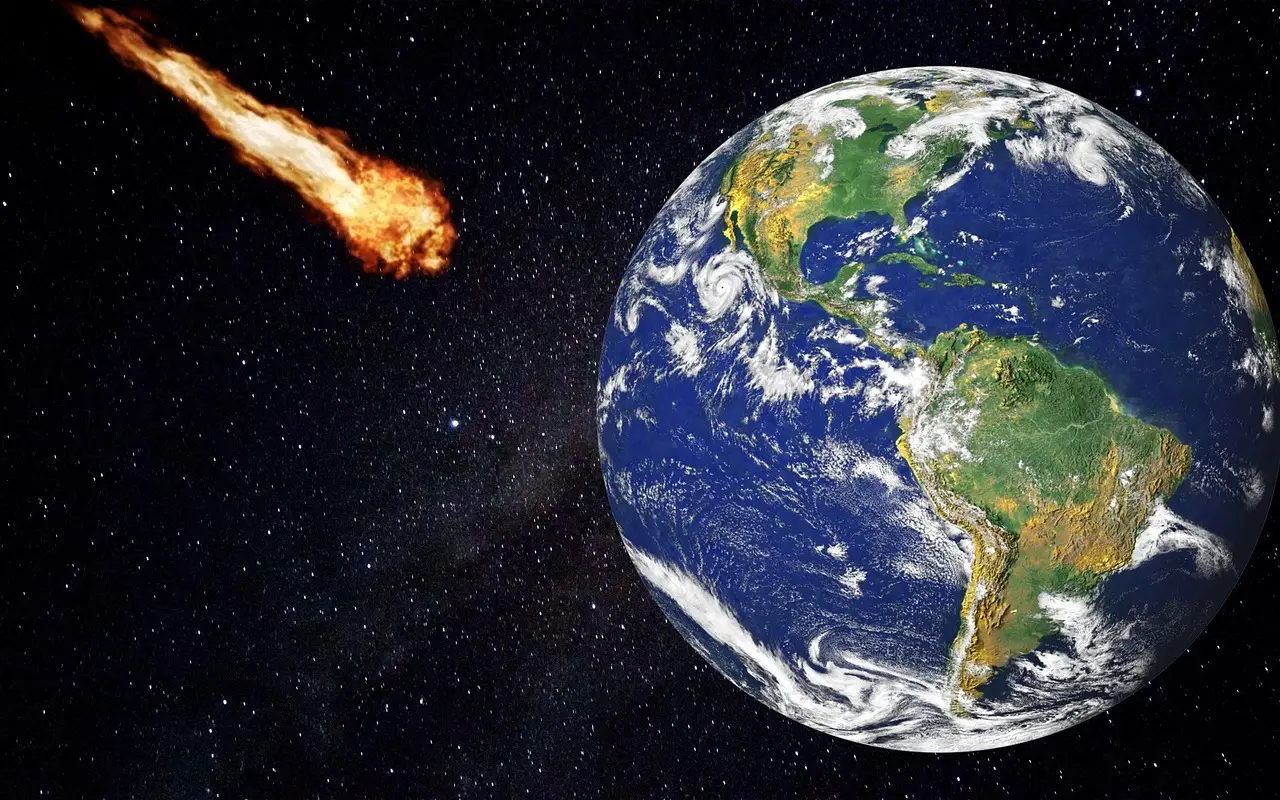
In 54 percent of 100,000 simulations, not one incoming comet delivered enough hydrogen cyanide to land on Earth. The models recreated conditions during an early comet bombardment, when more than 100,000 comets struck the planet, and tested whether those impacts could carry prebiotic chemistry (the chemistry that can assemble the ingredients of life) down to the surface.
Heat from impact was the biggest factor in these losses: comets broke apart in Earth’s atmosphere and lost their chemical payload. Ocean strikes posed a separate problem, because any surviving hydrogen cyanide dispersed in the water.
A longstanding theory, proposed for more than a century, holds that life on Earth emerged from prebiotic chemistry that arrived from space, possibly by comet. A growing body of evidence supports the idea, including scientists’ detection of organic molecules, or carbon-based compounds, in comets that could hypothetically supply some ingredients for life.
“It’s kind of a romantic idea, but our results suggest it’s highly unlikely,” astronomer Richard Anslow of the University of Cambridge said. Anslow and fellow researchers reported the simulations in Scientific Reports.
What molecule could carry the ingredients of life?
The researchers focused on hydrogen cyanide because it can act as a feedstock molecule (a starting material for reactions) that helps synthesize several building blocks of life: lipids (membrane components), sugars, nucleobases (units used in genetic information) and nucleotides (units that link into larger biological molecules).
Hydrogen cyanide has regularly been found in comets. To date, it is the only known feedstock molecule detected in sufficient abundance in observed Solar System comets to be considered capable of contributing to prebiotic chemistry. Cyanoacetylene and cyanogen have also been detected, but only at much weaker concentrations.
Could a single successful delivery have started life?
The other 46 percent of simulations contained at least one comet impact that could have transported enough hydrogen cyanide to Earth’s surface. Even those successful deliveries offered only a fleeting opportunity for prebiotic chemistry. The model did not show that such a transport guaranteed the concentration or subsequent chemical development required for the origins of life.
The simulations do not prove that comet delivery never happened or could never work. They do suggest that the cometary-impact route was less likely than researchers had previously realized.
“It would really have to be a one-in-a-million occurrence, because not only would you need an impact at just the right speed and just the right angle, you would also need everything to happen after that point, in terms of the concentration and the speed at which the chemical origins of life got going,” Anslow said.
“We can’t rule out for certain that it happened that way. But it seems to be a really rare occurrence – at best, a one-off fluke,” he added.
Why did Mars fit the model better?
Mars provided a better fit for the cometary-impact hypothesis. Its thinner atmosphere and lower impact velocities (the speeds at which incoming comets strike a surface) enabled more than five times as many successful transports as Earth. The finding does not rule out the mechanism on other planets; Mars offers a more favorable case.
Venus presented the opposite condition. Its dense atmosphere would consume most comets outright, including comets several kilometers in diameter. Across the three planets, the simulations indicate that atmospheric conditions and impact speed govern whether a cometary payload can survive long enough to reach a surface.
The findings appeared in Scientific Reports. Rebecca Dyer fact-checked and edited the article.
Comet delivery remains possible, but the simulations portray it as a rare route to life on Earth, not a likely explanation.
via doi.org (Original)
More from Priya Raman
Show full bio
Senior reporter covering people, launches and day-to-day practice in general science news at SciBeat.
280 articles
Nearby plates
- Comets Probably Didn't Seed Life on Earth, Cambridge Study Says
- Meteorite Sugar May Have Shaped Early Earth's Chemistry
- Ancient Mars Rains May Have Delivered a Life-Starting Molecule
- Interstellar Comet 3I/ATLAS Carries Methane Up to 10 Billion Years Old
- One Oxygen Atom May Have Given RNA a Head Start in Forming Life