Plate Nº 27 · recorded October 9, 2026
Biology & EvolutionReported finding
32.2-Centimeter 'Colossogiant' Isopod From Puerto Rico Is a New Species
A giant isopod kept in a German university collection since the 1980s turns out to be a new species, shedding light on how deep-sea crustaceans conquered the world's oceans.
By Elena Vasquez4 min read758 words
In brief
- A 32.2 cm giant isopod kept in Tübingen since the 1980s is a new species, Bathynomus tuebingoborikensis.
- The genus Bathynomus likely originated in the Gulf of Mexico over 15 million years ago during the Miocene.
- Giant isopods can reach 50 cm in length and live at depths of up to 2,500 meters.
- Earth's cooling 5.333 million years ago gave rise to 'colossogiants' exceeding 25.2 cm.
- The study appears in Scientific Reports (2026), DOI: 10.1038/s41598-026-69097-y.
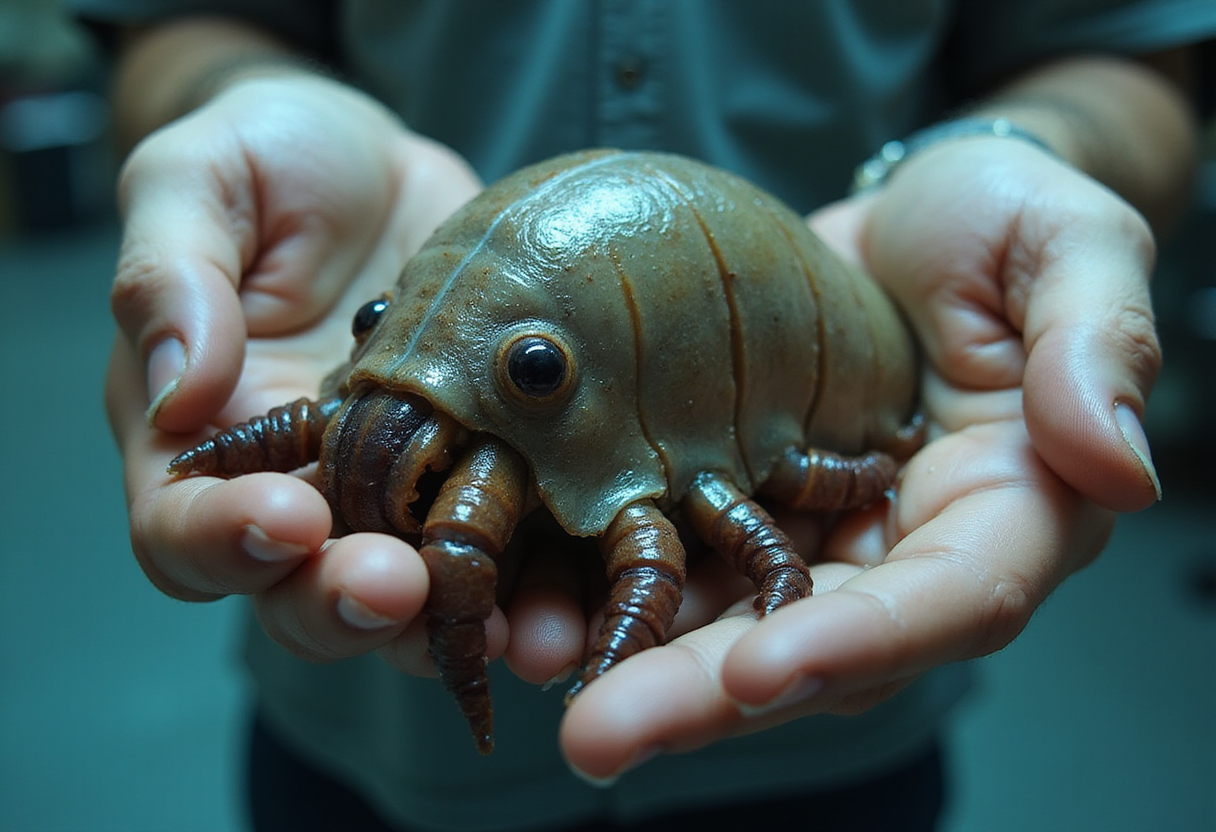
A 32.2-centimeter (12.7-inch) giant isopod that sat in a German university collection for roughly four decades has turned out to be a previously unknown species. Researchers Benedikt Kästle and Dr. Ingmar Werneburg describe the animal, named Bathynomus tuebingoborikensis, in the journal Scientific Reports.
The specimen came from Puerto Rico. In the 1980s, Tübingen paleontologist Professor Dolf Seilacher (1925–2014) acquired the dried animal at a research station on the island and brought it to Germany for teaching purposes. It then rested, unstudied, in the depository of the University of Tübingen's Paleontological Collection until Kästle, a paleontology student and isopod expert, and Werneburg, the collection's curator, took a closer look.
What did the researchers find?
Using state-of-the-art imaging techniques, the pair examined the dried specimen and compared its anatomy with that of giant isopods from around the world. The differences were significant enough to identify it as a representative of a new species.
The name honors two places at once: Tübingen, the researchers' university town, and Boríken, the Indigenous Taíno name for Puerto Rico.
The animal belongs to a group the researchers call "colossogiants" — giant isopods exceeding 25.2 centimeters (9.9 inches) in length. "Our Tübingen specimen from Puerto Rico, measuring 32.2 centimeters (12.7 inches) in length, falls into the category of 'colossogiants'," Kästle said.
The new species has a close relative: "The new species is very closely related to another giant species found off the Yucatán Peninsula in Mexico," Kästle noted.
What are giant isopods?
Giant isopods of the genus Bathynomus live in all of the world's oceans and can reach 50 centimeters (20 inches) in length and weigh several kilograms. That makes them among the largest invertebrates on Earth.
Key facts about these crustaceans:
- They live at depths of up to 2,500 meters (8,200 feet)
- They eat almost everything, living as omnivores
- Their bodies are encased in a hard exoskeleton of calcareous, scalelike segments
- In shape, they resemble woodlice, the much smaller land isopods found in caves and damp basements
How did giant isopods conquer the oceans?
The study goes beyond describing one new species. A phylogenetic analysis — a method for reconstructing evolutionary family trees from anatomical data — suggests the entire Bathynomus genus originated in what is now the Gulf of Mexico during the Miocene, more than 15 million years ago.
"At that time, the Isthmus of Panama was open, leaving a strait between North and South America, and the marine animals were able to spread westward, initially as far as Japan," Werneburg explained.
In the Indian and Pacific oceans, the genus diversified into many new species. "This gave rise to the so-called 'giant' isopods that are up to 15 centimeters (5.9 inches) long, and the 'supergiants' with a body length of more than 15 centimeters (5.9 inches)," Kästle said.
The animals spread to Australia and East Africa. They also reached Europe before the Arabian and African continental plates collided — but there they went extinct at the end of the Miocene.
A further turning point came when Earth cooled at the Miocene–Pliocene boundary 5.333 million years ago. In the Indo-Pacific, a distinct group of giant isopods evolved. "These veritable colossi grew to more than 25.2 centimeters (9.9 inches) in length and were physiologically perfectly adapted to the new climatic conditions," Werneburg said.
According to the researchers, these colossi spread from Australia via Antarctica to South and Central America. There they encountered their smaller, more distant relatives — leftovers of the genus's original westward expansion.
Why does one museum specimen matter?
The discovery highlights the scientific value of natural history collections, which often hold species that no one has yet recognized. "The discovery underscores the great importance of natural history collections as global archives of nature," Werneburg pointed out.
The researchers expect their description of the new species to help scientists understand the evolution of all deep-sea isopods. One dried specimen, bought at a Caribbean research station in the 1980s, ultimately helped trace a 15-million-year journey from the Gulf of Mexico to oceans across the globe.
As with any single-specimen description, the findings represent a first characterization; comparisons with additional material from the Caribbean could refine the picture of how this colossogiant fits into its family tree.
Publication: Ingmar Werneburg et al., "A new Caribbean species of the giant isopod genus Bathynomus (Crustacea, Isopoda, Cirolanidae) with notes on its evolutionary history," Scientific Reports (2026). DOI: 10.1038/s41598-026-69097-y
via Phys.org Biology (Source)
More from Elena Vasquez
Nearby plates
- Adult Fossil Confirms Homo erectus Roamed Southern Africa 2 Million Years Ago
- 700,000-Year-Old Elephant Tooth Rebuilds a Lost Levant Ecosystem
- Animals May Have Evolved 200 Million Years Earlier Than Fossils Show
- Animals May Have Evolved 200 Million Years Earlier Than Thought
- 94.5 Million Years Ago, the Tibetan Plateau Was a Hot-Tub Sea