Recorded November 20, 2026
Biology & EvolutionReported finding
Neutron scans reveal 156-million-year-old horned reptile new to science
Neutron and X-ray scans at the Paul Scherrer Institute identified a 156-million-year-old horned reptile from Wyoming, named after a death metal band, as a new choristodere species.
By Priya Raman3 min read685 words
In brief
- A 156-million-year-old fossil from Wyoming is a new species, Meilynodraco amonamarthi, named partly after the death metal band Amon Amarth.
- Neutron and X-ray tomography revealed an almost complete braincase under two centimeters across.
- It is the most complete early-branching choristodere known and the oldest record of the group in North America.
- The study, led by PSI and the University of Zurich, was published in Royal Society Open Science (2026).
- The fossil goes on display in the 'Rock Fossils on Tour' exhibition at the Aathal Dinosaur Museum in early 2027.
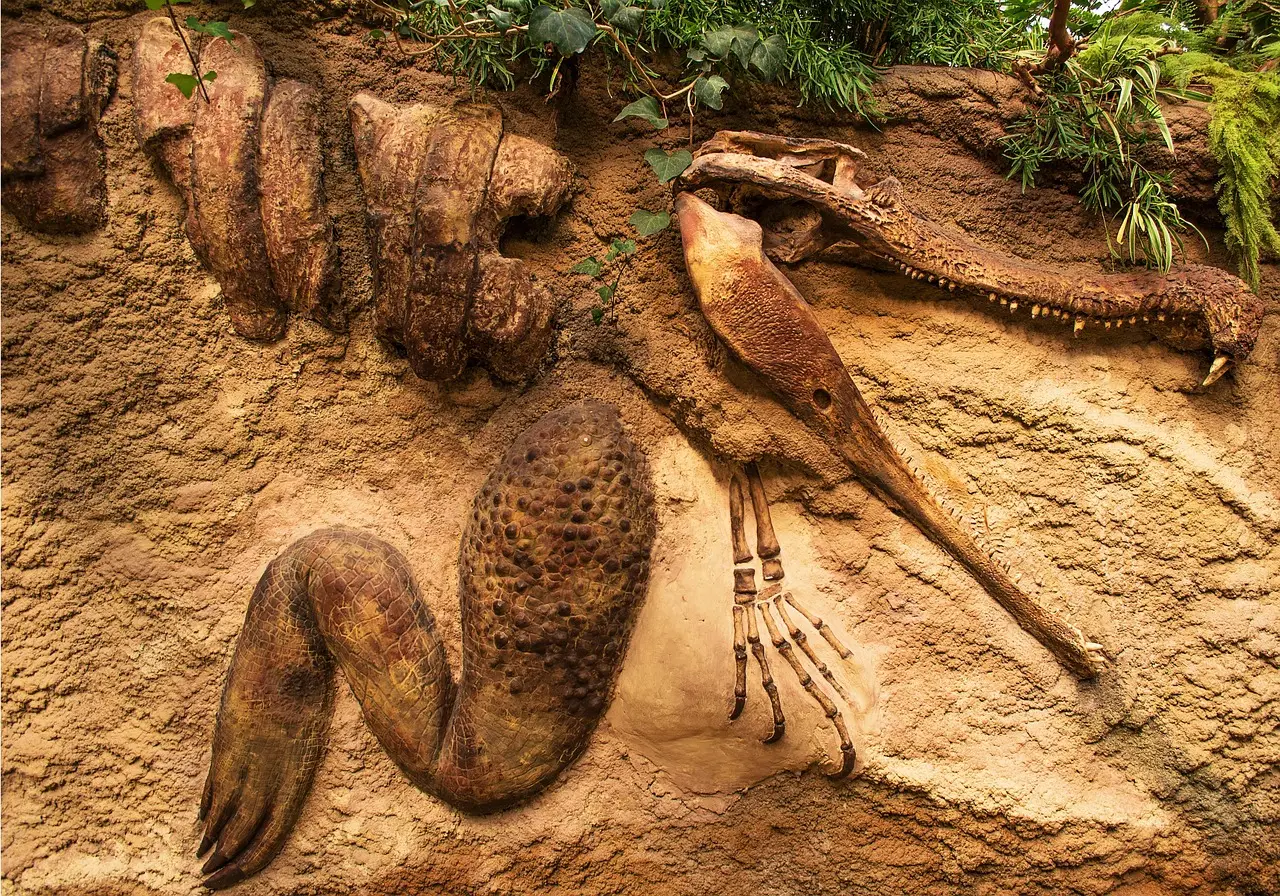
A 156-million-year-old fossil from Wyoming has been identified as a previously unknown reptile species, Meilynodraco amonamarthi — a 45-centimeter horned reptile whose skull was reconstructed with neutron imaging at Switzerland's Paul Scherrer Institute (PSI). The findings appear in the journal Royal Society Open Science.
The story begins, unusually, with a family day out. In January 2023, PSI materials scientist Pavel Trtik visited the Aathal Dinosaur Museum near Zurich with his three sons. Trtik works at the PSI Center for Neutron and Muon Sciences, and he left his business card at the museum with an offer: if the curators ever had something worth investigating, they should call. Ten days later, they did. The museum had received a fossil from the United States that nobody could classify.
What did neutron imaging reveal?
The fossil came from Wyoming's Meilyn Quarry, excavated in August 2022 by a team from the Aathal museum in a region already famous for yielding Diplodocus, Stegosaurus and Allosaurus. Only some vertebrae of a tiny skeleton were visible in a slab of sandstone; the rest stayed hidden in the rock.
Neutron imaging proved decisive. "Neutrons are particularly sensitive to hydrogen," Trtik explained. "And hydrogen is also present in hydroxyapatite, a mineral component of bones. This allows us to distinguish the fossilized remains from the surrounding sandstone."
An international team jointly led by Trtik and paleontologist Torsten Scheyer of the University of Zurich — which also included museum director Yolanda Schicker-Siber and two undergraduates from Worcester Polytechnic Institute in Massachusetts — combined neutron tomography with X-ray imaging performed at PSI, at Empa in Dübendorf and at the University of Zurich's Department of Paleontology. "Only by combining them can we get the clearest picture," Trtik said.
From tens of thousands of cross-sectional images, the reptile slowly took shape: pelvic bones, parts of a hind leg, and a tiny skull with an almost completely preserved braincase.
Why is the skull the real find?
The animal died in a river during the Jurassic period, its head and torso detached from each other. "It's difficult to determine why the skull became detached from the torso," Scheyer explained. "But we cannot rule out the possibility that a larger predator was involved."
That detached skull, with a braincase measuring less than two centimeters across, provides the strongest clues to the creature's evolutionary relationships. It belongs to the choristoderes, a long-extinct group whose place on the reptile family tree remains unsettled. "The unusual shape of their skull bones has long made it difficult for paleontologists to determine how they are related to other reptiles," Scheyer said.
The tiny inner ear bones offered a new clue. "They bear a striking resemblance to those of the so-called crown group of reptiles, which includes all living reptiles," Scheyer explained. "This could suggest that choristoderes are more closely related to living reptiles than previous fossil evidence indicated." The finding is preliminary in the sense that it revises, but does not settle, the group's contested position.
The specimen is the most complete early-branching choristodere known to date and the oldest record of the group in North America.
Why a death metal name?
Scheyer, a fan of The Lord of the Rings and hard rock, wanted a spectacular name for a spectacular creature. The genus name means "Dragon of Meilyn," a nod to the quarry and the two dragon-like horns on the animal's head. The species name honors his favorite band, the Swedish melodic death metal group Amon Amarth — whose own name is the Elvish term for Mount Doom in Tolkien's novels.
The new species will join the traveling exhibition "Rock Fossils on Tour" at the Aathal Dinosaur Museum in early 2027. "The little dragon will be in excellent company here, with other spectacular fossils named after famous metal musicians and rock bands," Schicker-Siber said.
Future fossil studies at PSI could scale up. A proposed test facility called UFO ("UltraFast neutron irradiation for large Objects"), considered as part of a potential SINQ++ upgrade, would accommodate objects up to one meter in length.
via phys.org/rss-feed/ (Source)
More from Priya Raman
Show full bio
Senior reporter covering people, launches and day-to-day practice in general science news at SciBeat.
576 articles
Nearby plates
- First European Meرaraptor Found in a Museum Drawer After 100 Years
- 220-Million-Year-Old Skull From South Africa Unveils New Dinosaur Species
- 240-Million-Year-Old Tanzania Fossil Reshapes Dinosaur Timeline
- UV Light Reveals Camouflage Pattern on 125-Million-Year-Old Crocodile
- Forgotten Museum Fossil Reveals New European Clawed Dinosaur