Plate Nº 56 · recorded October 16, 2026
Biology & EvolutionReported finding
First European Meرaraptor Found in a Museum Drawer After 100 Years
A 120-million-year-old skull fragment ignored for a century in a London drawer is Europe's first megaraptor, and hints at how the clawed predators reached Gondwana.
By James Calloway4 min read754 words
In brief
- A skull fragment found on the Isle of Wight in 1924 sat in a museum drawer for nearly 100 years before being identified as a new species.
- Invictibellatrix amberina lived about 120 million years ago and is the first megaraptoran dinosaur found in Europe.
- The study was published Oct. 14 in Royal Society Open Science.
- The dinosaur measured roughly 10-13 feet long and weighed an estimated 440-660 pounds, among the smallest known megaraptors.
- Evolutionary models suggest Asian megaraptors dispersed into Europe around 130 million years ago before reaching Gondwana.
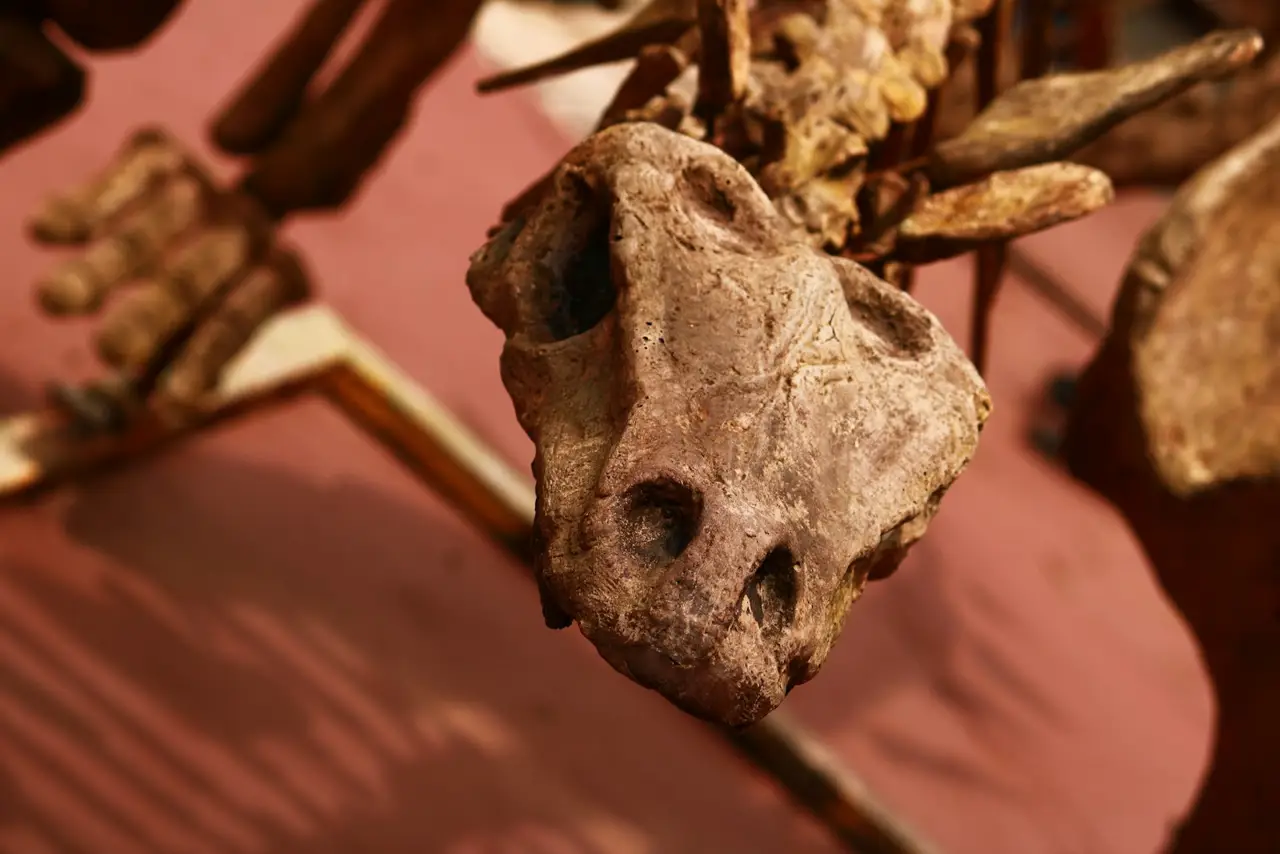
A fossil skull fragment that sat forgotten in a London museum drawer for nearly a century turns out to be Europe's first known megaraptor — a 120-million-year-old predator researchers have named Invictibellatrix amberina, the "unconquered female warrior."
The species, described in an Oct. 14 study in the journal Royal Society Open Science, may answer a longstanding question about how a group of formidable Cretaceous carnivores conquered the globe. That's the promise. The evidence, as always with a single skull, comes with strings attached.
How do you find a new dinosaur in a drawer?
The story starts in 1924, when an amateur fossil collector pulled a skull fragment from rocks on the Isle of Wight in southern England. The specimen entered the collections of London's Natural History Museum and was then, essentially, ignored.
Researchers revisited it as part of a broader study of dinosaur braincases — the bony casing that once held the brain. Using micro-CT scanning, a technique that images internal structure in fine detail without cutting the fossil, they built 3D digital models of the cavity. Two features stood out: an almost oval opening where the spinal cord entered the skull, and an unusual hourglass-shaped ridge at the back of the braincase.
Computer-based evolutionary analyses placed the specimen within the Megaraptora family tree, as a species no one had documented before. Hence the name: Latin for "unconquered" and "female warrior," plus "amberina" for the amber found in the surrounding rocks.
"It is a real mystery that this fossil was overlooked for so long, sitting in a drawer for nearly 100 years," study first author Cassius Morrison of University College London's Department of Earth Sciences said in a statement. "Lots of bones are found on the Isle of Wight — who knows what else is waiting to be discovered."
What kind of predator was it?
Megaraptors were two-legged carnivores related to tyrannosaurs, but they hunted differently. Instead of relying on crushing jaws, they likely used powerful arms and large curved claws to attack prey and defend themselves.
By megaraptor standards, I. amberina was small. The researchers estimate it measured 10 to 13 feet (3 to 4 meters) long, stood roughly 5 feet (1.5 m) tall, and weighed 440 to 660 pounds (200 to 300 kilograms). Compare that with Maip macrothorax from Argentina, which may have reached 33 feet (10 m) and weighed as much as an elephant.
Small doesn't mean safe, though. "It was not the apex predator of its time, but for humans this dinosaur would have been more dangerous than a T. rex," Morrison said. "We would have been perfectly sized prey, about a third of their body weight. They definitely would have chased us."
Here's what the fossil doesn't show. No arms. No claws. The researchers infer from its closest relative that its claws may have measured 4 to 8 inches (10 to 20 cm) long, and they suggest it may have been feathered — but the specimen itself can't confirm either claim. Read those numbers as educated inference, not observation.
What does this change for dinosaur migration?
Scientists have long suspected megaraptors originated in Asia, spread outward, and eventually dominated the southern supercontinent Gondwana — the landmass that included present-day Africa, South America and Antarctica. The problem: no European fossils. Without them, the migration route stayed a hypothesis.
The study's evolutionary models suggest I. amberina descended from Asian megaraptors that dispersed into Europe around 130 million years ago, then moved through what is now Africa toward Gondwana via temporary land connections across the shallow Tethys Ocean.
"This new species is the first proof we have that megaraptorans were also present in Europe and that they reached Gondwana this way rather than island-hopping further south," study co-author Charlie Scherer, a doctoral student at UCL Earth Sciences, said in the statement.
Plenty remains unanswered. The researchers cannot yet pin down the exact route these animals took over millions of years. Nor can they explain why megaraptors vanished from northern regions, though climate shifts or competition with other predators may have played a role. One skull fills a gap; it doesn't close the file.
The quieter lesson may be the one co-author Paul Barrett of the Natural History Museum drew: "Work like this shows the exceptional value of working with historical museum collections where there are still many discoveries to be made."
Sometimes the next discovery isn't in the ground. It's in the drawer.
via doi.org (Original)
More from James Calloway
Show full bio
Staff writer covering regulation, policy and their impact on general science news at SciBeat.
238 articles
Nearby plates
- Forgotten Museum Fossil Reveals New European Clawed Dinosaur
- 240-Million-Year-Old Tanzania Fossil Reshapes Dinosaur Timeline
- Scientists digitally reconstruct face of 315,000-year-old Homo sapiens
- New Armored Dinosaur From Japan Points to Ancient Migration
- First Diplodocus Ever Found Outside North America Came From Spain