Plate Nº 83 · recorded October 10, 2026
Biology & EvolutionReported finding
New Armored Dinosaur From Japan Points to Ancient Migration
A fossil found in Japan in 1995 belongs to a new armored dinosaur, Nipponopelta yezoensis — only the third nodosaurid in Asia, with ancestors that likely crossed the Bering Land Bridge 100–110 million years ago.
By Elena Vasquez4 min read794 words
In brief
- The newly named Nipponopelta yezoensis is only the third nodosaurid species ever found in Asia.
- The fossil was discovered in 1995 on Hokkaido and is 93–100 million years old.
- Researchers propose its ancestors migrated from North America to Asia via the Bering Land Bridge 100–110 million years ago.
- The study appears in the February 2027 issue of Cretaceous Research.
- CT scans of the skull, jaw, teeth and bony plates allowed 3D analysis without damaging the fossil.
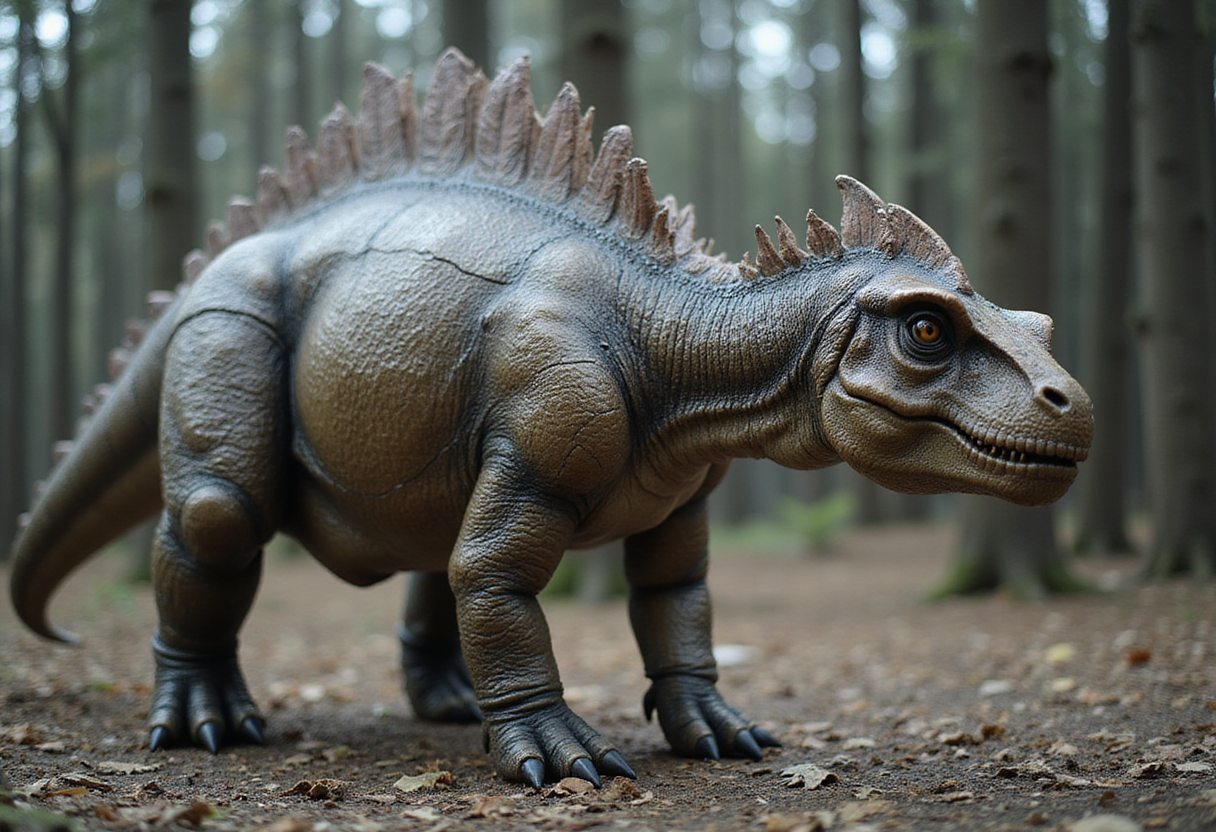
A dinosaur fossil pulled from Japanese rocks in 1995 has finally received a name and a story: it belongs to a newly identified species of armored dinosaur, and only the third of its kind ever found in Asia. Researchers say its ancestors likely walked from North America to Asia across a land bridge 100 million to 110 million years ago.
The species, described in the February 2027 issue of the journal Cretaceous Research, is called Nipponopelta yezoensis. "Nippon" refers to Japan, "pelta" is Greek for "shield," and "Yezo" is the traditional name for Hokkaido, the northernmost main island of Japan where the fossil was found.
The bones are between 93 million and 100 million years old and include the back of the skull, part of the lower jaw, several teeth, and bony plates. A research team led by S. Oyabu revisited the decades-old specimen and ran computed tomography (CT) scans, which build digital 3D models of objects without damaging them.
"It lets you just get more information than you'd be able to have otherwise, because you can look inside without breaking [the fossil]," said Victoria Arbour, manager of research and collections at the Royal B.C. Museum in Canada, who was not involved in the new work.
What are nodosaurids?
Nodosaurids were armored dinosaurs covered in bony plates. They are close relatives of ankylosaurids, but they lacked the heavy tail clubs that ankylosaurids swung against predators.
Most nodosaurid fossils come from North America and Europe. Asia has yielded only a handful, which makes the Japanese specimen scientifically valuable. N. yezoensis is now one of just three nodosaurid species described on the continent to date.
Why do scientists suspect a migration?
The CT scans and an anatomical analysis showed that N. yezoensis closely resembles North American nodosaurids in its body structure. That similarity, combined with the animal's rarity in Asia, points to a likely origin across the Pacific margin: the team proposes that the dinosaur's ancestors crossed from North America into Asia via the Bering Land Bridge, an ancient strip of land that connected present-day Alaska and Russia, sometime between 100 million and 110 million years ago.
There is also a possible explanation for how the migration happened. The original discoverers of the specimen found it in marine sediments — rocks that formed under ancient seas. Nodosaurids did not live in the ocean, so the carcass was probably swept out to sea along a river or estuary after the animal died, then sank to the ocean floor.
Several other nodosaurid fossils have turned up in similar marine deposits, which suggests these dinosaurs commonly lived along coastlines. Following the coast may have helped them disperse along the Bering Land Bridge, study co-author Darla Zelenitsky, a dinosaur paleobiologist at the University of Calgary, told Live Science.
What are the limits of the evidence?
Coastal finds don't prove nodosaurids avoided the interior. Upland and mountainous regions produce few fossils because erosion wears down rocks there, said Jordan Mallon, a paleontologist at the Canadian Museum of Nature who was not involved in the study. The dinosaurs may well have lived inland without leaving a trace.
"The nature of the fossil record is that it's patchy and incomplete," Mallon said. "It's very hard to tell a comprehensive story when you've only got a few pages out of a phone book's worth of time."
The imbalance between continents also remains unexplained. Several ankylosaurid species have been found further inland in Asia, yet nodosaurid fossils are scarce across the continent. "It could be the rock record, or just that [nodosaurids] weren't able to diversify as much in Asia," Zelenitsky said.
In other words, the rarity of Asian nodosaurids might reflect real biology — a limited expansion into the region — or simply gaps in where paleontologists have searched and where rocks of the right age survive.
What comes next?
More fossils would settle the open questions, and the researchers hope future digs will deliver them. "I hope that we find more of this animal," Mallon said. "It incites us to keep digging so that we can learn more about this animal and test some of our ideas about just what it is."
For now, a specimen that sat unstudied for roughly three decades has added a new species to the dinosaur family tree and sketched one plausible route — a coastal trek across a vanished land bridge — by which armored dinosaurs reached Asia during the Cretaceous period, the geological era that ended 66 million years ago.
Reference: S. Oyabu et al. (2026). A new nodosaurid ankylosaur (Dinosauria: Ornithischia) from the Upper Cretaceous Hikagenosawa Formation in Japan reveals dispersal pattern of Asian nodosaurid ankylosaurs. Cretaceous Research. https://doi.org/10.1016/j.cretres.2026.106477
via doi.org (Original)
More from Elena Vasquez
Nearby plates
- 240-Million-Year-Old Tanzania Fossil Reshapes Dinosaur Timeline
- Ancient DNA reveals extinct yak relative hidden in Siberian bones
- Giant 20-meter dinosaur found at Brazilian construction site
- Scientists digitally reconstruct face of 315,000-year-old Homo sapiens
- Gobi Desert Fossil Rewrites 40-Year Mammal Evolution Theory