Plate Nº 46 · recorded October 10, 2026
Biology & EvolutionReported finding
Ancient DNA reveals extinct yak relative hidden in Siberian bones
Twenty ancient genomes spanning 200,000 years in southern Siberia reveal a previously unknown extinct relative of modern yaks, a species that diverged roughly 400,000 years ago and vanished after the last ice age.
By Elena Vasquez3 min read591 words
In brief
- Researchers generated 20 ancient genomes spanning roughly 200,000 years from Denisova Cave and other southern Siberian sites.
- The extinct bovine began diverging from modern yaks about 400,000 years ago and became fully separated around 250,000 years ago.
- A population replacement occurred around 120,000 years ago during the last warm interglacial, with a measurable loss of genetic diversity.
- The youngest specimen is about 27,000 years old; the species went extinct sometime after that, though the timing and cause are unknown.
- The study was published in Current Biology in 2026 (DOI: 10.1016/j.cub.2026.09.043).
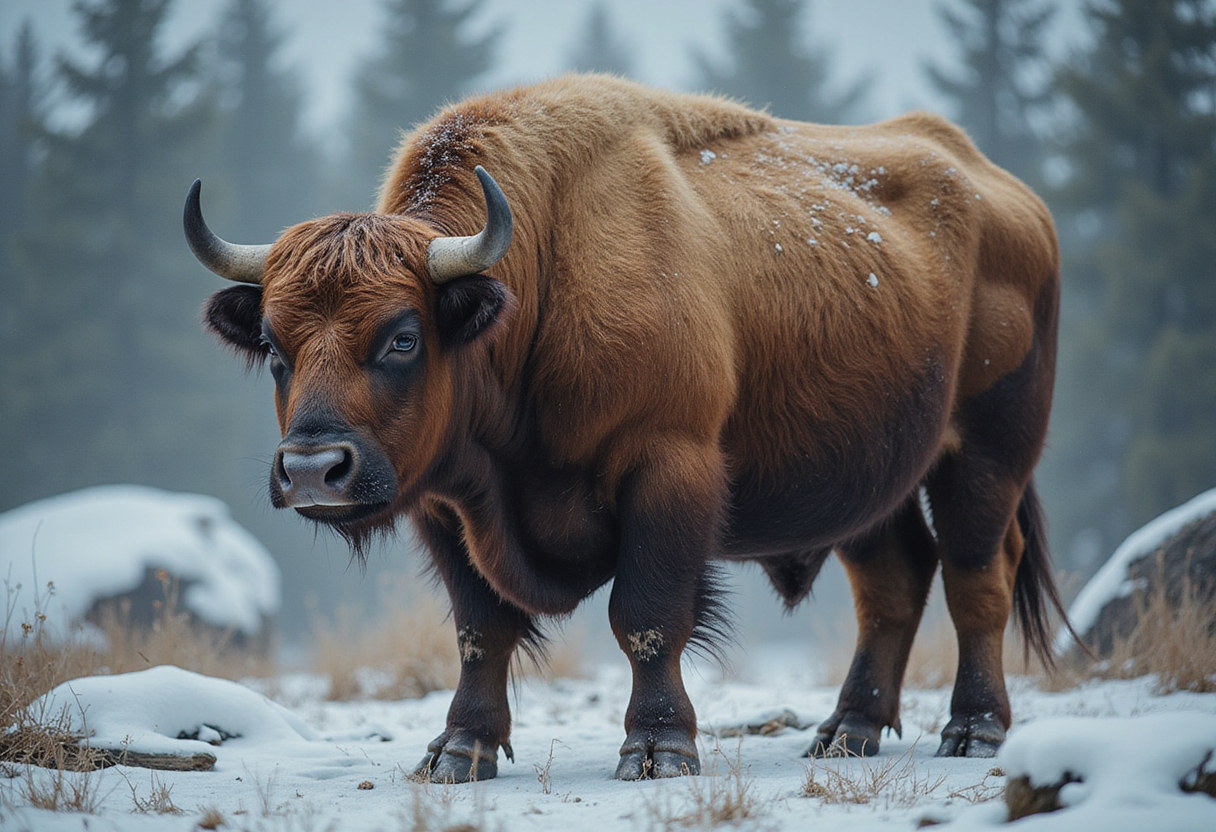
Twenty ancient genomes, extracted from unidentifiable bone fragments in southern Siberia and spanning roughly 200,000 years, have revealed a previously unknown extinct species related to modern yaks, researchers report in Current Biology.
The animals began diverging from modern yaks around 400,000 years ago and became fully separated around 250,000 years ago. Genetic evidence alone is not enough to formally name a new species, so the team has not yet proposed one.
How was the discovery made?
Researchers found the remains in Denisova Cave and other sites scattered across the Altai-Sayan Mountains. Scientists from Stockholm University's Center for Paleogenetics, UC Santa Cruz, and the University of Vienna sequenced DNA from small bones that could not be identified by shape alone.
"This is a remarkable discovery of a large extinct species based on small nondiagnostic bones," says Love Dalén, senior author and professor of evolutionary genomics at the Center for Paleogenetics, a joint venture between Stockholm University and the Swedish Museum of Natural History.
How does this species compare to modern yaks?
The extinct lineage split off roughly 400,000 years ago. For comparison, brown bears and polar bears also began diverging around the same time.
"A useful comparison for when this lineage originated is the divergence between brown bears and polar bears, which has also been estimated to have occurred around 400,000 years ago," says Alexandre Gilardet, one of the lead authors and a Ph.D. student at the Center for Paleogenetics. "This age overlaps with a particularly strong warm climatic period, which could have prompted population isolation and, ultimately, speciation."
What happened to the population?
The genetic data cover multiple ice age cycles, a span rarely available in ancient DNA research. Within that record, the team spotted signs of a population turnover about 120,000 years ago, during the last warm interglacial period. The shift came with a measurable loss of genetic diversity, suggesting the cold-adapted species suffered when temperatures climbed.
"This could reflect the genetic consequences of climate warming around 120,000 years ago on a cold-adapted species," says Jonas Oppenheimer, the other lead author and a postdoctoral researcher at the Center for Paleogenetics. "The long time span of our data set is really rare in ancient DNA and allows us to look across whole glacial cycles to see how they might have impacted biodiversity."
Did the species interbreed with other bovines?
No. The scientists found negligible evidence of interbreeding with steppe bison or aurochs, the extinct wild ancestor of domestic cattle. That pattern stands in contrast to the ancient Denisovans, archaic humans first identified from a single fossil in 2010 in the same region.
"These findings mirror the discovery of the Denisovans, a group of archaic humans, from a single fossil in 2010 and highlight the Altai region as a possible biodiversity hotspot and refugium across ice ages," Dalén says.
What remains unknown?
The youngest specimen is about 27,000 years old. The species vanished sometime after that, but the exact timing and cause of extinction stay unclear. Modern wild yaks now live only at high elevations on the Tibetan Plateau, far from the low-latitude Altai region where the extinct lineage once roamed.
Next, the team plans to compare the genetic data with previously described yak-like fossils from Siberia and neighboring regions. If those bones match genetically, researchers can connect scattered physical remains to the same lost species and possibly assign it a formal name.
The study appears in Current Biology (DOI: 10.1016/j.cub.2026.09.043).
via Phys.org Biology (Source)
More from Elena Vasquez
Nearby plates
- Animals May Have Evolved 200 Million Years Earlier Than Thought
- Animals May Have Evolved 200 Million Years Earlier Than Fossils Show
- Gobi Desert Fossil Rewrites 40-Year Mammal Evolution Theory
- Scientists digitally reconstruct face of 315,000-year-old Homo sapiens
- Adult Fossil Confirms Homo erectus Roamed Southern Africa 2 Million Years Ago