Plate Nº 26 · recorded November 13, 2026
Biology & EvolutionReported finding
220-Million-Year-Old Skull From South Africa Unveils New Dinosaur Species
A juvenile skull from South Africa's Eastern Cape names a new sauropodomorph, Nyana rooiwalensis, and pushes rapid growth back to 220 million years ago.
By Marcus Bennett5 min read905 words
In brief
- A new sauropodomorph species, Nyana rooiwalensis, lived roughly 220 million years ago in the Late Triassic.
- The 21.3 cm juvenile skull is the first near-complete articulated dinosaur skull from South Africa's Late Triassic.
- The fossil was collected in 2018 near Qhemegha village in the lower Elliot Formation, Eastern Cape.
- The juvenile was over four times the size of comparable-age Massospondylus and Mussaurus juveniles; adults may have reached multi-ton masses.
- The paper, by Atashni Moopen et al., was published in Royal Society Open Science (R. Soc. Open Sci 13 (11): 261002).
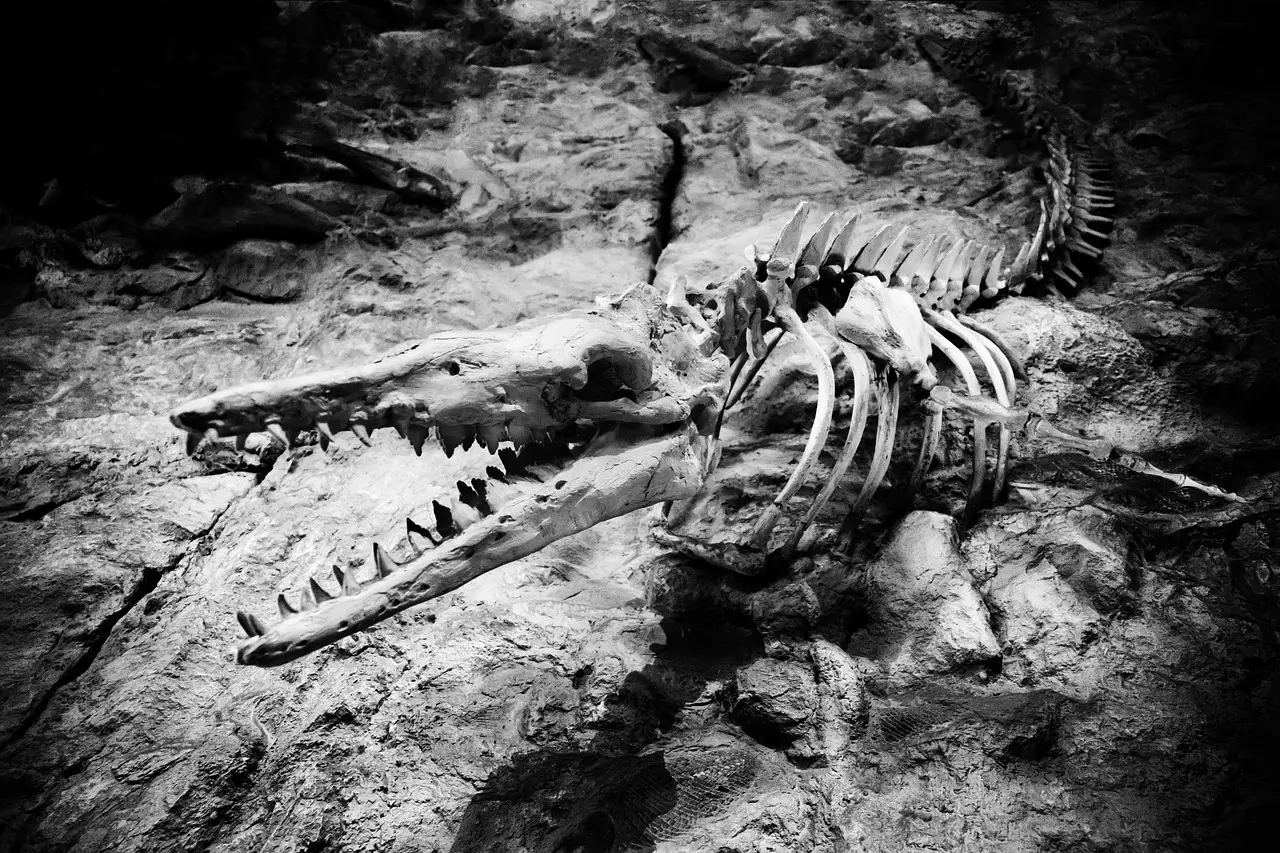
Roughly 220 million years after it died, a juvenile dinosaur from South Africa's Eastern Cape has yielded the first near-complete dinosaur skull ever recovered from the country's Late Triassic rocks — and it belongs to a species new to science.
Paleontologists named it Nyana rooiwalensis, in a paper published this week in the journal Royal Society Open Science. The animal was a sauropodomorph — the group that includes giant, long-necked sauropods such as Brontosaurus — and it walked on two legs, according to the proportions of its limb bones.
What was found, and where?
Collectors recovered a well-preserved, near-complete skull plus several bones from the spine, limbs and jaw in 2018, on the outskirts of Qhemegha village in Eastern Cape province. The fossil came from the lower Elliot Formation, a rock sequence that records a 30-million-year interval spanning the Late Triassic to the Early Jurassic.
The skull measures 21.3 cm (8.4 inches) as preserved and includes:
- a largely intact braincase;
- the palate;
- a hyoid, the small bone structure of the throat;
- the rings of bone that supported the eye.
The complete skull, the researchers note, would have been longer than that of the largest known adult Massospondylus, a well-known South African relative.
"The holotype and only specimen includes the first almost complete and articulated dinosaur skull from the South African Late Triassic and is one of only a handful of such skulls from this time in the southern continents," wrote Atashni Moopen of the University of the Witwatersrand and her colleagues.
Why one skull matters so much
Early sauropodomorph skulls from the Late Triassic are scarce, and that gap limits what researchers can infer about the group's early evolution and spread.
"Triassic sauropodomorph cranial material is known primarily from Argentina, Brazil and Europe and is sparsely distributed across the phylogenetic tree," Moopen and her colleagues wrote. "In southern Africa, only two Late Triassic species preserve cranial elements, Mbiresaurus and Kholumolumo, both represented by limited material."
In short: this single juvenile adds a third data point to a region that had almost none.
How the researchers read a dinosaur's age
The team scanned the fossil with a powerful X-ray beam at the European Synchrotron Radiation Facility in France. They also cut thin slices from the leg bones to read the animal's growth record.
Growth rings in bone work somewhat like tree rings. The leg bones showed at most two lines of arrested growth, and both the bone's surface and its internal structure indicated the animal was still growing actively when it died. The skull's sutures — the seams between bones — were still open. The researchers estimate the dinosaur was at least in its third year of life.
A giant in the making
Despite its young age, the animal was already large. It measured more than four times the size of juvenile Massospondylus and Mussaurus individuals of comparable age, making it one of the largest juvenile dinosaurs known from the Late Triassic.
"Extrapolation of these growth curves suggests that adult Nyana rooiwalensis may have reached multi-ton body masses," the scientists wrote — a projection that carries the usual uncertainty of extrapolating from a single juvenile specimen.
Even so, the findings support a significant conclusion: rapid growth arose early in sauropodomorph evolution, well before the true giants appeared. The biological machinery for huge body size, in other words, was assembling itself tens of millions of years before sauropods reached their record dimensions.
Where does the new species sit on the family tree?
The team's phylogenetic analysis — the method researchers use to map evolutionary relationships — places Nyana rooiwalensis as a close relative of either Sarahsaurus, from North America, or Ngwevu, from South Africa. Depending on the analysis, it is either an early-branching member of a group called massopodans or a member of Massospondylidae.
Both placements carry implications.
"If Nyana rooiwalensis is a massospondylid, it is the first Triassic member of the clade recovered from South Africa and indicates that the clade had a southern Gondwanan distribution in the Late Triassic prior to the radiation across Pangea in the Early Jurassic," the paleontologists wrote.
"If the new species is considered an early-branching massopodan, this suggests that this clade was widely distributed prior to the massospondylid radiation."
There is a third possibility, and it may be the most geographically striking: "The placement of Nyana rooiwalensis, as the sister taxon of Sarahsaurus aurifontanalis, provides a biogeographic link between the early-diverging sauropodomorphs of southern Africa and western North America."
A sister taxon is the closest known relative on the tree — so in that scenario, an Eastern Cape juvenile connects directly to a dinosaur lineage in North America, hinting at movement or shared ancestry across the ancient supercontinent.
What this changes for the field
For practitioners, the specimen does three things at once: it fills a cranial gap in southern African Late Triassic records, it documents fast juvenile growth in an early sauropodomorph, and it offers a testable biogeographic link between southern Africa and western North America.
Each conclusion rests on a single juvenile skeleton, and the adult body-mass estimate remains an extrapolation. Those caveats noted, the skull gives researchers a 220-million-year-old anchor point in a part of the tree that has long been defined by fragments.
One skull from Qhemegha village has rewritten what southern Africa's Late Triassic can tell us.
via sci.news (Source)
More from Marcus Bennett
Show full bio
News editor covering regulation, policy and their impact on general science news at SciBeat.
378 articles
Nearby plates
- 240-Million-Year-Old Tanzania Fossil Reshapes Dinosaur Timeline
- Giant 20-meter dinosaur found at Brazilian construction site
- First European Meرaraptor Found in a Museum Drawer After 100 Years
- 210-Million-Year-Old Dinosaur From Zimbabwe Rewrites Africa's Map
- Taung Child Dated to 3 Million Years Ago Still Reshapes Human Origins