Plate Nº 64 · recorded October 10, 2026
Biology & EvolutionReported finding
Giant 20-meter dinosaur found at Brazilian construction site
A 20-meter sauropod that lived 120 million years ago has emerged from fossils found at a road-rail construction site in Brazil's Maranhão state. Its closest known relative lived in what is now Spain.
By James Calloway4 min read719 words
In brief
- Dasosaurus tocantinensis measured about 20 meters long and lived roughly 120 million years ago
- Fossils were found about 8 meters underground at a road-rail terminal under construction in Davinópolis, Maranhão
- Its closest known relative lived in what is now Spain
- Ancestors likely reached South America by crossing North Africa between 140 and 120 million years ago
- The skeleton includes a 1.5-meter femur, tail vertebrae, ribs, foot bones, and limb bones
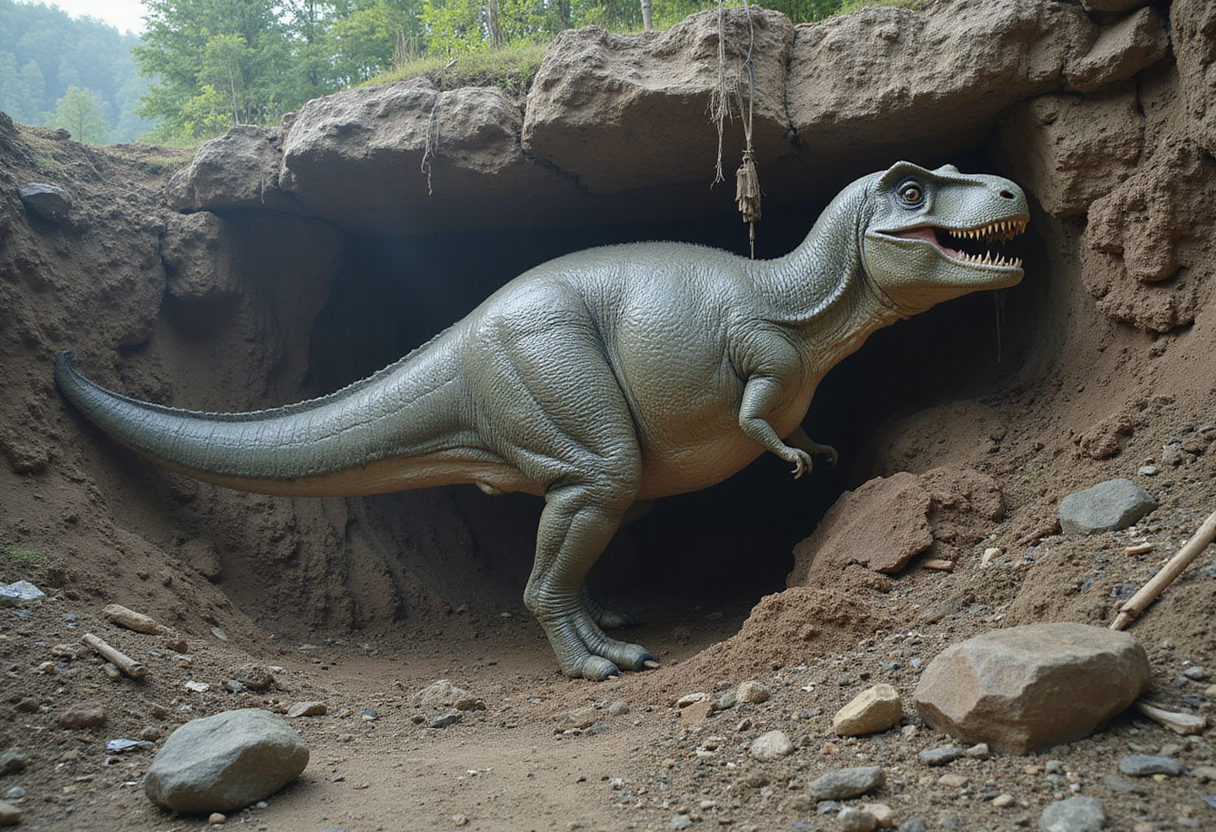
A 20-meter-long sauropod dinosaur that lived 120 million years ago has emerged from fossils uncovered at a road-rail construction site in Davinópolis, in Brazil's Maranhão state. Researchers describe the new species, Dasosaurus tocantinensis, in a paper appearing September 8, 2026 in the Journal of Systematic Palaeontology.
The find is the largest dinosaur known from Maranhão. It also carries an unexpected twist: its closest known relative lived in what is now Spain, hinting that the animal's ancestors crossed ancient land connections between South America, Africa, and Europe before the Atlantic Ocean fully opened.
How did a European-style dinosaur end up in Brazil?
Researchers propose that the ancestors of Dasosaurus tocantinensis reached South America by moving through North Africa sometime between 140 and 120 million years ago. At the time, these landmasses still formed part of the supercontinent Gondwana.
The new species belongs to a broader lineage of titanosauriform sauropods, large herbivorous dinosaurs with long necks and tails. Relatives had previously been documented in European rocks of comparable age, but not in this part of South America.
What makes the fossil unusually informative?
The preserved skeleton includes tail vertebrae, a 1.5-meter femur, ribs, foot bones, and arm and leg bones. Paleontologist Max Langer, who co-authored the study, called it a "relatively complete specimen."
"We believe there are more fossils from this same specimen yet to be excavated at the site," said Langer, a professor at the University of São Paulo's Ribeirão Preto campus.
Fossils lay about eight meters below the surface. Workers first uncovered them during environmental monitoring tied to the construction project's licensing process. Archaeologists initially mistook the bones for remains of large prehistoric mammals that may have lived alongside ancient humans.
Who recognized the find?
Elver Luiz Mayer, a professor at the Federal University of the São Francisco Valley, became involved in 2021. He typically studies mammals from the much more recent Quaternary period.
"Given its depth of about eight meters, I realized that it was much older. The age of the geological formation was already known from previous research and indicated that it was material from the transition from the Lower to the Upper Cretaceous, about 120 million years ago," Mayer said.
He then assembled a multidisciplinary team to study the specimen. Crews prepared the fossils extensively in the state of Pará before returning them to Maranhão. The bones now reside at the State Center for Natural History and Archaeology Research in São Luís.
What does bone microstructure reveal about its growth?
A separate analysis, led by Tito Aureliano and Aline Ghilardi of the Federal University of Rio Grande do Norte, examined thin sections of the dinosaur's bones under a microscope. The growth pattern mixes features seen in older sauropods with traits typical of titanosaurs, a group closely related to Dasosaurus.
The combined pattern suggests that certain bone remodeling processes may have evolved earlier in the sauropod lineage than scientists previously thought. That could help explain how some members of the group reached truly enormous body sizes.
Why does a construction site matter to paleontology?
Brazil's dense vegetation makes traditional fossil hunting difficult. Large building projects, highways, and quarries often expose rock layers that researchers could not reach on their own.
"Brazil is a tropical country with dense vegetation. Geologists and paleontologists rely heavily on human activity to excavate, expose the rocks, and reveal the fossils," Langer said.
"If we map Brazil's fossil sites, we'll see highways and quarries," he added. "These projects are important for understanding our heritage. But it's obvious that specialized monitoring and artifact recovery are necessary, which doesn't always happen."
Mayer added that closer cooperation between builders and paleontologists would help protect fossil deposits while supporting new discoveries.
What happens next?
The research team is negotiating with the construction company for permission to return to the Davinópolis site. Additional bones could refine the picture of Dasosaurus tocantinensis and the larger dinosaur group to which it belonged.
The species name honors the dense forests of Maranhão, which early Portuguese colonizers called a "maranhão" tangle, and the Tocantins River, whose waters run near the fossil site.
The study received support from the São Paulo Research Foundation (FAPESP) through a doctoral scholarship, a postdoctoral fellowship, and a Young Investigator grant.
via agencia.fapesp.br (Original)
More from James Calloway
Show full bio
Staff writer covering marketplaces and e-commerce at SciBeat.
205 articles
Nearby plates
- 240-Million-Year-Old Tanzania Fossil Reshapes Dinosaur Timeline
- First Diplodocus Ever Found Outside North America Came From Spain
- Adult Fossil Confirms Homo erectus Roamed Southern Africa 2 Million Years Ago
- Animals May Have Evolved 200 Million Years Earlier Than Thought
- New Armored Dinosaur From Japan Points to Ancient Migration