Recorded November 10, 2026
Earth & ClimateReported finding
65 Years of Maple Leaves Trace a Cold War Nuclear Legacy
A 65-year archive of Gatineau Park maple leaves shows Cold War bomb-test radiocarbon finally vanished from the local biosphere — and that leaves lag the air by 2.2 years.
By Priya Raman4 min read702 words
In brief
- Bomb-pulse radiocarbon in Gatineau Park maple leaves peaked in 1964 at 842 parts per thousand above the reference level.
- By 2025 the signal had fallen to –13.9 parts per thousand; local leaves crossed the pre-bomb baseline only in 2024.
- Leaf collection began in 1961; AEL-AMS extended the record through 2025 with 59 added measurements.
- Sugar maple leaves lag atmospheric radiocarbon changes by about 2.2 years (±0.3) because trees use stored carbon.
- The study was published in Scientific Reports (2026), DOI: 10.1038/s41598-026-76700-9.
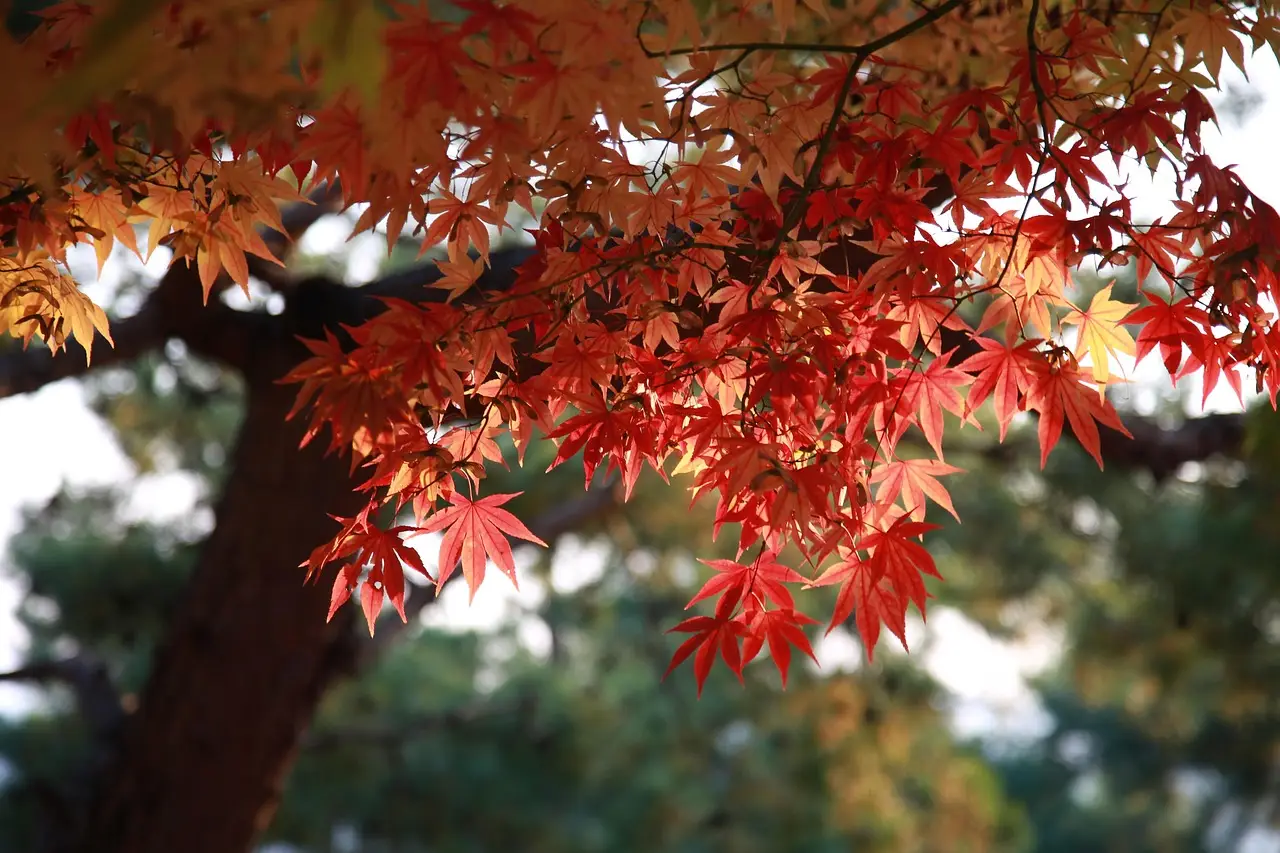
For 65 years, scientists have walked the same paths in Gatineau Park, collecting sugar maple leaves once a month through every growing season. A new analysis of that archive, published in Scientific Reports, shows that the radiocarbon released by Cold War nuclear weapons testing has only now disappeared from the Ottawa-area biosphere — more than six decades after the tests began.
The study, led by the André E. Lalonde National Facility for Accelerator Mass Spectrometry (AEL-AMS) at the University of Ottawa, carries the title "Stored carbohydrates buffer Bomb and Suess radiocarbon effects in maple leaves across a 65-year Ottawa region record."
"These leaves are a 65-year diary of the atmosphere," said Dr. Leonard Wassenaar, executive director of the facility. "It took more than 65 years for the extra radiocarbon from weapons testing to disappear from the Ottawa-area biosphere. The effects were still with us decades after the last test."
How do maple leaves record the atmosphere?
The record began in 1961, when the Geological Survey of Canada started sampling leaves in the park. Its scientists analyzed them until the agency's radiocarbon laboratory closed in 2004. The AEL-AMS then took over and extended the record through 2025, adding 59 annual and seasonal measurements. The collection continues; leaves gathered in September 2026 fall outside the current study.
The method rests on a simple fact of tree physiology. Leaves absorb carbon dioxide and convert it into sugars that fuel growth, so the radiocarbon (a radioactive form of carbon, used by scientists as a natural timestamp) inside each leaf preserves a chemical snapshot of the atmosphere in which it grew. Few places on Earth offer such a long, unbroken chain of snapshots.
What was the 'bomb pulse'?
Above-ground nuclear tests in the late 1950s and early 1960s — conducted mostly by the United States and the Soviet Union, but also by the United Kingdom, France and China — released enormous amounts of radiocarbon, roughly doubling global levels. Scientists call this spike the "bomb pulse."
The numbers from Gatineau Park tell the story plainly:
- The bomb-pulse signal in local leaves peaked in 1964 at 842 parts per thousand above the reference level.
- By 2025 it had fallen to –13.9 parts per thousand.
- Direct air measurements crossed below the pre-bomb baseline around 2021–2022, but local maple leaves did not cross it until 2024.
Two processes drove the decline. Oceans gradually absorbed much of the excess radiocarbon. At the same time, emissions from burning coal, oil and natural gas diluted it, because fossil fuels are so ancient that the carbon dioxide they release contains virtually no radiocarbon at all.
Why do leaves lag behind the air?
The study's second finding may matter even more for future research. Scientists who reconstruct past atmospheres from leaves and tree rings usually assume a sample reflects the year it grew. The Ottawa record shows the reality is subtler: trees do not build new growth solely from carbon absorbed that same year. They also draw on carbohydrates stored during earlier growing seasons.
The researchers measured this effect precisely. Sugar maple leaves closely track changes in atmospheric radiocarbon, but they lag behind by about 2.2 years, with an uncertainty of 0.3 years. The leaves also carried a small positive offset averaging 7.4 parts per thousand between 1990 and 2019.
"Plants often use older carbon, stored from previous years, to grow new leaves," Wassenaar said. "We didn't know how much that changed a leaf's radiocarbon signature, or whether leaves tracked the atmosphere consistently. Now we do."
The finding gives scientists a correction tool for interpreting radiocarbon in preserved leaves, tree rings and other plant material — an archive that reaches far beyond places with direct instruments.
"Leaves are a reliable way to reconstruct atmospheric radiocarbon from places and periods we never measured directly," Wassenaar said. "Once you factor in the two-year delay, our interpretations should be more precise."
The leaves were collected with permission from the National Capital Commission. The paper, by Leonard I. Wassenaar et al., appears in Scientific Reports (2026), DOI: 10.1038/s41598-026-76700-9.
The park's maples, in other words, are still keeping the diary.
via phys.org/rss-feed/ (Source)
More from Priya Raman
Show full bio
Senior reporter covering people, launches and day-to-day practice in general science news at SciBeat.
611 articles
Nearby plates
- JWST Detects Dirty Ice Circling Young Star Beta Pictoris
- A Famous 2-Billion-Year-Old Signal From Early Earth May Be Local, Not Global
- Carbon Storage Wells Triggered Canada's Largest Induced Quakes
- Titanium Oxide Gas Seen Around Massive Young Star for First Time
- MIXS X-ray telescope clears first space test en route to Mercury