Plate Nº 76 · recorded November 18, 2026
Reported finding
A 120-Year-Old Chessboard Puzzle Still Stumps Mathematicians
Posed in 1906, the no-three-in-line puzzle still has no answer. Records now reach n = 78, and AI hasn't cracked a problem that outlived Erdős.
By Elena Vasquez4 min read859 words
In brief
- Henry Dudeney posed the no-three-in-line puzzle in the London Tribune on November 7, 1906.
- The current record, set in October, is a 2n solution on a 78-by-78 grid by Thomas Prellberg.
- Guy and Kelly's 1968 conjecture, corrected to about 1.81n, predicts 2n solutions eventually run out.
- A February 2026 preprint estimates a possible drop-off near a 493-by-493 grid.
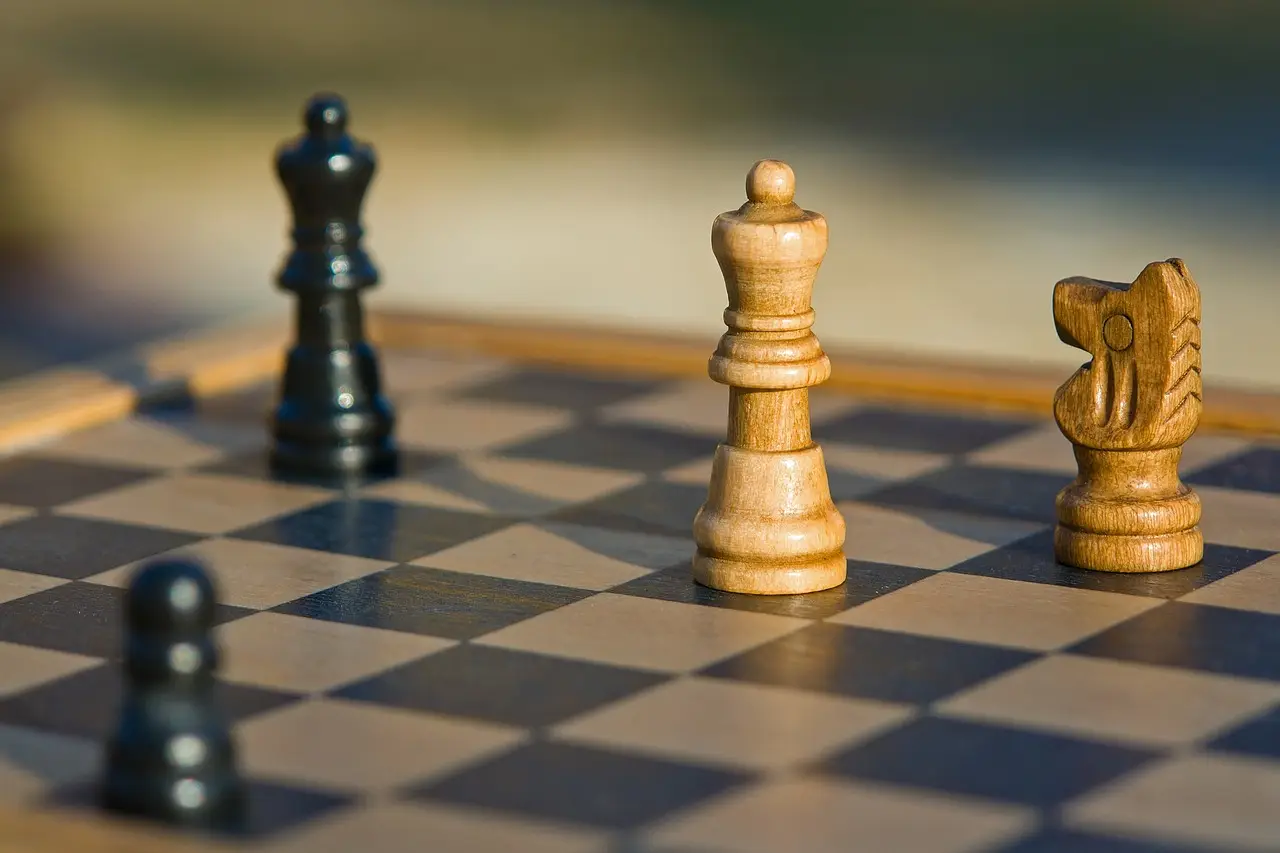
A chessboard puzzle posed on November 7, 1906 remains unsolved today, surviving Paul Erdős, modern supercomputers and artificial intelligence alike. Mathematician Marijn Heule found a record-setting solution in August; Thomas Prellberg beat it in October. The puzzle still stands.
The story began when puzzle columnist Henry Dudeney asked readers of the London Tribune a simple question: can you place all 16 pawns on a chessboard so that no three lie in a straight line? One catch. "Line" means any line of any slope, not just rows, columns and diagonals.
What is the no-three-in-line problem?
Mathematicians generalized Dudeney's puzzle to any square grid, like graph paper. The goal: pencil in as many points as possible so no three sit on a straight line of any slope.
The math is straightforward in part. Each row holds at most two points — a third would violate the rule. An n-by-n grid has n rows, so 2n points is the theoretical ceiling. The open question is whether every grid can actually reach that maximum. Nobody knows.
"The thing that makes the no-three-in-line problem hard is not the horizontal and vertical lines," says David Eppstein, a computer scientist and mathematician at the University of California, Irvine. "We know what to do with them, but not all the lines of other slopes."
Who has attacked it, and how?
In the 1950s, Erdős moved the puzzle from geometry into algebra. He placed his points along a parabola — a U-shaped curve that a straight line can cross at most twice, guaranteeing no three points align. Four mathematicians adapted the trick in 1975 and published a recipe for placing 1.5n points. They could not extend it to 2n.
Achim Flammenkamp, a computer scientist at Bielefeld University in Germany, has run a public scoreboard of solutions since 1992, tracking ever-larger grids. The past year turned competitive:
- June: Heule, of Carnegie Mellon University, found a 2n solution at n = 70.
- July: Prellberg, of Queen Mary University of London, reached n = 74.
- August: Heule answered with n = 76.
- October: Prellberg took the current record, n = 78.
Every grid ever tested hits the full 2n maximum. Whether that holds forever is the mystery.
Does the general version work?
In July, six mathematicians at Oxford, Caltech and the Institute of Science and Technology Austria cracked a broader variant: grids forbidding k+1 points in a row rather than just three. They proved that this no-(k+1)-in-a-line question has kn solutions when k is at least 3 and the grid is large enough. Frustratingly, the proof fails at k = 2 — Dudeney's original case, which they call the "notorious no-three-in-line problem."
Oxford's Peter Keevash says the method uses an infinite sum that converges when k is at least 3 but blows up at k = 2. He sees no deep meaning in that failure. "It just means you have to either find a more clever way of using the method or you find a completely different method," he says.
Will 2n solutions eventually run out?
In 1968, Richard Guy and Patrick Kelly, then at the University of Calgary, conjectured exactly that. They calculated that at large enough grid sizes, solutions should decline toward about 1.87n — later corrected to about 1.81n after an error was found.
In February 2026, Prellberg uploaded a preprint estimating the drop-off might occur near a 493-by-493 grid. He calls the figure a "crude heuristic." The main point: that crossover involves so many possible lines that today's computers cannot exhaustively check it.
Eppstein doubts Guy and Kelly anyway. In a paper citing a 1976 Scientific American column by Martin Gardner, he and colleagues note that the 1968 work assumed the points behave independently — in reality, they correlate. The paper wasn't "intended to be a rigorous argument," he says. "These things do not behave randomly. But if they did behave randomly, this is the answer we would get."
Serge Belongie of the University of Copenhagen points to Guy's "strong law of small numbers," coined in 1980: "There aren't enough small numbers to meet the many demands made of them." Small-grid intuition can fail at scale. He also invokes it to explain why the problem stays hard despite feeling tractable at first. "You can build a certain amount of intuition on small grids, incorporating symmetry tricks, and this gets you off to a good start," he says. "But then some poorly understood behavior starts to emerge."
The field has split into camps. Keevash backs 2n: "Personally I think 2n is right because I'm optimistic." Eppstein leans that way too, though he pauses before answering whether 2n is final: "I don't know."
Belongie predicts AI will crack it within a year. "But I'm very curious to see if it will draw upon a brilliant flash of insight," he says, "or soul-sucking brute-force lameness."
The takeaway: a question a newspaper reader could pose in 1906 still has no answer — and a 493-by-493 grid may be where the ceiling breaks.
via scientificamerican.com (Source)
More from Elena Vasquez
Show full bio
Correspondent covering money, funding and market shifts around general science news at SciBeat.
510 articles
Nearby plates
- MIT Origami Method Builds Structures 3.5 Times Stiffer With Two-Thirds the Material
- After Math's Upheaval, Physicists Ask Whether Science Is AI's Next Conquest
- Math Method Makes X-ray Images Three Times Sharper at Nanoscale
- Quantum 'dark horse' anyons hit universal computing milestone
- Magnetic Order Survives Quantum Jostling in Gapless Magnets