Recorded November 22, 2026
Space & AstronomyReported finding
A 3,200-Year-Old Eclipse May Recalibrate the Reign of Ramesses the Great
A 1207 B.C. annular eclipse, possibly recorded in the book of Joshua, may be the oldest dated solar eclipse in writing — and could shift Ramesses the Great's reign to 1276–1210 B.C.
By Priya Raman4 min read774 words
In brief
- Humphreys and Waddington linked Joshua's passage to an annular eclipse visible from Canaan on Oct. 30, 1207 B.C., for five minutes.
- If correct, Ramesses II reigned c. 1276–1210 B.C., versus the British Museum's 1279–1213 B.C.
- A total solar eclipse will pass over Luxor on Aug. 2, 2027, with 6 minutes 22 seconds of totality.
- Giulio Magli's 2025 research proposes a 2471 B.C. eclipse influenced Pharaoh Shepseskaf's rectangular tomb at South Saqqara.
- The Merneptah Stele, found in 1896, mentions Israelites in Canaan around 1209/1208 B.C.
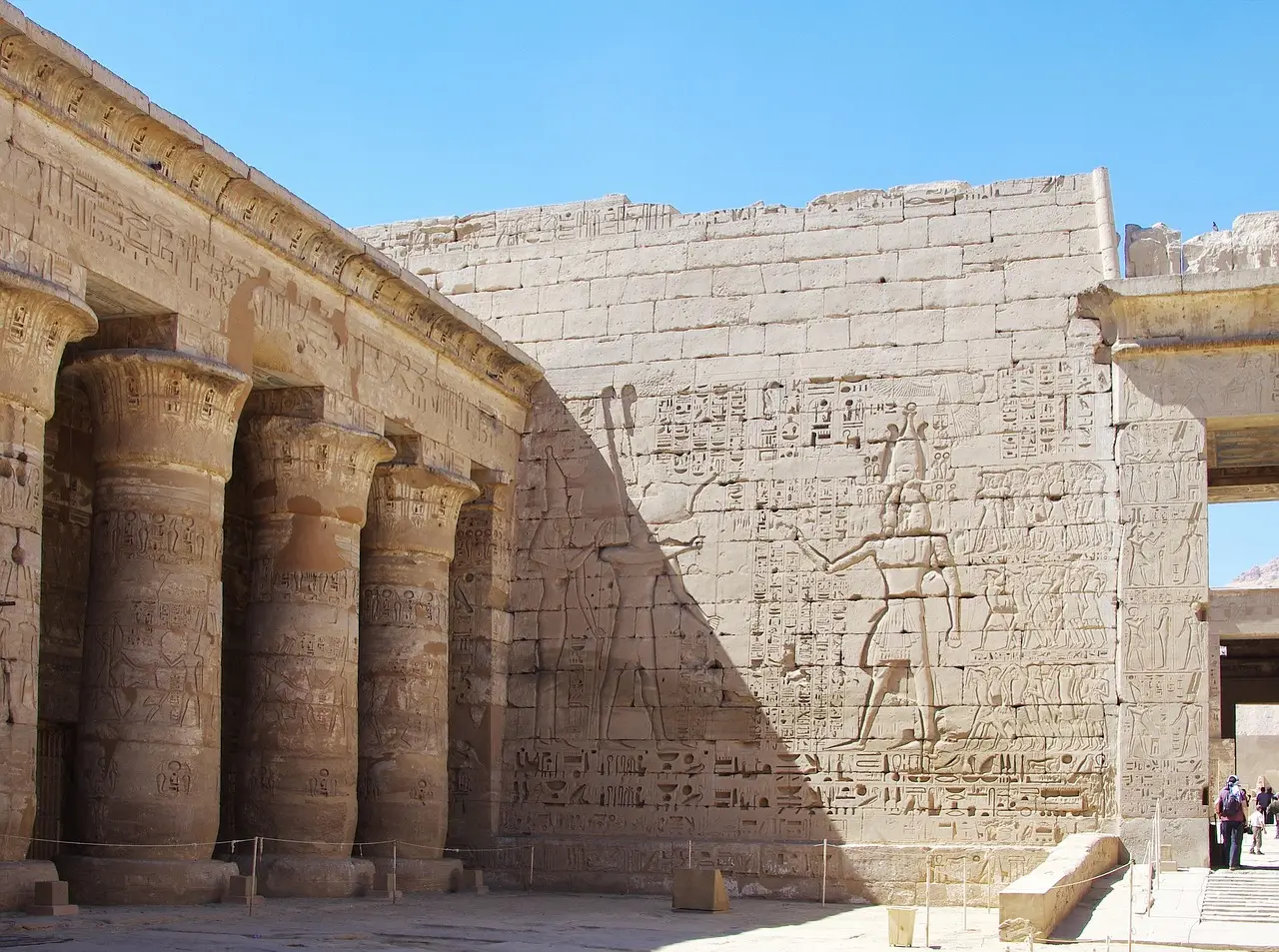
A "ring of fire" solar eclipse that crossed Canaan on Oct. 30, 1207 B.C. may be the oldest solar eclipse identified in any written record — and, if one contested reading of the Bible holds, it could shift the accepted dates of Ramesses the Great's 66-year reign by roughly three years.
That is the claim Colin Humphreys and Graeme Waddington of Cambridge University advanced in research published in 2017. Their argument turns on a passage in the Old Testament book of Joshua, in which the leader of the Israelites, having brought his people into Canaan — modern-day Israel and Palestine — prays: "Sun, stand still at Gibeon, and moon, in the Valley of Aijalon. And the sun stood still, and the moon stopped, until the nation took vengeance on their enemies." Ancient Gibeon lies about six miles (10 kilometers) northwest of Jerusalem.
Why eclipses work as timestamps?
The solar system behaves like a clock that astronomers can run in both directions. Calculations that account for changes in Earth's rotation over thousands of years allow researchers to reconstruct precisely where the moon's shadow fell in the distant past — even when nobody wrote it down. When an ancient text reliably describes an eclipse, it can anchor a moment in history to a specific place and time, like a timestamp on an undated photograph.
The same clock runs forward. On Aug. 2, 2027, a total solar eclipse will sweep across Egypt, passing directly over Luxor. Totality will begin there at approximately 1:02 p.m. EEST and last 6 minutes 22 seconds, according to Time and Date, plunging some of ancient Egypt's greatest surviving monuments into darkness.
What did Joshua's text actually describe?
Humphreys and Waddington calculated that an annular eclipse (an eclipse in which a ring of the sun's edge remains visible around the moon) was visible from Canaan for five minutes on the afternoon of Oct. 30, 1207 B.C. If the Joshua passage records that event, it becomes a fixed astronomical date.
The interpretation is controversial. It depends heavily on how the ancient Hebrew text is translated. Marinus Anthony van der Sluijs has challenged the reading, arguing that the narrative describes the sun standing over Gibeon and the moon over the Valley of Aijalon simultaneously — which would not be an eclipse at all.
How does this date Ramesses II?
The connection runs through the Merneptah Stele, a large inscribed granite monument now held in the Egyptian Museum in Cairo. Discovered in 1896 at Pharaoh Merneptah's mortuary temple on the west bank of the Nile, opposite modern-day Luxor, it was written in the fifth year of Merneptah's reign — he succeeded Ramesses II — and describes an Egyptian military campaign in Canaan that mentions Israelites.
Egyptologists generally date Merneptah's reign to around 1213–1203 B.C., placing his fifth year around 1209/1208 B.C. That means the Israelites were already living in Canaan by then. If the 1207 B.C. eclipse appears in the Joshua narrative, Humphreys and Waddington proposed, it likely occurred during the second, third or fourth year of Merneptah's reign — and Ramesses II would have reigned from approximately 1276 to 1210 B.C., with an uncertainty of about a year. The British Museum uses the conventional dates of 1279–1213 B.C.
Ramesses II, also called Ramesses the Great, commissioned Abu Simbel, made major additions to Karnak and Luxor Temple, lived past 90 and marked the final peak of ancient Egyptian imperial power. The BBC has called him the "Jupiter" of the pharaonic system. Yet the precise dates of his reign remain subject to debate, reconstructed from archaeological, historical and astronomical evidence.
Are there earlier Egyptian eclipses?
Eclipses crossed Egypt long before any identifiable written record of one exists. On April 1, 2471 B.C., a total solar eclipse swept across northern Egypt during the age of the great pyramid builders. In research published in 2025, archaeoastronomer Giulio Magli of the Polytechnic University of Milan proposed that it may explain why Pharaoh Shepseskaf broke with tradition and built a huge rectangular tomb at South Saqqara instead of a pyramid. But no surviving Egyptian text records that eclipse — a tantalizing hypothesis without a witness.
On Aug. 2, 2027, there will be no such ambiguity. Almost 4,500 years will separate that eclipse from the one of 2471 B.C., and 3,233 years from the one of 1207 B.C. — all movements of the same celestial clock, run forward to predict and backward, occasionally, to date history itself.
Run it backward, and an eclipse of the sun can put a date on history.
via space.com (Source)
More from Priya Raman
Show full bio
Senior reporter covering people, launches and day-to-day practice in general science news at SciBeat.
549 articles
Nearby plates
- Tree Rings and Ice Cores Date Babylon's Fall to 1587 B.C.
- Tree rings, Venus and Alaska date Babylon's fall to 1587 BCE
- Stellar activity, not a giant planet, explains nearby wobble
- Rubin Observatory Finds a Backward-Orbiting Object Beyond Neptune
- Perseverance Breaks Off-World Driving Record: 28.10 Miles on Mars