Plate Nº 68 · recorded October 10, 2026
Biology & EvolutionReported finding
AI Reads 25,000 Years of Grass History Hidden in Look-Alike Pollen
Machine learning plus super-resolution microscopy let researchers read 25,000 years of grass diversity and C3/C4 shifts from a Mount Kenya lake-bed pollen core.
By James Calloway4 min read888 words
In brief
- A machine-learning model analyzed 25,000 years of grass pollen from a lake core on Mount Kenya.
- Pollen diversity was lowest between roughly 21,000 and 18,000 years ago, during the Last Glacial Maximum.
- C4 grasses declined gradually as the climate warmed and CO2 rose, letting C3 grasses take over.
- Grasses were potentially the first domesticated plants, around 12,000 years ago.
- The study appears in the Proceedings of the National Academy of Sciences (2026).
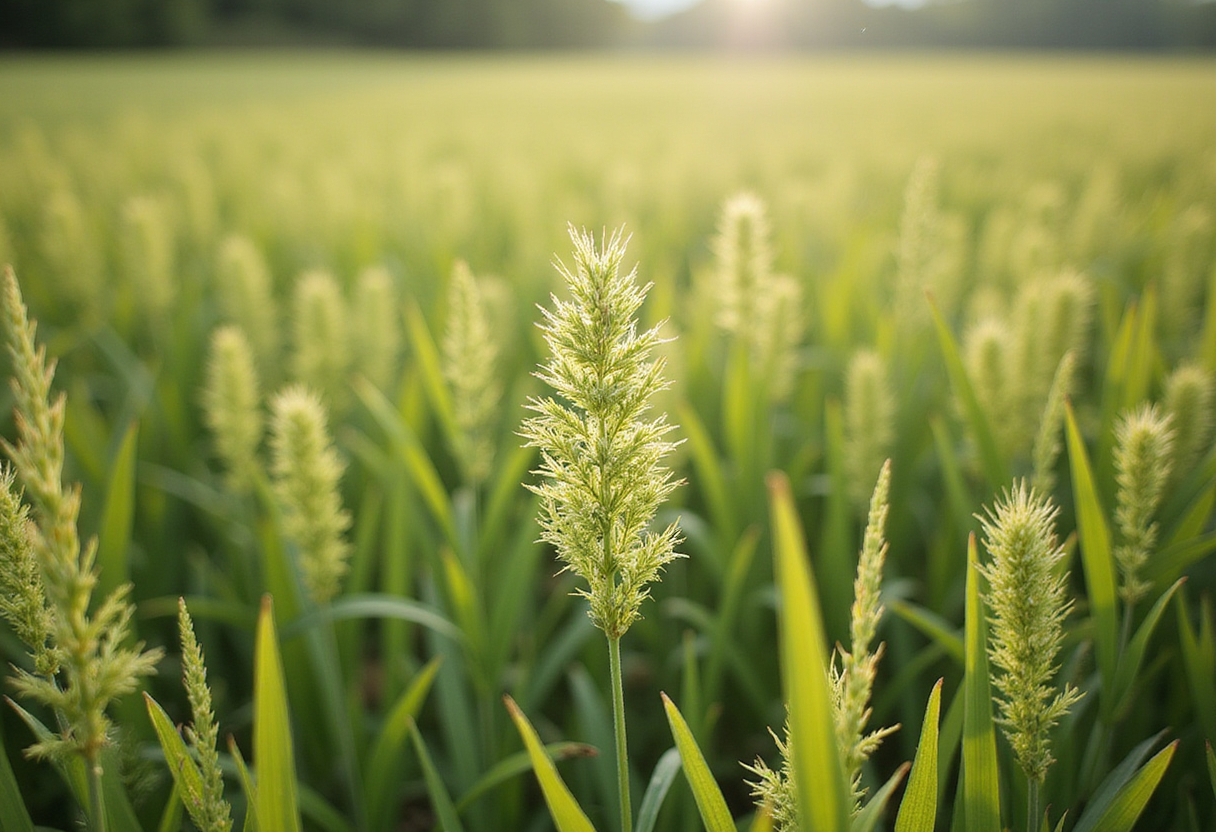
A single lake-bed core from Mount Kenya has just yielded 25,000 years of grass history, thanks to a machine-learning method that can finally tell grass pollen grains apart — a challenge that has frustrated botanists for decades.
Researchers led by University of Illinois Urbana-Champaign plant biology professor Surangi Punyasena and former doctoral student Marc-Élie Adaimé, now at the Smithsonian's Office of Digital and Innovation, published their findings in the Proceedings of the National Academy of Sciences. Their approach tracks how grass diversity shifted across an entire ice age at one East African site.
Why was grass pollen so hard to read?
Pollen from other flowering plants is easy to classify: shapes, spikes, grooves and pore arrangements differ visibly between species. Grass pollen is not so cooperative. Under a standard light microscope, grains from different grass species look remarkably similar.
"As paleobotanists and paleontologists, we're restricted to working with the morphology of pollen grains, which are one of the main parts of the plant that can be fossilized," Punyasena said.
The bottleneck was never a lack of material. "Within a small cubic centimeter of sediment, you could have thousands, potentially millions of pollen fossils," she said. "But the level at which we were able to analyze it before machine learning was limited by human ability."
Light microscopy could not resolve the fine surface features of a grain. Electron microscopy could, but slowly and at high cost. This gap limited what scientists could learn about how grasses evolved and spread — a serious problem for a plant family that feeds the world.
"Grasses were potentially the first plants domesticated about 12,000 years ago and today include several of the world's most important staple foods, such as wheat, rice, maize, barley, sorghum and millet," the researchers wrote. Open grasslands themselves are recent in Earth's history, with open-habitat grasses appearing in the Eocene, roughly 40 million years ago.
How does the new method work?
The team built on earlier work using super-resolution microscopy, which illuminates a sample point by point with a laser and then uses algorithms to reconstruct where scattered light originated.
"You get close to electron microscopy quality, but the process is much faster, much easier," Punyasena said.
When Adaimé examined the resulting images, he spotted small but consistent differences between species:
- the patterning on the pollen grain's surface
- the complexity of that patterning
- the thickness of the pollen cell wall
Adaimé trained a machine-learning model to recognize these differences using images of identifiable grass species. He then built a statistical method that uses the learned patterns to estimate species diversity in mixed samples. Tested on samples of known composition, the estimates closely tracked actual diversity.
"That's essentially the definition of machine learning: for a computer model to be able to learn patterns and apply that learning to new data without being given explicit rules," Adaimé said.
The model relies on convolutional neural networks, which are loosely inspired by how neuron networks in the human brain process visual information — though, as Adaimé noted, "the artificial neurons in these networks are obviously much simpler than actual nerve cells."
One limitation remains: the model cannot name individual grass species in a sample. It can, however, accurately estimate how many species are present.
What are C3 and C4 grasses?
The model also distinguished between the two main photosynthetic types of grasses. C3 and C4 grasses differ in how they concentrate carbon dioxide in their tissues to perform photosynthesis, with C4 grasses using CO2 more efficiently, boosting their photosynthetic capacity and water-use efficiency. Earlier research found that C4 species put more biomass into roots and grow less dense leaves than C3 species.
Adaimé and Punyasena hypothesize that C4 grasses also invest fewer resources in each pollen grain, which could explain their thinner walls and simpler surface patterns. Some evidence supports this idea, but Adaimé stressed that more work is needed to confirm it.
What did 25,000 years of pollen reveal?
Applied to the Mount Kenya lake core, the method showed pollen diversity was substantially lower during the last ice age, especially between about 21,000 and 18,000 years ago — the coldest, harshest stretch, known as the Last Glacial Maximum.
"That period is particularly fascinating for biologists and Earth scientists because the CO2 levels in the atmosphere were extremely low," Adaimé said. Diversity rose afterward, coinciding with increasing CO2 and temperatures.
The C3-to-C4 balance behaved differently. The proportion of C4 grasses was higher during the final stretch of the ice age and then very gradually declined, showing no obvious link to carbon dioxide or temperature. "The fraction of C4 grasses decreased, and C3 grasses took over as the climate got warmer and CO2 got higher," Adaimé said.
The study is a proof of concept: it shows scientists can convert fossil pollen into reliable ecological data faster than before. Punyasena said future studies aim to refine the method and eventually extend it to pollen and spores from all land plants.
"It is satisfying to see that there is so much more information to be unlocked," Adaimé said. "Now we have a way to begin unraveling the history of grasslands, and perhaps even the deep evolutionary history of grasses, from clues hidden in subtle differences among their pollen grains."
via Phys.org Biology (Source)
More from James Calloway
Show full bio
Staff writer covering marketplaces and e-commerce at SciBeat.
205 articles
Nearby plates
- Africa's Underwater Meadows Need Urgent Protection, Scientists Warn
- Climate, not latitude, drives global plant-pollinator specialization
- Drones, Satellites and AI Team Up to Track Antarctica's Tiniest Life
- 240-Million-Year-Old Tanzania Fossil Reshapes Dinosaur Timeline
- Animals May Have Evolved 200 Million Years Earlier Than Thought