Plate Nº 73 · recorded October 10, 2026
Earth & ClimateReported finding
Anak Krakatau Eruption Sent Ash 50,000 Feet, Disrupted 3,000 Flights
Indonesia's Anak Krakatau volcano sent volcanic ash as high as 50,000 feet into the atmosphere during a September 5, 2026 eruption that lasted over 24 hours, disrupted nearly 3,000 flights, and closed eight airports.
By Priya Raman2 min read487 words
In brief
- Ash column reached 50,000 feet (about 15 km) west of the volcano, per Indonesia's meteorological agency on September 6, 2026
- Eruption began September 5, 2026 and lasted more than 24 hours
- Eight airports across Java and Sumatra closed; news reports say nearly 3,000 flights were disrupted
- Airports resumed normal operations by September 8, 2026
- Anak Krakatau has held the second-highest alert level on Indonesia's volcanic warning scale since early July 2026
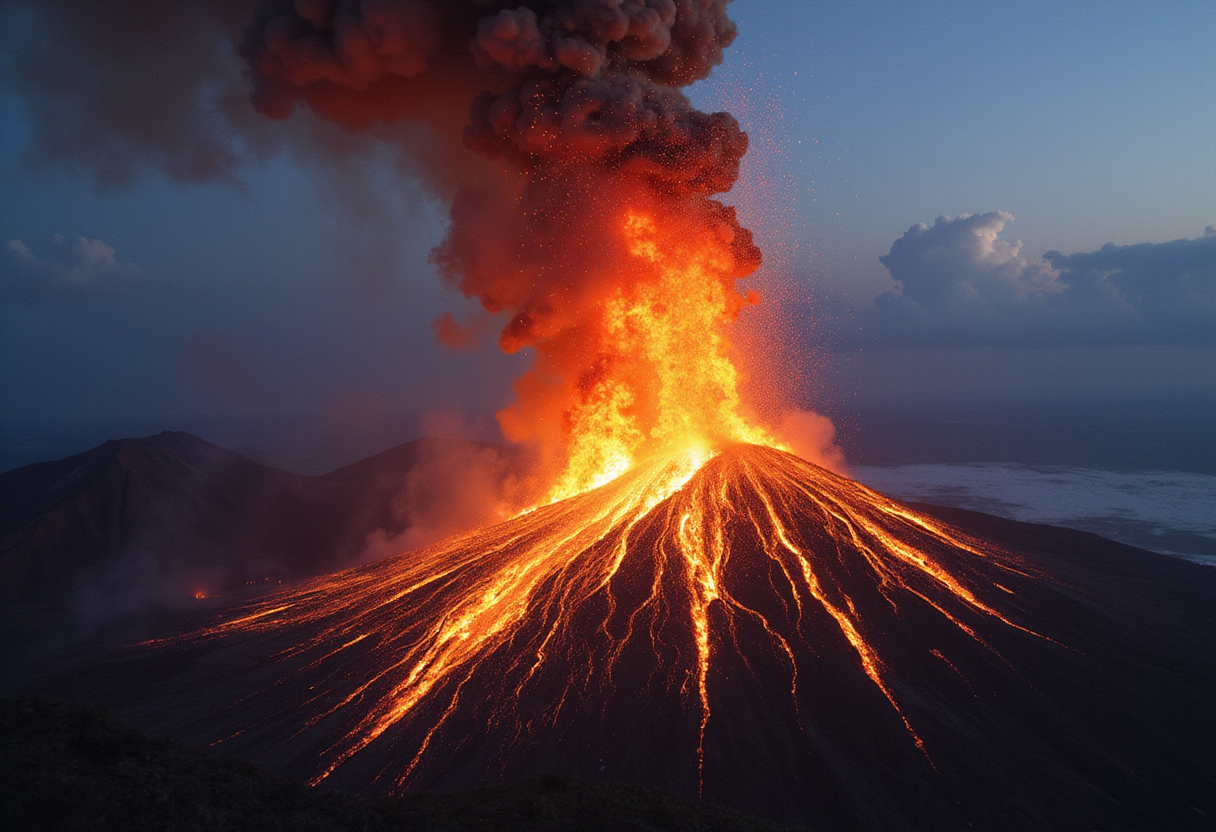
Indonesia's Anak Krakatau volcano sent volcanic ash as high as 50,000 feet (about 15 kilometers) into the atmosphere during a prolonged eruption on September 5, 2026.
The blast lasted more than 24 hours and forced the temporary closure of eight airports across Java and Sumatra. News reports said it disrupted nearly 3,000 flights into and out of the region.
What is Anak Krakatau?
Anak Krakatau — Indonesian for "Child of Krakatau" — is a small, highly active volcano that rises from the Sunda Strait between Java and Sumatra. It emerged from the sea in 1927, decades after its parent volcano, Krakatoa, exploded catastrophically in 1883.
The volcano usually produces modest Strombolian eruptions. That style involves periodic bursts of ash, gas, and small volcanic bombs. But Anak Krakatau can also generate far more explosive events.
How high did the ash reach?
Indonesia's meteorological agency reported on September 6 that the ash column climbed to about 6,000 meters (20,000 feet) east of the volcano. To the west, the plume reached roughly 15,000 meters (50,000 feet).
How did satellites see the eruption?
Two NASA spacecraft captured the event from orbit:
- The OLI (Operational Land Imager) on Landsat 8, a joint NASA–U.S. Geological Survey mission, recorded a bright white plume of volcanic gas rising above a darker brown ash cloud.
- The VIIRS (Visible Infrared Imaging Radiometer Suite) on the Suomi NPP satellite imaged volcanic material spreading across a much wider region.
Both instruments detect visible and infrared light coming from Earth's surface and atmosphere. Scientists use the data to track plume composition, height, and movement.
Why did airports close?
Volcanic ash is abrasive. The tiny rock fragments can fuse onto engine parts and stall jet turbines. Aviation authorities therefore keep aircraft well away from ash-rich airspace.
By September 8, the eight closed airports had resumed normal service.
How far did the ash travel?
Indonesia's Humanitarian Coordination Platform (IHCP) reported ash falling over communities east of Anak Krakatau, including Jakarta and other parts of West Java. Jakarta sits about 100 kilometers (60 miles) east of the volcano.
The IHCP also noted that volcanic ash differs from the smoke produced by Indonesian peatland fires. The two have different particle sizes, move through the atmosphere differently, and demand different protective measures.
What are the health risks?
Volcanic ash contains tiny fragments of rock, minerals, and glass. Inhaling these particles can irritate airways, eyes, and skin. People with asthma or other lung conditions face the greatest danger.
Local authorities urged residents in heavy ashfall zones to wear masks and stay indoors.
Is the volcano still dangerous?
Explosive activity weakened on September 6, though the volcano continued to rumble. Its behavior shifted back toward typical Strombolian bursts of ash and rock.
Anak Krakatau remained at the second-highest level on Indonesia's volcanic warning scale. The volcano has held that status since early July 2026.
via scitechdaily.com (Original)
More from Priya Raman
Show full bio
Senior reporter covering industry trends and analytics at SciBeat.
207 articles
Nearby plates
- US-India Satellite Watches a Sleeping Kamchatka Volcano Wake
- Tonga Plume Broke Down Methane for 10 Days, Study Finds
- Indonesia's Underground Peat Fires Are Surging Early in 2026
- Soviet-Era Satellite Breaks Apart, Adding Tens of Debris Fragments to Orbit
- NASA Catches a Fire-Made Thunderstorm Over an Idaho Grass Fire