Plate Nº 56 · recorded November 13, 2026
Biology & EvolutionReported finding
Ancient DNA Identifies Cyclopia’s Cause in a 1,600-Year-Old Infant
Ancient DNA identified trisomy 13 in a 1,600-year-old Nasca infant with cyclopia. Her ordinary urn burial suggests inclusion, but not whether she lived beyond birth.
By Elena Vasquez4 min read873 words
In brief
- Three copies of chromosome 13 were found in the 1,600-year-old infant’s leg-bone DNA.
- The infant lived around 325–440 CE in Peru’s Palpa Valley.
- Cyclopia occurs in about 1 in 100,000 births and is almost always fatal.
- Nasca urn burials accounted for about one-quarter of documented graves in Palpa.
- A 2024 study of nearly 10,000 ancient genomes found no Patau syndrome cases.
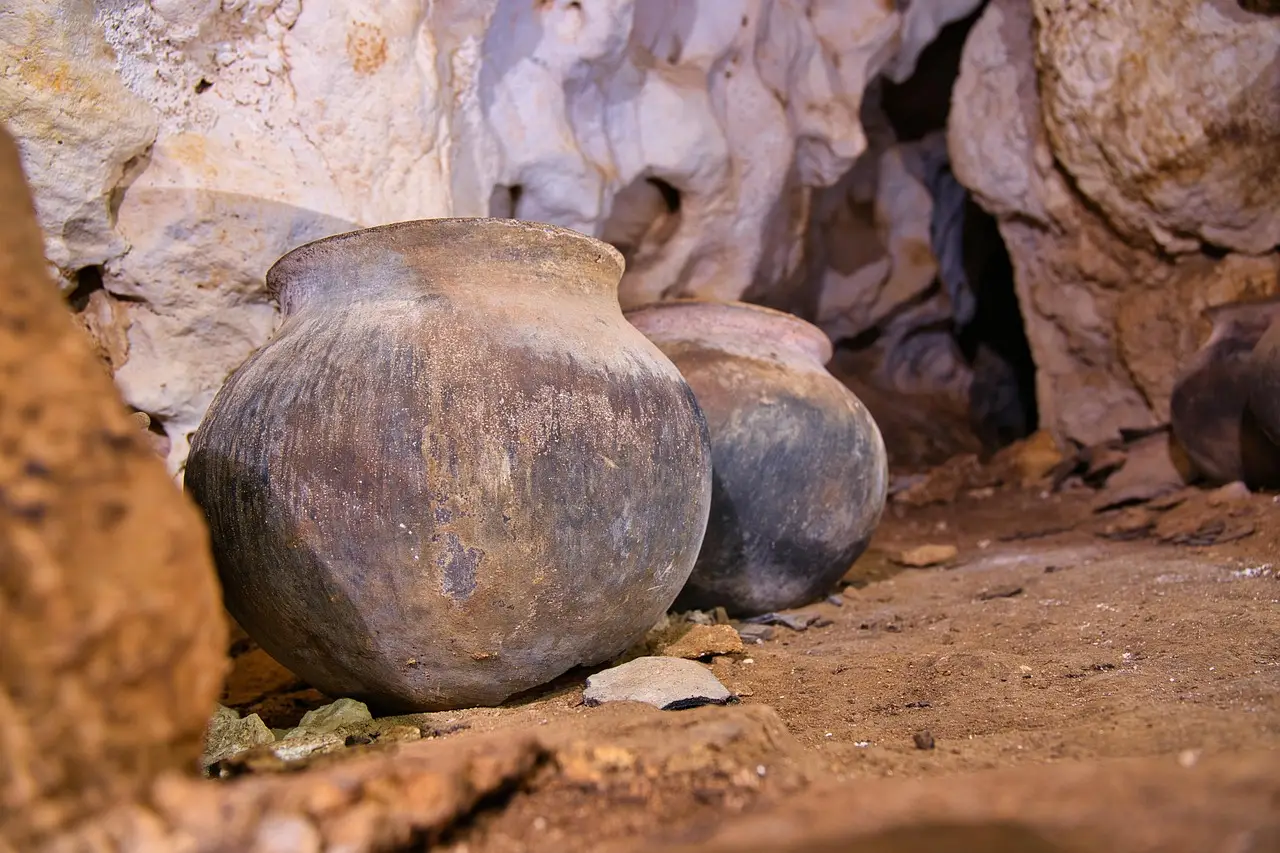
Ancient DNA links a 1,600-year-old Nasca infant’s cyclopia to trisomy 13, but her bones cannot establish whether she survived birth.
What did the ancient DNA show?
The child lived in what is now southern Peru around 1,600 years ago, among the Nasca people. Researchers sequenced ancient DNA recovered from one leg bone and found three copies of chromosome 13 instead of the usual two. Three separate analytical methods supported the result.
The diagnosis is trisomy 13, also called Patau syndrome. It is a major chromosomal cause of severe holoprosencephaly, a condition in which the brain fails to separate properly, although only a minority of babies with trisomy 13 develop cyclopia.
“The cause of the malformation was present at fertilization,” said Elsa Tomasto-Cagigao, the study’s lead author and an archaeologist at the Pontifical Catholic University of Peru, told Live Science. The visible facial abnormalities emerged as the embryo’s brain and face began forming.
The finding adds Patau syndrome to the chromosomal disorders identified in ancient human remains. A 2024 investigation of nearly 10,000 ancient genomes found Down and Edwards syndromes but no cases of Patau syndrome.
The DNA identifies the cause, but not what happened after birth.
How does trisomy 13 reshape the face?
Cyclopia is an extremely rare developmental defect, estimated to occur in about 1 in 100,000 births. The developing brain fails to divide properly, and the eyes form in one central socket, often alongside severe abnormalities of the nose and brain. The condition is almost always fatal.
Despite its name, cyclopia does not always produce one fully formed eye. The eyes may be fused or partly divided inside the central socket.
The disruption begins during the first weeks of pregnancy, when the brain must divide into left and right hemispheres. Severe failure of that separation produces alobar holoprosencephaly. Because the brain and face develop together, the same disruption can prevent the eyes and nasal structures from forming normally. In severe cases, the nose is missing or replaced by a small tube-like structure above the eye.
The Nasca infant had one eye socket in the center of her face, and her nose had not developed normally.
One early developmental failure can account for the central eye socket and abnormal nose.
Did she survive for months?
Archaeologists discovered the infant at Jauranga in Peru’s Palpa Valley, a region known for the enormous geoglyphs called the Nazca Lines. She lay at the bottom of a ceramic urn beneath another infant girl. Both infants belonged to the Middle Nasca period, between 325 and 440 CE.
Her developing teeth resembled those of a two- to four-month-old. But her thigh bones and other long bones matched those of a fetus at about 36 to 40 weeks of pregnancy, near the time of birth. Normally, those measurements help estimate age at death. Here, they pointed in opposite directions.
One possibility is that she survived for weeks or months after birth while her condition severely restricted skeletal growth. Another is that trisomy 13 disrupted tooth development, making her appear older than she really was.
“We cannot really say how long this individual survived,” anthropologist Lars Fehren-Schmitz, a study co-author at the University of California, Santa Cruz, told Live Science. “[But] the burial of this infant suggests that the Nasca treated this individual in death like most other infants.”
The bones and teeth do not establish how long she lived.
What did the burial show?
Both infants went into the urn during what appears to have been a single burial event. DNA showed that they came from different maternal family lines. They may have shared a father, but they also may have come from different families.
Urn burials were common for Nasca children and account for about one-quarter of documented graves in Palpa. The infant with cyclopia had no unusual grave goods and no obvious sign of different funerary treatment. That pattern suggests her community included her in established burial traditions. It does not show whether anyone gave her special care while she was alive.
This case fits a growing collection of burials of children with rare, severe conditions. A 2024 genetic study identified six infants with Down syndrome and one with Edwards syndrome, dating from around 5,000 years ago to the 18th century, in Bulgaria, Greece, Spain and Finland. Some died before birth, while others survived for months.
In Iron Age Spain, people buried an infant with Down syndrome alongside multiple offerings, suggesting that ancient communities sometimes gave children with severe genetic conditions careful funerary treatment.
The shared urn and lack of exceptional grave goods point to inclusion in usual Nasca child burial practice.
What remains unknown?
The remains do not show whether the infant was born alive, or whether she survived for days, weeks or months. They cannot reveal what her brief life was like or how the people around her responded to her condition. Her DNA identifies a condition present from fertilization; her bones and teeth offer conflicting clues about what followed.
Researchers published the study in the journal Proceedings of the National Academy of Sciences.
The cause is known; the length and quality of her life remain unknown.
via zmescience.com (Source)
More from Elena Vasquez
Show full bio
Correspondent covering money, funding and market shifts around general science news at SciBeat.
395 articles
Nearby plates
- DNA confirms rare cyclopia in 1,600-year-old Nazca infant
- Six-Million-Year-Old Peru Skull Rewrites Whale Facial Symmetry
- Scientists digitally reconstruct face of 315,000-year-old Homo sapiens
- Ancient DNA reveals extinct yak relative hidden in Siberian bones
- Proteins From 20 Fossils Give Denisovans a Face of Their Own