Plate Nº 36 · recorded November 13, 2026
Space & AstronomyReported finding
Astronomers Map 450 Gamma-Ray Sources in a Neglected Energy Range
Astronomers identified roughly 450 gamma-ray sources between 20 and 200 megaelectronvolts using 14 years of data from NASA's Fermi space telescope, opening a neglected window on black holes and stellar wreckage.
By Priya Raman3 min read575 words
In brief
- Roughly 450 gamma-ray sources were cataloged in the 20–200 megaelectronvolt energy range.
- The analysis used 14 years of data from NASA's Fermi space telescope.
- The result is the Second Catalog of Low-Energy Fermi-LAT Sources, abbreviated 2FLE.
- The catalog offers targets for follow-up rather than final identifications of every source.
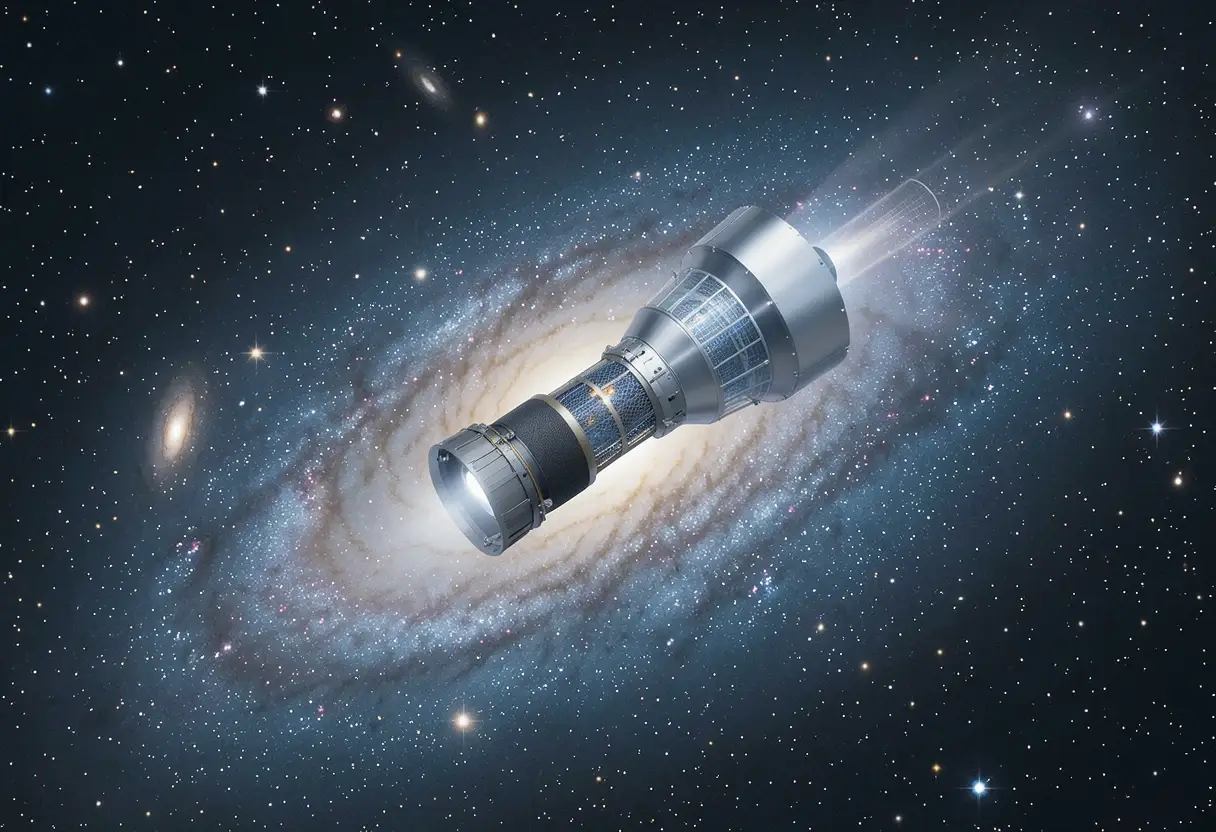
Astronomers have identified roughly 450 sources of powerful gamma rays in an energy range that has long resisted study. The international team built its catalog from 14 years of observations by NASA's Fermi space telescope, focusing on gamma rays between 20 and 200 megaelectronvolts (a megaelectronvolt being one million electronvolts, a unit that measures the energy of light particles). The result is a new reference map for some of the universe's most extreme objects, including black holes and the remnants of exploding stars.
The findings appear in the Second Catalog of Low-Energy Fermi-LAT Sources, known as 2FLE. It draws on measurements from Fermi's Large Area Telescope, the instrument aboard the observatory that detects gamma rays across the sky.
Why are these gamma rays hard to trace?
Gamma rays are an especially energetic form of light, invisible to human eyes. Nature produces them when particles accelerate to enormous speeds near black holes, inside powerful jets, or in other violent cosmic environments. Studying them helps scientists understand how the universe generates energies that Earth-bound laboratories cannot recreate.
The difficulty lies in pointing back to the source. Lower-energy gamma rays scatter when they interact with matter, so their arrival direction becomes uncertain. Background signals compound the problem, making it harder to distinguish genuine celestial objects from noise. This is why the 20 to 200 megaelectronvolt band has received far less attention than higher-energy gamma rays.
To overcome this, the researchers carefully re-analyzed years of Fermi measurements. Their approach shows how valuable information can still be recovered from long-running observatories when scientists revisit old data with fresh questions and improved analysis methods.
What does the catalog actually contain?
The 2FLE catalog does not claim that every entry is a newly discovered or fully identified object. Instead, it provides a more systematic picture of where emissions appear in the sky and offers concrete targets for follow-up investigation.
Astronomers can now compare these gamma-ray signals with observations at other wavelengths — radio, optical and X-ray — to work out which objects are responsible. Such cross-checks matter because a single kind of light rarely tells the whole story. An unexplained signal might turn out to be a pulsar (a rapidly spinning, magnetized stellar corpse), an active galaxy, or something else entirely.
Why does the energy range matter?
Different gamma-ray energies reveal different physical processes. Without measurements across the full spectrum, astronomers risk missing important clues about how particles are accelerated and how they lose energy. The new catalog fills a gap between well-studied higher-energy gamma rays and other bands of light.
The catalog also serves as a starting point for identifying objects that have no obvious match in existing sky surveys. The researchers stress that they will need additional evidence before they can confidently explain the most puzzling entries. Preliminary identifications, in other words, remain hedged until other telescopes confirm them.
What comes next?
The team hopes the catalog will guide future space missions designed specifically to explore this energy range. For now, 2FLE gives astronomers a structured list of places to look — and a reminder that decade-old data can still yield new skies.
The work was conducted by an international research team and builds on observations from NASA's Fermi space telescope, which has operated long enough to make such deep re-analysis possible.
Fourteen years of patience, distilled into 450 pinpricks of violent light.
via knowridge.com (Source)
More from Priya Raman
Show full bio
Senior reporter covering people, launches and day-to-day practice in general science news at SciBeat.
378 articles
Nearby plates
- Fermi catalog maps about 450 gamma-ray sources in 14 years
- H.E.S.S. telescopes set strongest limits yet on Milky Way dark matter
- Gamma-ray burst's engine fired for 27 days, shattering the record
- Einstein Probe catches 10-minute X-ray tail of neutron star merger
- Record 10-Minute X-Ray Flash Traced to a Collision of Dead Stars