Plate Nº 44 · recorded November 17, 2026
Neuroscience & MindReported finding
Bigger Brain Surface, Slightly Shareper Minds — And Maybe the Reverse
A genetic study of 11,289 UK Biobank adults finds cortical surface area explains ~2.4% of reasoning scores — and cognition may shape the cortex back.
By Nathan Brooks4 min read719 words
In brief
- Cortical surface area explained only about 2.4% of differences in reasoning test scores among 11,289 UK Biobank participants.
- Genetic analyses suggested surface area and cognitive ability may influence each other in both directions.
- The strongest regional links were in the dorsolateral prefrontal and superior temporal cortices.
- The study was published in Human Brain Mapping by Chun-Ju Chou and colleagues.
- Sample: adults aged 45–80, average age 64, of European ancestry.
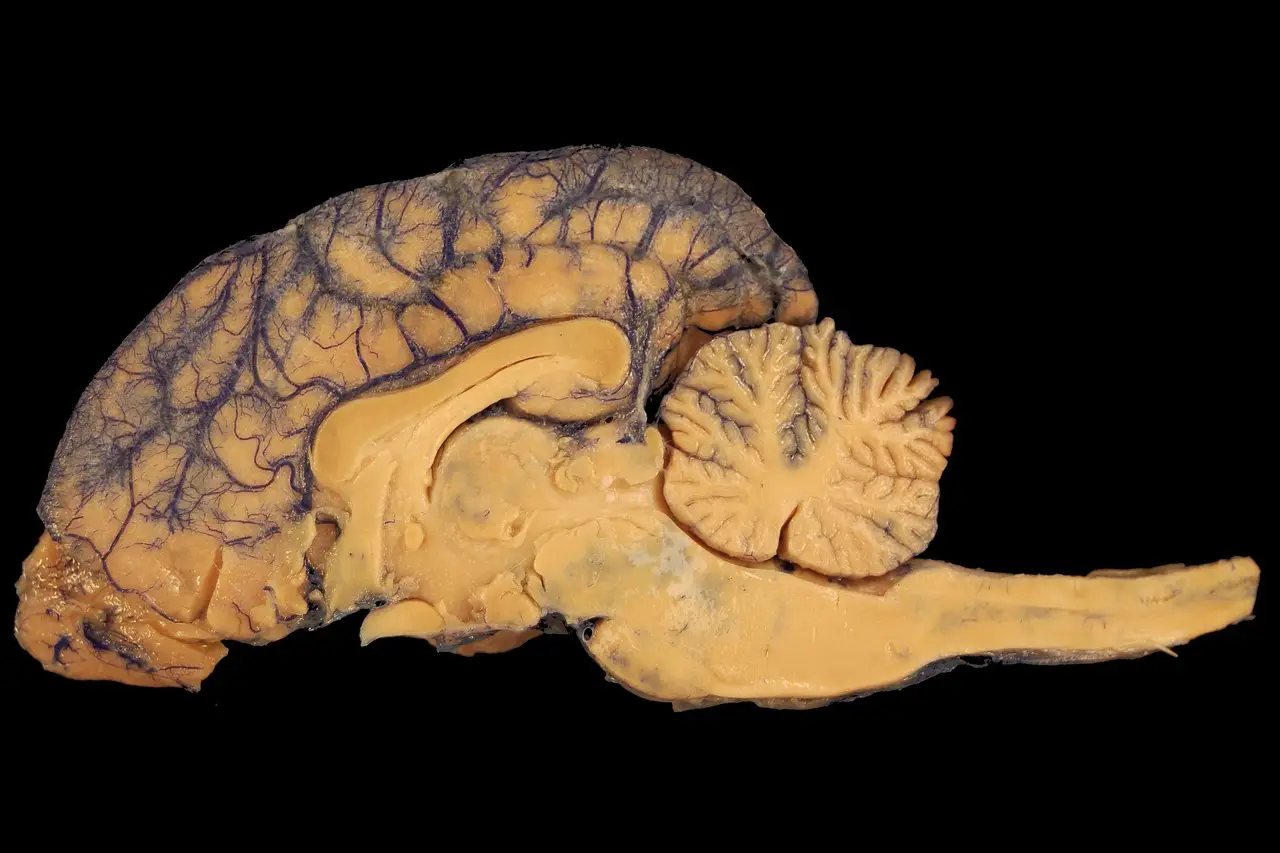
A larger cortical surface area tracks with slightly higher scores on a verbal and numerical reasoning test, according to a new analysis of 11,289 UK Biobank participants. But the effect is small: surface area explained only about 2.4% of the differences in test performance.
The genetic analyses went a step further, suggesting the relationship may run in both directions. A bigger cortical surface area may contribute to higher cognitive ability — and higher cognitive ability may, in turn, contribute to a bigger surface area. The study, led by Chun-Ju Chou, was published in the journal Human Brain Mapping.
What is cortical surface area?
The cerebral cortex is the brain's folded outer layer, the part that handles complex jobs like reasoning, memory and decision-making. Its total area, spread across all those folds, is the cortical surface area. Researchers have long known that people with larger brains tend to score higher on intelligence tests, but the link is modest.
Recent work has shifted from total brain volume to two finer measures: the cortex's surface area and its thickness. Genetic factors appear to explain most of the volume–intelligence link, and surface area — not thickness — seems to carry that signal. Genetics explains up to 80% of individual differences in intelligence, yet scientists still don't fully understand how brain structure maps onto cognitive ability.
How was the study done?
Chou and colleagues — Mark Fiecas, Elisabetta C. del Re, Eero Vuoksimaa and Chi-Hua Chen — drew on the UK Biobank, a biomedical database holding genetic, health and brain imaging data from roughly 500,000 people in the United Kingdom.
- They started with 34,842 participants of European ancestry who had brain scans, then removed close relatives and people without cognitive scores.
- The final sample: 11,289 adults aged 45 to 80, average age 64, slightly more than half women.
- Cognitive ability was measured with 13 verbal and numerical reasoning questions, answered in two minutes.
- The authors note this short test likely captures both fluid abilities (on-the-spot problem solving) and crystallized abilities (accumulated knowledge), and they treated it as a proxy for general cognitive ability.
Instead of a traditional anatomical map, the team used a genetically informed brain atlas — one that groups cortical areas sharing genetic influences. They expected this would reveal multiple regions linked to cognition, with surface area and thickness showing distinct patterns.
What did they find?
Every cortical region showed a positive association between surface area and test scores. The strongest links appeared in the dorsolateral prefrontal cortex — a hub for working memory and executive function — followed by the superior temporal and orbitofrontal areas. The dorsolateral prefrontal and superior temporal regions stayed significant even after accounting for total surface area.
Cortical thickness told a different story. Associations with test performance were modest, and after accounting for overall thickness, a thinner cortex in some frontal and temporal regions actually went hand in hand with higher scores.
The researchers then applied Mendelian randomization, a method that uses genetic variants as natural experiments to test whether one trait may influence another. Those analyses suggested possible effects in both directions between total surface area and cognitive ability. Higher cognitive ability also appeared to influence the thickness of the perisylvian region, which is involved in language processing. Regional genetic effects in the prefrontal and temporal areas, however, did not survive statistical correction for multiple comparisons.
"These findings support a polyregional SA architecture underlying GCA, with prominent contributions from prefrontal and temporal association cortices," the authors concluded. "Our results refine global brain–GCA models and highlight the value of genetically informed parcellation for identifying regional cortical contributions."
How far do the findings reach?
The caveats are real. A 13-question, two-minute test is a narrow proxy for something as broad as general cognitive ability. Cortical structure explained only a sliver of score differences, so nothing here can predict an individual's intelligence. Mendelian randomization rests on assumptions that can't be fully verified. And the sample — middle-aged and older adults of European ancestry — may not generalize to younger people or other populations.
For now, the study's value lies in refining the map: multiple cortical regions, especially prefrontal and temporal ones, appear to contribute to cognitive ability, and the influence may flow both ways between brain and mind.
via psypost.org (Source)
More from Nathan Brooks
Show full bio
Market editor covering companies, deals and strategy in general science news at SciBeat.
456 articles
Nearby plates
- Childhood abuse linked to brain structure changes in largest neuroimaging study
- Distant Brain Synapses Build Their Own Proteins, Study Finds
- Brain Wiring Starts Precise, Not Random, Mouse Study Finds
- Brain Cells Vote: How Conflicting Visual Signals Fade in a Fraction of a Second
- Neanderthal Gene Variant Still Shapes Human Brains Today