Recorded November 24, 2026
Earth & ClimateReported finding
Cloud-to-ground lightning may rise 76% to 140% by century's end
A 2026 Earth's Future study projects 76% to 140% more cloud-to-ground lightning under high emissions, but regional uncertainty and storm timing may reshape risk.
By Priya Raman4 min read739 words
In brief
- A 2026 Earth's Future study projects 76% to 140% more cloud-to-ground lightning by century's end than in 1995-2014 under SSP3-7.0.
- The model estimated an 11% rise over the 20th century, equivalent to about 12% for every 1°C of warming.
- Under SSP3-7.0, the projected response could reach 30% per 1°C, nearly three times the historical sensitivity.
- Alaska's projected strike density could rise 116% to 594% from the 1995-2014 baseline.
- Cloud-to-ground lightning kills several thousand people and hundreds of millions of trees globally each year.
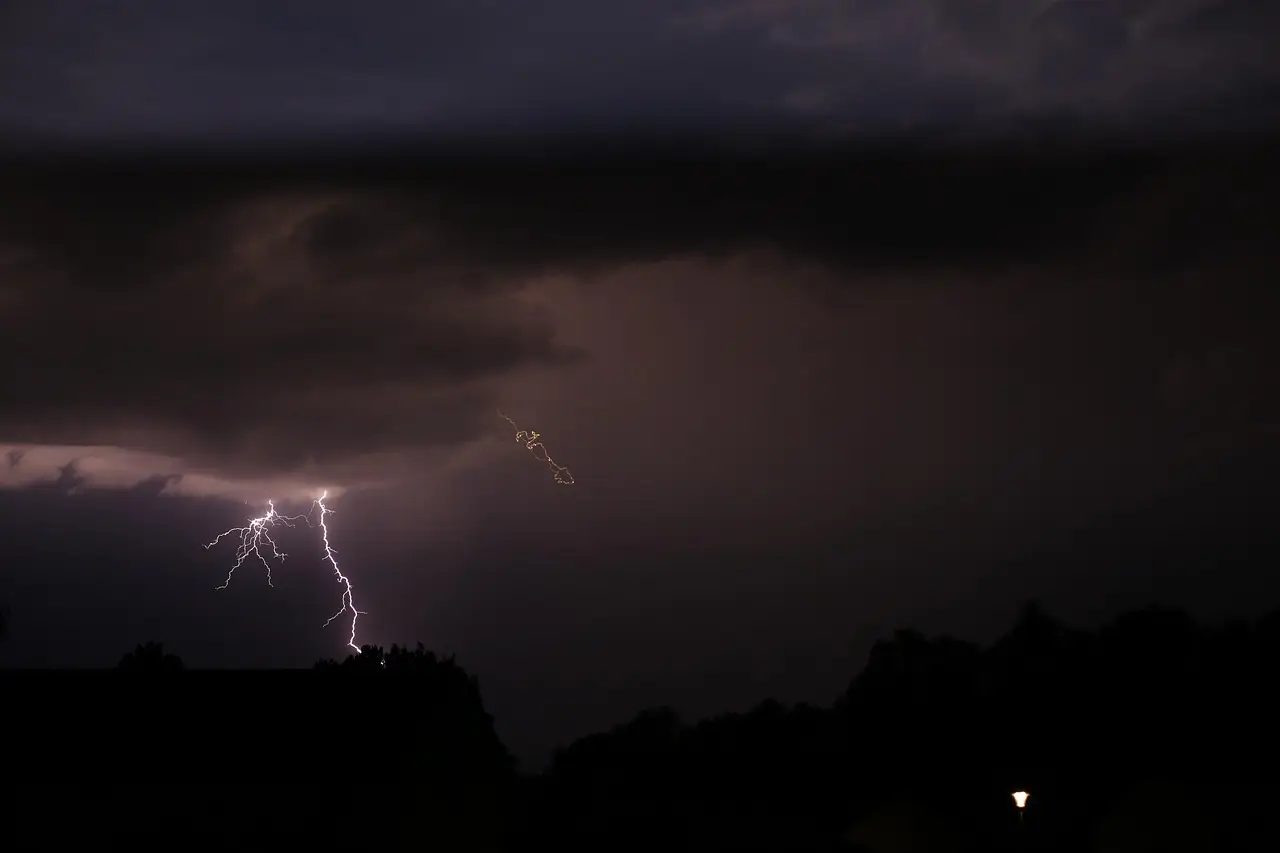
Under a high-emissions climate, cloud-to-ground lightning could become 76% to 140% more common by the century’s end than during 1995–2014, according to a 2026 study in Earth’s Future.
The projection concerns bolts that reach the ground, not lightning confined to clouds. Those strikes can ignite wildfires and damage wind turbines, power lines, offshore oil rigs and other infrastructure. Globally, they kill several thousand people and hundreds of millions of trees each year.
At the Technical University of Munich, Earth system scientist Andreas Krause, the study’s lead author, cautioned: “There is actually quite a large uncertainty about how lightning will respond to climate change.”
How does warming affect lightning?
Warm air near Earth’s surface rises through convection (upward movement of air driven by heating). That motion stirs colder air above. Within frigid clouds high in the atmosphere, tiny ice crystals collide and exchange electric charge. Lighter crystals rise above heavier ones, carrying opposite charges and creating the electric field that can trigger a lightning discharge.
Climate warming can intensify that upward motion and stir more cloud, potentially generating more lightning. Yet a warmer atmosphere may also hold fewer ice crystals high above, making strong electric fields harder to produce. Krause said researchers do not yet know which effect matters more.
Existing patterns provide a partial clue: lightning peaks in the early afternoon, when temperatures usually run highest, and occurs more often in the warm tropics than in colder high latitudes far from the equator.
What did the machine-learning model estimate?
The team trained a machine-learning model (a statistical system that recognizes patterns in data) on lightning and climate observations from 2019. The climate inputs included:
- Temperature
- Rainfall
- Humidity
- Air pressure
- Wind speed
- Incoming solar radiation (energy arriving from the Sun)
Applied to climate conditions in 1901–1920 and 1995–2014, the model estimated that cloud-to-ground lightning frequency rose 11% over the 20th century, equivalent to about 12% for every 1°C of warming.
Under SSP3-7.0 (a high-emissions climate scenario), the modeled response to warming could become nearly three times as sensitive, producing a 30% increase in lightning frequency for every 1°C. By the century’s end, that relationship would imply 76% to 140% more ground strikes than the 1995–2014 baseline, depending on the climate model considered.
The 30% response exceeds earlier estimates, whose highest projected increases ranged from 8% to 17% per degree. The discrepancy stems mainly from different mathematical methods for estimating future lightning and the new study’s use of a newer, more robust global lightning dataset. Krause said: “I was quite surprised that the projections were so high. I expected smaller changes.”
Where would lightning change most?
The model projects the largest increases in total strike counts in the tropics, where lightning is already common, particularly the Amazon, Southeast Asia and Oceania. The Amazon carries the greatest uncertainty because future conditions there may differ vastly from the historical conditions used to train the lightning model. Some other studies predict less tropical lightning in the future.
The largest relative changes could occur at high latitudes far from the equator, where strikes remain rare. In many regions, model projections show density (strikes per unit area) more than doubling. Alaska could see 116% to 594% more ground strikes than during 1995–2014, when most of the state’s land received an average of fewer than one bolt per square kilometer per year.
What does the projection mean for risk?
The study does not translate more strikes directly into more casualties. Krause said human danger may hinge on whether lightning becomes more frequent specifically during storms’ early stages, when people are most likely to remain outdoors without realizing the danger.
The researchers did not examine how forests would respond. Conifers generally sustain more visible damage from direct strikes than broadleaved trees. Some studies in the tropics have found that forests experiencing frequent lightning are more resilient to the bolts.
Krause said trees have evolved to adapt to local lightning frequency. He wants to identify which species tolerate strikes and survive them, noting that evidence remains scarce.
The paper, “Large Projected Increase in Cloud-to-Ground Lightning Under Future Climate,” appeared in Earth’s Future in 2026. Its digital object identifier (DOI) is 10.1029/2026EF008820.
Until the regional and timing effects are resolved, the global percentage cannot serve as a uniform forecast of danger.
via phys.org/rss-feed/ (Source)
More from Priya Raman
Show full bio
Senior reporter covering people, launches and day-to-day practice in general science news at SciBeat.
574 articles