Plate Nº 12 · recorded October 13, 2026
Space & AstronomyReported finding
Curiosity rover logs 5,000 sols at Mars ridge Chocolatal
NASA's Curiosity rover marked 5,000 sols on August 30, 2026, transmitting twin panoramas from the Chocolatal ridge that engineers stitched into a single colorized Gale Crater postcard.
By Marcus Bennett3 min read582 words
In brief
- Curiosity logged sol 5,000 on August 30, 2026 at 9:56 a.m. local Mars time
- 5,000 sols equal roughly 5,137 Earth days of accumulated operations
- Twin panoramas shot on sols 5,000 and 5,003 were merged into a colorized postcard
- Mount Sharp rises 3 miles (5 kilometers) inside Gale Crater
- NASA's Jet Propulsion Laboratory built Curiosity; Caltech manages JPL for NASA's Science Mission Directorate
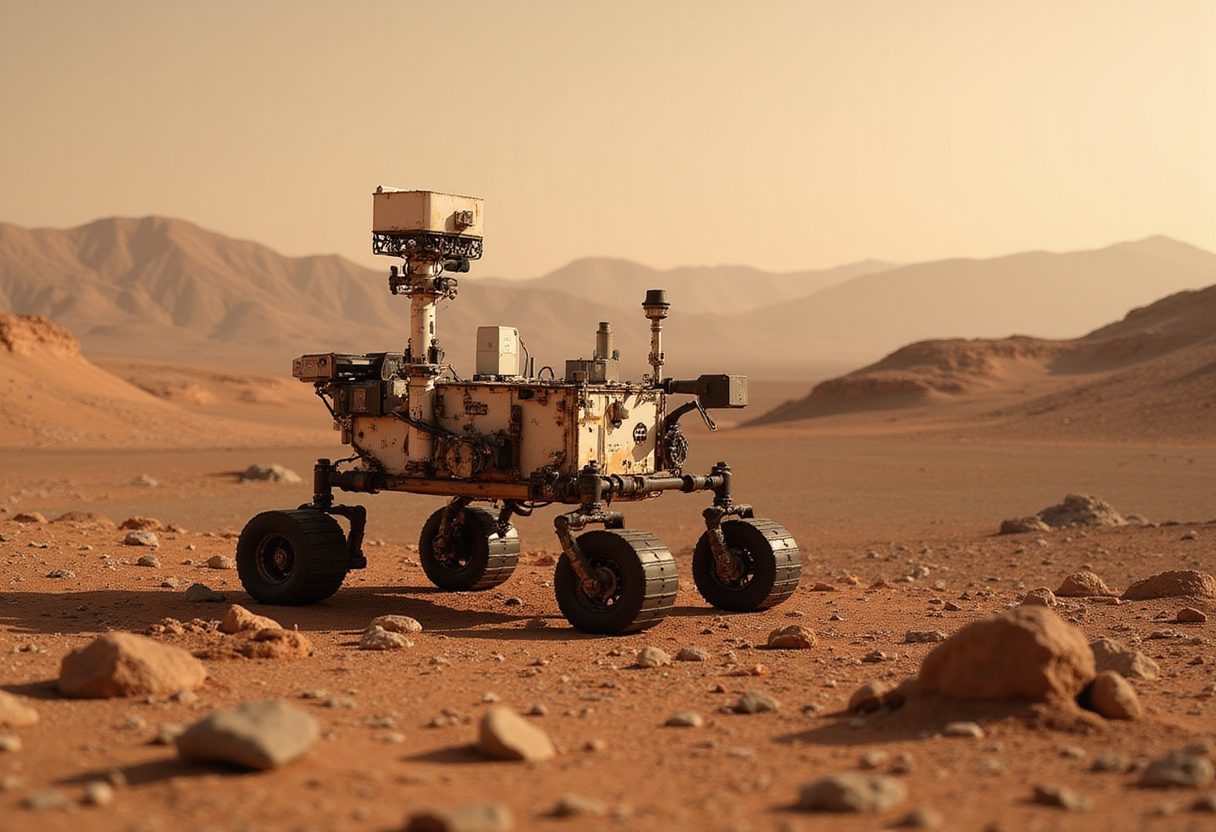
NASA's Curiosity rover logged its 5,000th sol on August 30, 2026, transmitting twin panoramas from a sandy ridge nicknamed Chocolatal that mission engineers stitched into a single colorized postcard of Gale Crater, in imagery NASA released on September 30, 2026.
The count puts Curiosity among the longest-running surface missions ever flown on another planet. A sol runs 24 hours and 39 minutes, so 5,000 sols equal roughly 5,137 Earth days of accumulated operations since the rover's arrival. For mission teams tracking the health of nuclear-powered rovers, that figure is the headline.
How did the two panoramas become one?
Curiosity's navigation cameras, which normally record in black and white, shot the first panorama at 9:56 a.m. local Mars time on August 30, 2026. That timestamp made the frame Curiosity's 5,000th sol. A second panorama arrived at 5:39 p.m. local Mars time on September 2, 2026, on sol 5,003.
On Earth, image processors merged the two scenes into one view. They added color afterward as artistic interpretation, blue for the morning half and yellow for the afternoon. The recipe matches a Curiosity postcard NASA released in November 2021.
The two-time-of-day combination surfaces shadow detail a single exposure would have lost. Two stitched exposures remain the quicker path to readable terrain than waiting for a single perfect lighting window on Mars.
What parts of the rover appear in the frame?
The composite foreground displays recognizable hardware:
- Curiosity's cylindrical UHF antenna near the front of the deck. Engineers use that antenna to send data to spacecraft orbiting Mars.
- The finned Multi-Mission Radioisotope Thermoelectric Generator (MMRTG) at the rear, which serves as the rover's nuclear power source.
- Curiosity's wheel tracks cutting away across the Martian terrain, confirming the sandy character of the Chocolatal ridge stop.
The undegraded appearance of both the antenna and the MMRTG at sol 5,000 confirms the long-life hardware is performing as designed, and gives engineers a fresh visual baseline for any future MMRTG redesign.
Why does the sol count matter?
Mission teams track sols rather than Earth days because sols drive the rover's daily planning cycle. Lighting, thermal cycling, and uplink windows all reference the local 24-hour-39-minute clock. Reaching sol 5,000 with all systems nominal sets a new endurance marker for MMRTG-driven platforms on the Martian surface.
The number tells engineers that the radioisotope source, the wheel actuators, the navigation cameras, and the UHF relay chain are all still inside their original design margins at year five on the surface. That margin matters for any future MMRTG payload planning a comparable campaign.
Where is Curiosity working?
The rover now explores the lower foothills of Mount Sharp, a mountain rising 3 miles (5 kilometers) inside Gale Crater. From that position, the panorama looks downhill toward the crater floor.
The distant rim of Gale Crater sits faintly along the horizon, hinting at the scale of the impact basin that Curiosity has called home since touchdown.
NASA's Jet Propulsion Laboratory, managed by Caltech in Pasadena, California, designed and built Curiosity. JPL operates the mission for NASA's Science Mission Directorate in Washington as part of NASA's Mars Exploration Program portfolio.
For mission planners benchmarking endurance, the practical reference is now set: 5,000 sols of unbroken operations from a single MMRTG-driven platform is the working baseline for any future nuclear-powered Mars rover.
via scitechdaily.com (Original)
More from Marcus Bennett
Show full bio
News editor covering regulation, policy and their impact on general science news at SciBeat.
243 articles
Nearby plates
- Mars Express Releases 4-Minute Aerial Tour of 460-km Schiaparelli Crater
- Smile Mission Delivers First Ultraviolet Footage of Earth's Full Aurora Ring
- Mars Express Images Purple Ice Cliff Towering Over 1 Kilometre
- Perseverance rover uncovers three water histories in Jezero Crater
- Smile Mission Opens Its Eyes on Space Weather Science