Plate Nº 19 · recorded October 13, 2026
Space & AstronomyReported finding
Thousands of Tiny Robots Have a Blind Spot Problem
A new telescope simulator finds three robot-design rules — tighter fiber spacing, longer reach, smaller safety gaps — that could stop surveys from skipping galaxies in crowded clusters.
By James Calloway4 min read729 words
In brief
- Future survey telescopes plan to use more than 20,000 tiny fiber-positioning robots at once.
- The study, led by Ummee T. Ahmed et al., was published in the Astronomical Journal in 2026 (DOI: 10.3847/1538-3881/ae9d7a).
- Highest fiber density — smallest pitch — delivered the best survey completeness and allocation efficiency.
- Extending a robot's patrol radius helped more than shrinking its exclusion radius.
- The simulator tracks allocation efficiency and survey completeness across repeated virtual sky visits.
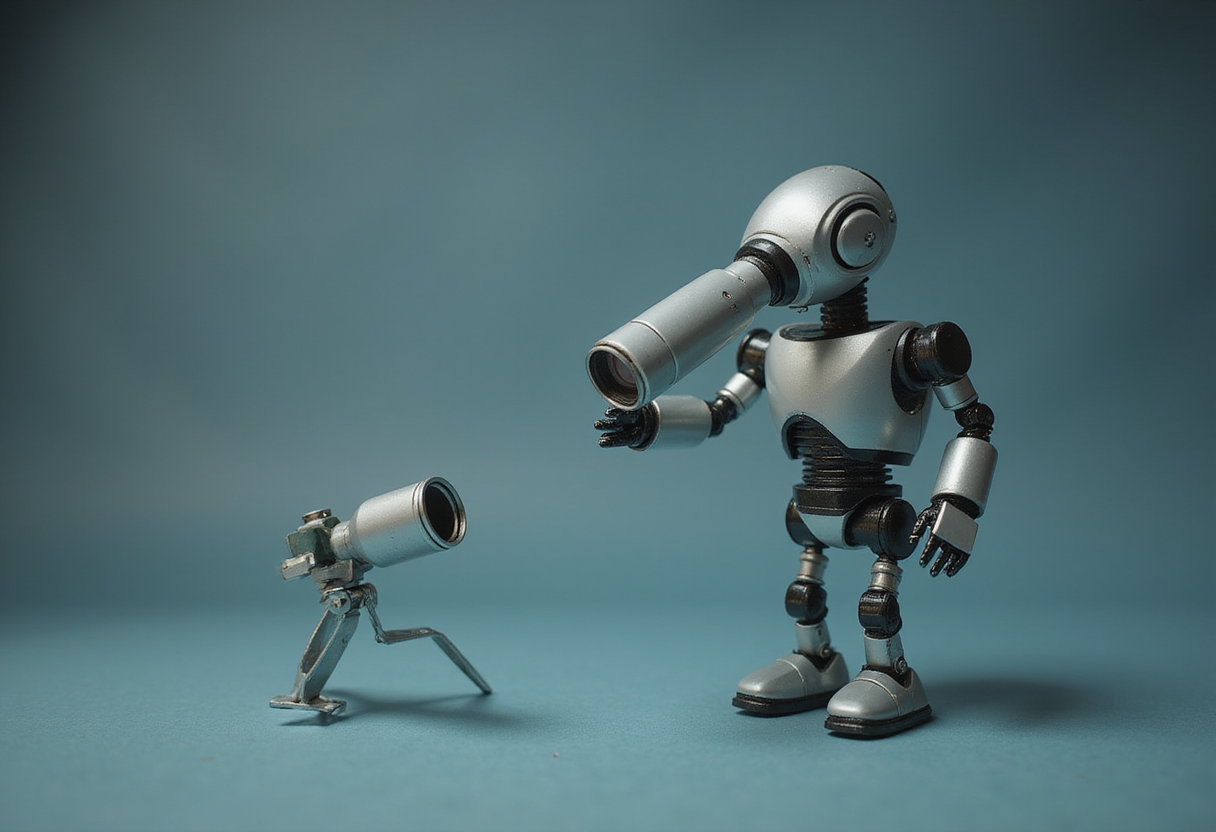
A computer tool published in the Astronomical Journal in 2026 shows why modern survey telescopes can miss entire galaxies, and it found three design rules that could stop that from happening.
The tool came from a study led by Ummee T. Ahmed and colleagues, titled "Modeling the Technical Specifications for Future Multiobject-spectroscopy Instrumentation." It's a simulator. Think flight simulator, but for telescopes that haven't been built yet.
Here's the problem it attacks. Modern sky surveys don't stare at one star at a time. They scan huge patches of sky, repeatedly, using thousands of small robots that position optical fibers — hair-thin light collectors aimed at distant stars and galaxies. Future telescopes plan to run more than 20,000 of these robots at once. Each fiber feeds a device called a multi-object spectrograph, which splits the light into its colors. That split reveals what a galaxy is made of and how far away it sits.
But the robots have elbows, metaphorically speaking.
Why do the robots miss galaxies?
The robots can collide. In dense galaxy clusters, where targets sit practically shoulder to shoulder, the machines run out of room. The system's answer is to skip some galaxies rather than risk a crash. Skipped galaxies become blind spots. Feed biased data like that into a cosmic map, and the map can quietly mislead you about how galaxies grow and how the universe changes over time.
Engineers already control this with three settings: the spacing between robot bases (the pitch), how far each robot can reach around its base (the patrol radius), and the minimum gap two robots must keep to avoid touching (the exclusion radius). What nobody had cleanly tested was how those three knobs trade off against each other before a telescope ever sees first light.
The new software does exactly that. It mimics repeated visits to the sky, moving virtual robots to park their fibers on targets, then tracks two numbers: allocation efficiency, meaning how well the system assigns fibers to targets, and survey completeness, meaning how many total galaxies get observed over time. The team ran the tests against specifications from real telescopes.
Three rules fell out of the results.
- Shrink the pitch — pack fibers more densely — and you get the best completeness and efficiency. This was the strongest effect.
- With pitch fixed, extend each robot's patrol radius. This is the second-best lever for improving fiber assignment.
- Tighten the exclusion radius, the safety gap. This helps too, but less than extending reach.
The ordering matters. Not every parameter is equally worth fighting for.
What does this change for astronomy?
In practice, it moves an argument earlier in the pipeline. Astronomers set science goals; engineers face hardware limits; the two sides often discover the mismatch late, when changes cost real money. The study's authors put it plainly: engineers can use this code to test ideas for future instruments before spending millions of dollars building them. A proof-of-concept simulator is not a telescope, and the paper itself frames the work as preliminary groundwork rather than a finished design guide. Still, the three rules are testable claims now, not guesses.
There's a caveat worth sitting with. The tool is a model, and models simplify. The study tested robot systems against simulated targets using real telescope specifications, which is a strong start but not the same as years of on-sky operations. Wear, calibration drift, and software failures in the wild may add blind spots the simulator doesn't yet capture.
The bigger point survives the hedging. Astronomers have cataloged billions of stars and hundreds of billions of galaxies, and found thousands of planets beyond the solar system. But the universe still holds objects too faint, too far, or too crowded to study easily. A picture of a galaxy tells only part of its story, and even the best telescopes carry mechanical blind spots the pretty images never show.
Future maps of the cosmos, in other words, depend on more than giant mirrors. They depend on software that catches what the hardware would drop. Sometimes mapping the whole universe starts with getting thousands of tiny robots to move in exactly the right way — and with knowing, before you build, which ones they'll bump into.
The paper appears in The Astronomical Journal (2026), DOI: 10.3847/1538-3881/ae9d7a.
via Phys.org Space & Astronomy (Source)
More from James Calloway
Show full bio
Staff writer covering regulation, policy and their impact on general science news at SciBeat.
224 articles
Nearby plates
- AI and the Largest 2D Map of the Universe Uncover 70 New Gravitational Lenses
- Simulations Trace First Stars to Chemical Clues in Today's Universe
- NASA's Roman Telescope Will Image 100× More Sky Than Hubble
- Newton's gravity law passes largest test yet, dark matter gains ground
- NASA's Roman Telescope Will Survey 200 Times More Sky Than Hubble