Plate Nº 92 · recorded November 12, 2026
Biology & EvolutionReported finding
Deep-Sea Metal Nodules Are Alive With Thousands of Tiny Animals
Softball-size metal nodules on the Pacific floor host an average of 17 microscopic animals each, new research finds — a discovery with major implications for deep-sea mining.
By Elena Vasquez2 min read499 words
In brief
- A study published Wednesday in Scientific Reports found an average of 17 animals per deep-sea nodule.
- Researchers analyzed hundreds of nodules from the Clarion-Clipperton Zone in the Pacific Ocean.
- Nodule communities 1,000 km apart were more similar to each other than to nearby sediment life.
- France backs a mining ban, while Palau and Fiji have called for a moratorium.
- Nodules supply metals like manganese and copper used in electronics, solar panels and batteries.
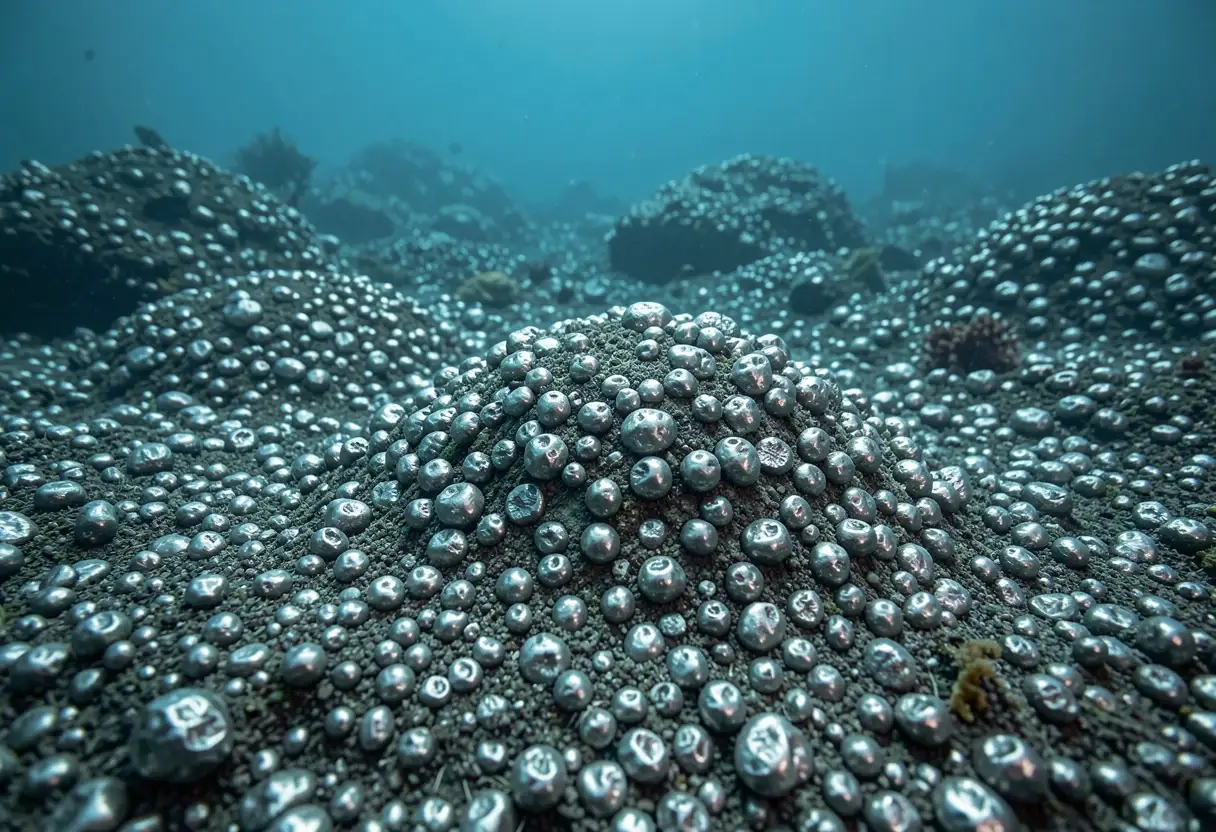
A single softball-size metal nodule on the Pacific seafloor hosts an average of 17 microscopic animals — and sometimes hundreds — according to a new study that could complicate plans to mine the deep ocean for battery metals.
The research, published Wednesday in the journal Scientific Reports, analyzed hundreds of nodules collected from the Clarion-Clipperton Zone, a stretch of the Pacific Ocean that miners consider a prime target. The crevices of those rocks held thousands of tiny creatures, including roundworms and minute crustaceans. The most common resident was a single-celled protist the researchers have named "Thurammina sp. 1."
What are polymetallic nodules?
Polymetallic nodules are small clumps of rock and metal that take millions of years to form on the deep seafloor. They're rich in manganese, copper and other metals crucial to modern electronics, solar panels and batteries. That makes them a potentially very valuable — and highly controversial — target for deep-sea miners.
The catch: researchers have long warned that plucking nodules from the ocean floor could do serious ecological damage. The new findings add a fresh wrinkle.
Why does the hidden life matter?
The study finds the nodules provide a "distinct habitat" — one that differs from the sediment surrounding them. Organisms living on nodules collected 1,000 kilometers (about 621 miles) apart resembled each other more than they resembled communities in nearby sediment, said study co-author Coral Diaz-Recio Lorenzo, a postdoctoral researcher at Sorbonne University in France.
That pattern suggests the nodules themselves may be essential for the survival of certain species, including Thurammina sp. 1. Remove the rocks, and the animals could go with them.
What does this mean for mining?
The study's authors argue the hidden biodiversity should factor directly into mining plans. Right now, few rules govern how to do this responsibly, and nations are split.
- The U.S., under President Donald Trump, has pushed to expand deep-sea mining to cut reliance on foreign mineral imports.
- Japan is considering mining in its own waters.
- France has called for a ban on the practice.
- Germany and Chile have urged a pause, while Palau and Fiji back a moratorium.
- The company Impossible Metals says it has tested an autonomous robot that uses artificial intelligence to retrieve nodules without disturbing nearby marine life.
"Our findings point out that commercial mining may result in an irreversible loss of undescribed and unique biodiversity associated to nodules," said senior author Sabine Gollner, a researcher at the Royal Netherlands Institute for Sea Research (NIOZ) and an honorary professor at the University of Groningen, in a statement. "This needs to be considered in environmental management of deep-sea mining."
The stakes are real. The animals found in the study include species that may not yet be formally described by science. Mining them could erase them before anyone has even named them.
That's the bottom line: the rocks miners want contain entire communities we barely understand, and the study's authors say losing them could be permanent.
via scientificamerican.com (Source)
More from Elena Vasquez
Show full bio
Correspondent covering money, funding and market shifts around general science news at SciBeat.
384 articles
Nearby plates
- Swimming Sea Cucumbers Intercept Sinking Carbon in the Deep Ocean
- Predator 'Alarm Scents' Predict Toxic Algal Blooms Seven Weeks Early
- Microplastics Reach Wild Mammals' Blood 40 Miles From Any Human Infrastructure
- Ultrasensitive Radiocarbon Method Reveals Hidden Quake Layers Off Japan
- 66-Million-Year-Old Feather in Dinosaur Poop Sheds Light on Bird Survival