Plate Nº 56 · recorded November 12, 2026
Biology & EvolutionReported finding
Dive Depth, Not Duration, Sets Sea Lions' Recovery Clock
A 22-year study of 800,000 sea lion dives finds surface recovery depends on dive depth, not duration, challenging an 80-year-old assumption about how diving animals recover.
By Elena Vasquez4 min read833 words
In brief
- Researchers analyzed over 800,000 dives by 374 sea lions from five species across 18 colonies.
- The study combined dive records collected over 22 years in environments from tropical to subpolar waters.
- Deeper dives led to longer surface recovery; dive duration alone had little effect after shallow dives.
- Findings were published in Proceedings of the Royal Society B: Biological Sciences (2026), DOI 10.1098/rspb.2026.1690.
- The nitrogen-offloading explanation remains hypothetical because the team did not measure nitrogen accumulation.
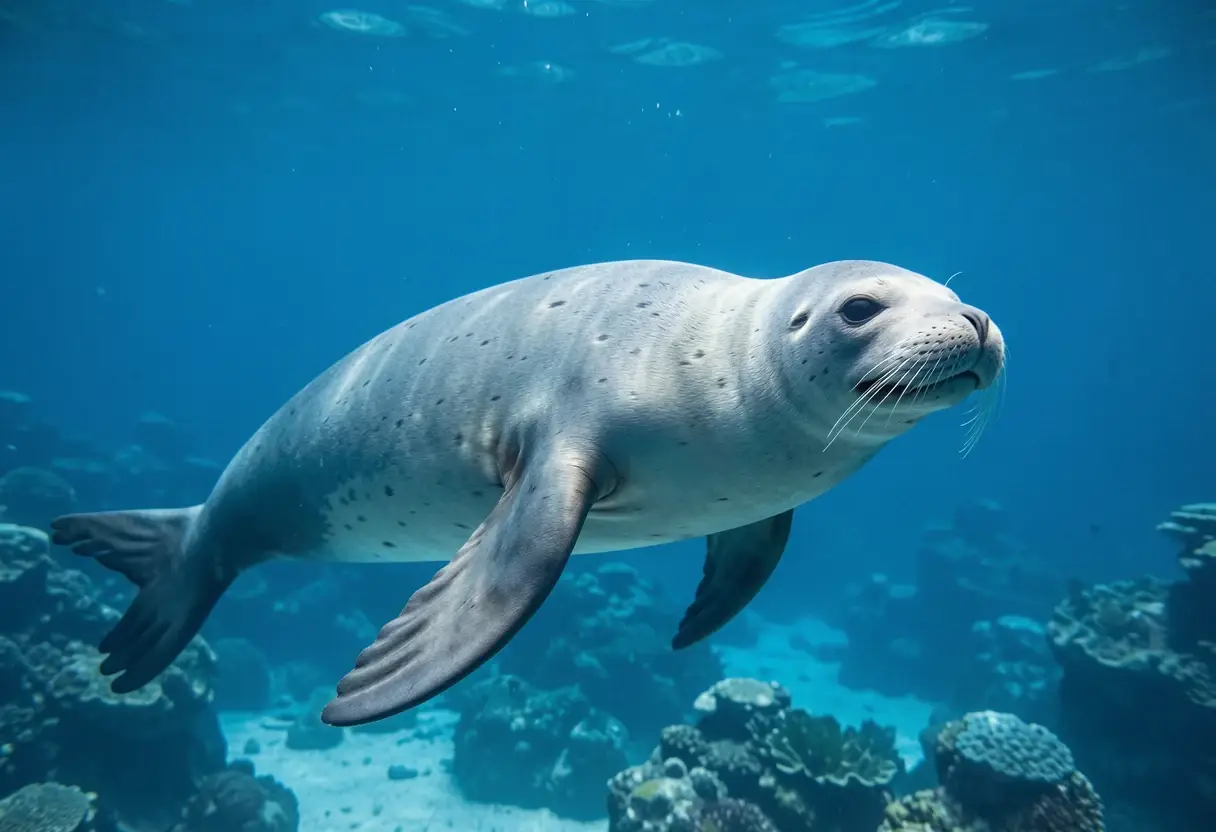
Sea lions need longer rest at the surface after deeper dives, not after longer ones. That's the central finding of a study published in Proceedings of the Royal Society B: Biological Sciences in 2026, based on more than 800,000 dives recorded from 374 animals across five species and 18 colonies worldwide.
For roughly 80 years, marine biologists assumed surface time between dives served mainly to reload oxygen, clear carbon dioxide and, past a certain effort threshold, process lactate — a waste product of energy production without oxygen. Under that view, longer foraging dives should demand longer recovery. The new data say otherwise.
"Interestingly, we hadn't originally set out to investigate what shapes the recovery time of sea lions," Jonas F. L. Schwarz, first author of the paper, told Phys.org. Schwarz and his colleagues at the University of California, Santa Cruz, Bielefeld University and other institutions were comparing diving behavior across species to understand how environment and physiology shape foraging strategies.
Then the data threw a curveball. "While exploring the data, I noticed that beyond a certain dive duration, the time animals spent at the surface suddenly increased," Schwarz said.
What did the researchers find?
At first, the team read that jump as the so-called aerobic dive limit — the point beyond which dives rely increasingly on oxygen-free energy production, pushing lactate levels up in the blood and, in theory, forcing longer recovery.
The numbers refused to cooperate. "The more I looked into it, the less sense the numbers made," Schwarz said. "Eventually, I realized that this apparent threshold was simply the point where shallow dives became increasingly rare, as longer dives tended to be deeper."
That insight forced a separation of two tangled variables: depth and duration.
The team combined dive records gathered in different countries over the past 22 years, spanning marine environments from tropical to subpolar waters. Each sea lion carried a small recording device that measured pressure — and therefore depth — every four seconds. From these logs, researchers extracted maximum depth, time underwater and surface recovery time, then fed the data into statistical models that accounted for differences between individuals and species.
The result: deeper dives, where animals experience greater pressure, were followed by longer recoveries. Duration alone had little effect after shallow dives, gaining influence only at greater depths.
"While individual parts of the pattern, like the linear relationship of depth and recovery time, can actually have different explanations, the pattern as a whole demonstrates that time spent under pressure, rather than metabolic recovery alone, is the major factor determining how long sea lions need to recover between dives," Schwarz explained.
The takeaway: depth, not dive length, sets the recovery clock.
Why might pressure matter?
The researchers' leading hypothesis involves nitrogen. Sea lions inhale before diving, carrying air down in their lungs. Greater underwater pressure, they propose, may push nitrogen from that stored air into the blood and tissues, and surface intervals may let the animals offload some of the accumulated gas.
The catch: the team never measured nitrogen directly. The explanation remains hypothetical, and the authors flag it as such — a preliminary mechanism awaiting confirmation.
What does this change?
"Our work revisits a concept within diving physiology that has been present for nearly 80 years," Schwarz said. The implications reach past physiology into ecology. Recovery time directly shapes foraging efficiency, which determines which hunting strategies are viable.
Misjudge recovery costs, and you misjudge the animals. "If we underestimate the recovery time associated with deeper dives, we risk drawing the wrong conclusions about the trade-offs animals face, which foraging strategies are most profitable and how they might respond to changes in their environment," Schwarz explained.
The study covers sea lions — eared seals — and the findings may or may not transfer to other divers. Schwarz is already expanding the dataset to test that, adding fur seals, true seals and penguins. Fur seals are close relatives with similar dive physiology; true seals are more distant and differ sharply, for instance by exhaling before a dive; penguins aren't related to seals at all but share the habit of diving with air in their lungs.
That comparison doubles as a nitrogen test. Animals that dive with full lungs should show the pressure effect if nitrogen is the culprit; animals that exhale first shouldn't.
"I want to find out how widespread this recovery pattern is among marine predators and why some species might show it while others do not," Schwarz said. "By comparing animals that dive with air in their lungs with those that exhale before diving, I also hope to find further evidence for whether nitrogen is responsible for the pattern we observed."
The next dataset, in short, should reveal whether sea lions are the rule or the exception.
Publication details: Jonas F. L. Schwarz et al., "Depth sets the recovery clock: evidence for a time-at-pressure effect in sea lions," Proceedings of the Royal Society B: Biological Sciences (2026). DOI: 10.1098/rspb.2026.1690.
via phys.org/rss-feed/ (Source)
More from Elena Vasquez
Show full bio
Correspondent covering money, funding and market shifts around general science news at SciBeat.
384 articles
Nearby plates
- Swordfish Dive Over 1,000 Meters — Possibly to Navigate the Ocean
- Swimming Sea Cucumbers Intercept Sinking Carbon in the Deep Ocean
- Study backs a mostly underwater life for giant Spinosaurus
- Southern Ocean Weakened Carbon Storage and Fueled Eocene Heat
- Fish Evolved Schooling 60 Times—and Lost It 320 Times