Plate Nº 63 · recorded November 10, 2026
Biology & EvolutionReported finding
Fish Evolved Schooling 60 Times—and Lost It 320 Times
Fish gained schooling behavior about 60 times over 350 million years and lost it some 320 times, a machine learning study of 2,839 species reveals.
By Nathan Brooks4 min read810 words
In brief
- Fish species independently evolved schooling about 60 times and lost it roughly 320 times over 350 million years.
- The study, published Nov. 6 in PNAS, quantified schooling in 2,839 species—nearly 10% of ~39,000 living fish.
- Schooling lineages generate new species at a higher rate than non-schooling lineages.
- Species lower in the food chain are more likely to school, though the correlation isn't absolute.
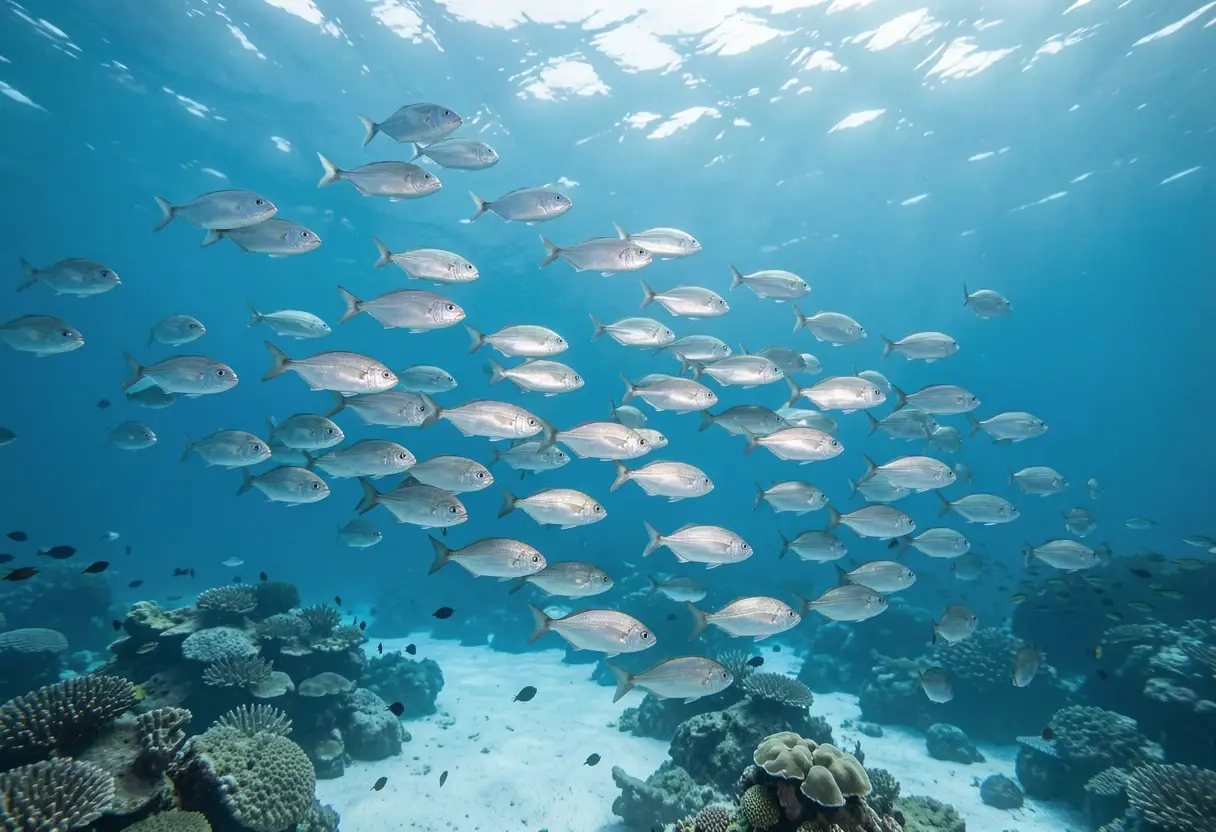
Fish species independently evolved the ability to swim in schools about 60 times over the last 350 million years—and lost that ability roughly 320 times, according to a study published Nov. 6 in the Proceedings of the National Academy of Sciences.
The finding flips a long-standing assumption on its head. Experts expected losses of collective behavior to be rare. The data say otherwise.
"There were hundreds of examples across the tree where a lineage that engaged in collective movement left a daughter species that was solitary," said Andrew Hein, senior author and associate professor of computational biology in Cornell's College of Agriculture and Life Sciences. "If you had asked me or other evolution of behavior experts before this study, we'd tell you that losses of collective behavior are probably very rare, but that's simply not true."
Jay Love, a postdoctoral researcher in Hein's lab, is first author of the paper. The authors describe it as one of the largest studies ever conducted on the evolution of any behavior in any group of species.
How do you measure schooling across thousands of fish?
Previous research on collective behavior—fish schooling, birds flocking, even fans starting a wave in a stadium—typically covered one or two species at a time, adding up to a few dozen in total. Nobody had found a way to scale that up.
Machine learning changed the equation. The team trained a text transformer—the same technology behind large language models—to read scientific descriptions of species and encode them as numbers. Those numbers let the researchers estimate whether a given species engages in collective movement.
For images, the researchers applied a series of machine learning techniques to photos and videos from iNaturalist and other citizen science sources. The algorithms converted the visuals into three dimensions, tracked the direction individual fish were heading, and paired alignments to determine whether fish moved as a group.
In total, the team quantified schooling behavior—an observable trait scientists call a phenotype—for 2,839 species. That's nearly 10% of the roughly 39,000 living fish species.
"The study shows us that behaviors, which we often think of as very flexible and difficult to quantify, can be studied at this large evolutionary scale, in part with the help of these new machine learning methods," Hein said.
Why do fish school in the first place?
The dataset let the researchers test two classic hypotheses about why collective movement evolves.
The first is predator defense—safety in numbers. "One is that it's related to predator avoidance or collective defense, and that's never been broadly tested," Love said. The team examined where schooling species sit in the food chain, expecting prey species with many predators to school and top predators to go solo.
The pattern held, but loosely. "There, in the data, species that are lower in the food chain are more likely to engage in collective behavior," Hein said. Still, many species low in the food chain don't school, and many near the top do—so multiple factors are clearly at work.
The second hypothesis concerns finding scarce resources. "It would make sense to follow your neighbors around if they are eating the same thing," Love said. The data support this too: predators that move in groups virtually all eat prey that also move in groups, Hein said.
More species, but what's the catch?
The researchers also found that lineages where all species school are far more diverse, generating new species at a higher rate than non-schooling lineages.
"We don't know if the speciation rate is higher or the extinction rate is lower, but we know that through a combination of those two things, we have more species being generated," Love said.
That raises the obvious question: why would lineages lose schooling so often? The researchers don't have a definitive answer, but they point to possible costs of collective life:
- Misinformation. A skittish fish that darts away on a false alarm can scatter the whole group—a fish-scale echo chamber.
- Competition. When food is limited, moving and eating as a group may not pay off.
- Disease. "If you live in groups, you're around lots of other individuals that are susceptible to similar diseases as you are, and that could be exerting some sort of major evolutionary force," Hein said.
The findings are preliminary in places—the cause of the 320 losses remains open, and the mechanisms behind speciation rates need more work. But the study demonstrates something bigger: behaviors, long considered too slippery to measure, can now be tracked across entire branches of the tree of life.
The paper: Jay Love et al., "Evolutionary dynamics of collective behavior across the tree of ray-finned fishes," Proceedings of the National Academy of Sciences (2026). DOI: 10.1073/pnas.2611720123.
via phys.org/rss-feed/ (Source)
More from Nathan Brooks
Show full bio
Market editor covering companies, deals and strategy in general science news at SciBeat.
325 articles
Nearby plates
- Two Finland eagle populations grew 9% a year — but differently
- Dive Depth, Not Duration, Sets Sea Lions' Recovery Clock
- Genes, Not Colony Life, Steer Cory's Shearwater Migration
- Fish thrive in urban waters, but their genes tell a different story
- Elephants synchronize rumbles during group decisions, study finds