Plate Nº 14 · recorded October 9, 2026
Biology & EvolutionReported finding
Fish thrive in urban waters, but their genes tell a different story
Okinawa damselfish show no visible signs of urban stress, yet 1,010 genes across two life stages tracked human activity, hinting at a 'junk food effect' on coastal reefs.
By Nathan Brooks3 min read680 words
In brief
- Researchers identified 425 genes in juveniles and 585 in adults linked to urbanization in blue damselfish across 18 Okinawa sites.
- Less than 40% of Okinawa's coastline remains natural and unaltered.
- The study was published in Nature Communications (2026); DOI: 10.1038/s41467-026-77751-2.
- The team compared wild urban fish to laboratory fish fed under different conditions to test the 'junk food effect' hypothesis.
- The research was led by OIST, CNRS and the Indiana University School of Medicine.
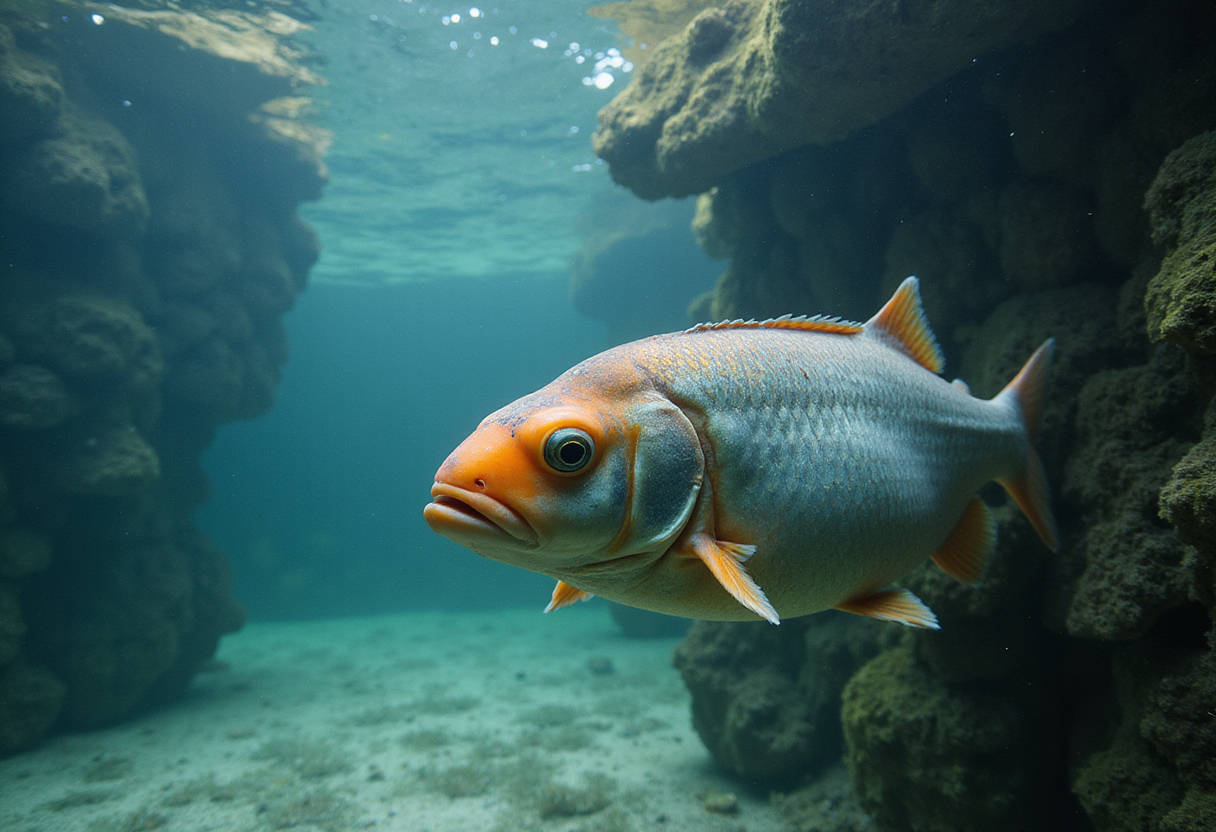
A genome-wide analysis identified 425 genes in juvenile and 585 in adult blue damselfish (Chrysiptera cyanea) whose activity tracked urbanization across 18 coastal sites on Okinawa's main island. The findings appear in a 2026 Nature Communications study led by an international team.
What did the researchers find?
Scientists at the Okinawa Institute of Science and Technology (OIST), the French National Centre for Scientific Research (CNRS) and the Indiana University School of Medicine collaborated on the work. They sampled fish from sites ranging from nearly pristine northern reefs to heavily urbanized southern coastlines.
Less than 40% of Okinawa's coastline remains natural and unaltered. Young coral reef fish spend their early lives in calm, shallow waters close to shore, exposing them to runoff, pollutants and other human impacts during a critical life stage.
What does gene activity reveal that traditional monitoring cannot?
"Classic methods of ecological and environmental monitoring involve water sampling or counting the number of fish species, but this doesn't really tell us about the health of the fish," said first author Emma Gairin, a research fellow and former Ph.D. student in OIST's Marine Eco-Evo-Devo Unit. "To know what the fish is experiencing, looking at gene activity is key."
The team sequenced RNA from fish livers, a tissue that reflects metabolism, immune function and environmental responses. Sequencing RNA, the molecular messenger cells produce from active genes, lets researchers measure how strongly each gene is switched on at a given moment. They compared activity patterns across thousands of genes against environmental variables including temperature, salinity and urbanization level.
Standard pollution-marker genes failed the test. Their activity often reflected temperature or diet, not human impact. Only when researchers examined the entire genome did a clear urbanization signal emerge.
Why might fish prefer polluted waters?
The gene-activity data suggest an answer. Urbanized sites may contain more organic matter, making food abundant and easily accessible for young fish. Adult fish from urban areas showed gene patterns resembling those of well-fed laboratory fish. Yet these same fish also displayed elevated inflammation and immune responses, hinting at a hidden cost.
"We suggest this is a 'junk food effect,'" said Vincent Laudet, head of OIST's Marine Eco-Evo-Devo Unit and senior author of the study. "It's like teenagers going to a fast-food chain: there is plenty to eat, it is cheap, but it may not be good for their health."
The finding may help resolve a long-standing question in reef ecology: why young fish settle in visibly degraded coastal areas when cleaner habitats lie nearby.
Could animals themselves become environmental sensors?
The researchers argue their approach could complement water-quality testing by tapping organisms as integrated recorders of their surroundings.
"What is exciting here is that instead of simply measuring the environment around an animal, we can ask the animal itself what it has experienced," Laudet said. "Genome-wide gene activity integrates the many different environmental influences acting on an organism and can reveal physiological effects that remain invisible when we measure water quality or simply count which species are present. There is no reason why this approach should be limited to fish or coral reefs. In principle, any animal, in any ecosystem, could become a living sensor of environmental change."
Gairin added: "Some of the sites we were sampling were really dirty and polluted, but still, there they were. Just because they are present doesn't mean they're not under stress."
What are the limits?
The study examined one species on one island. Whether the same gene signatures appear in other reef fish, or in other ecosystems, remains untested. The "junk food" interpretation rests on a comparison between wild urban fish and laboratory-fed fish, which cannot capture every variable wild fish encounter, including predators, disease and microplastic exposure. Still, the results point to chronic physiological costs that conventional population surveys would miss entirely.
The paper, "Landscape transcriptomics reveals ecological constraints on fish under anthropogenic coastal change," appears in Nature Communications (2026). DOI: 10.1038/s41467-026-77751-2.
via Phys.org Biology (Source)
More from Nathan Brooks
Nearby plates
- 3D genome reshuffling may explain cephalopod brain complexity
- Fossil Teeth Suggest Some Dinosaurs Grazed on Seaweed
- Underwater Umbrellas Helped Florida Corals Survive Record Heat Stress
- Baby Whales Are Washing Up Dead in Argentina, and Scientists Are Racing to Find Out Why
- Rising Seas Threaten the World's Migratory Shorebirds