Plate Nº 59 · recorded September 30, 2026
Biology & EvolutionReported finding
Fossil Teeth Suggest Some Dinosaurs Grazed on Seaweed
Chemical fingerprints in fossil tooth enamel suggest coastal dinosaurs, crocodiles and turtles supplemented their diets with seaweed washed ashore, mirroring modern coastal food webs.
By Marcus Bennett4 min read786 words
In brief
- Researchers found elevated carbon isotope values (δ13C) in tooth enamel of coastal dinosaurs, crocodiles, turtles and fish from deposits roughly 113–96 million years old.
- The pattern points to marine subsidization—ocean food washing ashore—identified in prehistoric ecosystems for the first time, likely involving seaweed.
- Tenontosaurus tilletti lacked the marine signal, indicating the high δ13C values reflect diet rather than post-burial chemical alteration.
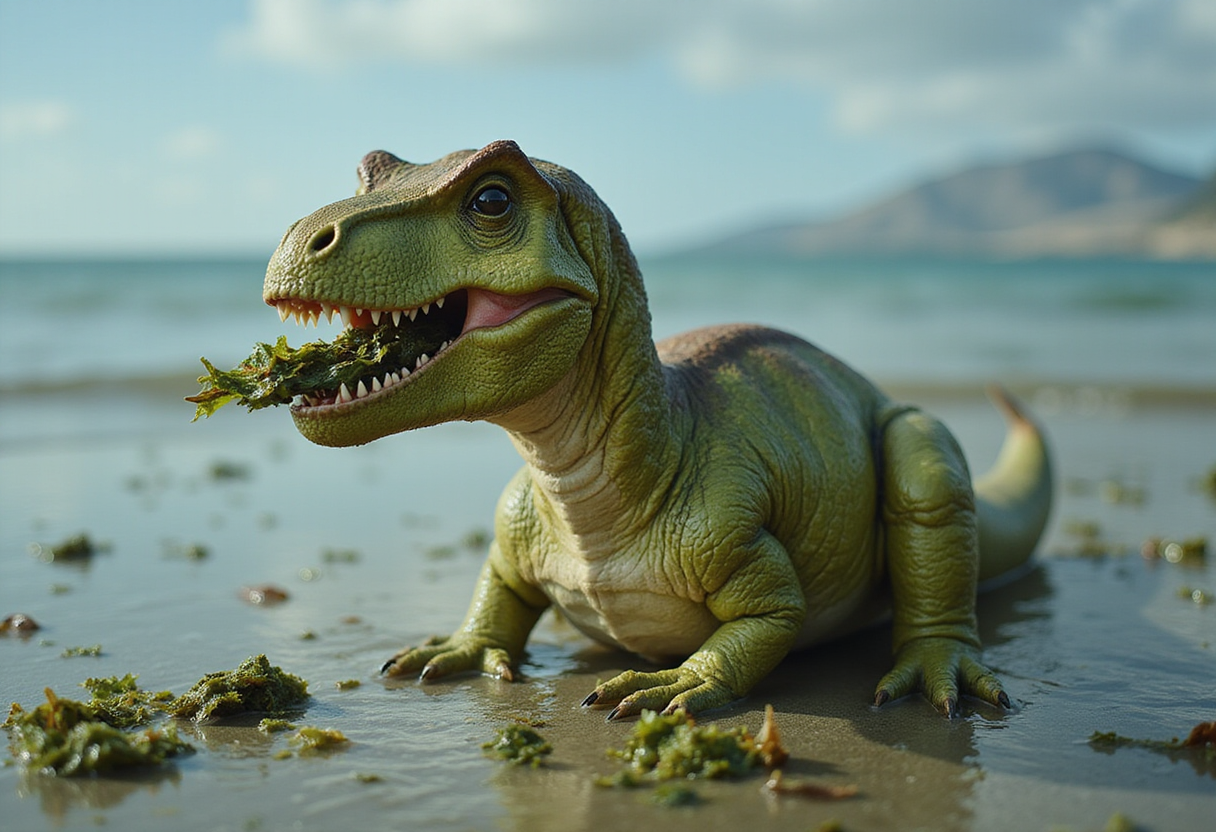
Some dinosaurs may have wandered onto prehistoric beaches to snack on seaweed, according to a new study published in Frontiers in Ecology and Evolution. Chemical traces preserved in fossil teeth suggest that coastal dinosaurs, crocodiles, turtles and fish all drew part of their diet from the ocean, in a pattern scientists see among coastal animals today.
The finding concerns a process called marine subsidization. Storms routinely wash marine material ashore, and land animals feed on it. This food delivery service matters most when land ecosystems produce less food than usual, for example during droughts. Today it is common in coastal ecosystems worldwide. The new study is the first to identify it in prehistoric ecosystems.
"We show that coastal terrestrial organisms in the greenhouse climates of the Cretaceous relied on marine resources to supplement their diets in a similar way that modern organisms do," said first author Dr. Clayton Forster, a geologist at the University of Arkansas. "We can identify that marine resources are passed along the food chain and incorporated in the minerals of bones and teeth of dinosaurs, crocodiles, turtles and fish."
Mystery in the teeth
The evidence comes from carbon isotopes—versions of carbon atoms with slightly different weights. Plants contain both "light" carbon (C-12) and "heavy" carbon (C-13), and the ratio between them, expressed as δ13C, acts as a chemical fingerprint. That fingerprint passes from food into the body of whatever eats it. In tooth enamel, the δ13C value sits higher than in the food itself. In living animals, this difference amounts to 11–13 parts per thousand.
Dinosaur teeth told a stranger story. The difference between their enamel and their food has consistently measured higher than expected. Their δ13C values were also higher than expected for animals eating only land-growing plants, which carry lower δ13C values than most marine plants. If dinosaurs—or the animals they preyed on—ate marine matter, that discrepancy could be explained.
"By determining the carbon isotope composition of dinosaur, fish and crocodile tooth enamel, we can determine what their primary dietary source was and if they were different between regions," Forster explained.
The team analyzed fossils from sites that once lay along the Western Interior Seaway—a vast inland sea that split North America into two landmasses around 100 million years ago—and along the ancient Gulf of Mexico coastline. They also examined fossils from landlocked sites. These deposits formed either during the early Albian, roughly 113–107 million years ago, or the early Cenomanian, approximately 100–96 million years ago. Grinding the fossils into powder allowed the researchers to measure isotopic composition across both time intervals and to determine the latitudes at which the animals lived.
The results were clear. Fossils from coastal sites carried higher δ13C values than fossils from the landlocked formation. The pattern held across all coastal sites, regardless of latitude or age.
The seaweed suspect
"Coastal-dwelling organisms must have eaten some kind of organic matter from the ocean, or prey that had done so," Forster explained. "This pattern is shared from fish to megaherbivores and indicates that the extra carbon source must have been low in the food chain to affect both aquatic and terrestrial animals."
The source also had to be an organism that lived in coastal but not inland habitats, and one that stayed available over many millions of years.
"Few organisms meet these criteria besides marine macroalgae or macrophytes—seaweeds," Forster said. "Given the almost ubiquitous behavior of large coastal herbivores today to supplement their diet with seaweeds, it's likely that most of the sampled herbivorous dinosaurs were no different."
Not every dinosaur joined the beach buffet. Tenontosaurus tilletti, a large herbivore found across many Cretaceous locations, showed δ13C values similar to living animals that eat land-growing plants. That distinction matters. Because some dinosaurs show the marine signal and others do not, the higher δ13C values likely reflect genuine dietary preferences rather than geological processes that altered the chemistry of tooth enamel after death.
The study has limits. It lacks data from polar and equatorial latitudes during the early Albian and early Cenomanian. Whether marine subsidization was common at other latitudes, or in other periods such as the Jurassic or the early Cenozoic, remains an open question for future research.
Still, the takeaway is a broad one about how ecosystems connect.
"Our study emphasizes the connections between terrestrial and marine ecosystems," Forster concluded. "They are deeply intertwined and have been for hundreds of millions of years. It highlights the importance of environmental linkages across time and space and protecting them where they exist today."
Publication details: Marine Subsidization of Dinosaurian Ecosystems, Frontiers in Ecology and Evolution (2026). DOI: 10.3389/fevo.2026.1895247
via Phys.org Biology (Source)
More from Marcus Bennett
Nearby plates
- Africa's Underwater Meadows Need Urgent Protection, Scientists Warn
- Ancient Ocean Chemistry Kept Earth Breathing, Study Finds
- Insects Keep Vertebrates Alive as Food, Medicine and Home Builders
- Meteorite Sugar May Have Shaped Early Earth's Chemistry
- Animals May Have Evolved 200 Million Years Earlier Than Thought