Plate Nº 83 · recorded November 13, 2026
Reported finding
Warming Oceans Are Rewiring the Menu of the Sea's Base Layer
Dinoflagellates make up 54.4% of Arctic copepod diets, a new isotope study finds, revealing how warming-driven nutrient shifts are reorganizing the base of the marine food web.
By James Calloway3 min read686 words
In brief
- Dinoflagellates made up 54.4 ± 10.5% of copepod basal diets in the Bering Strait and Chukchi Sea.
- In tropical Pacific waters, heterotrophic bacteria contributed 30.6 ± 5.3% and N₂-fixing bacteria 19.6 ± 5.8% of the copepod diet.
- Nitrates supplied an estimated 91.4 ± 2.3% of nitrogen supporting microalgae in the Pacific Arctic.
- The study, led by Professor Kyung-Hoon Shin of Hanyang University, was published in Science Advances (DOI: 10.1126/sciadv.aed3966).
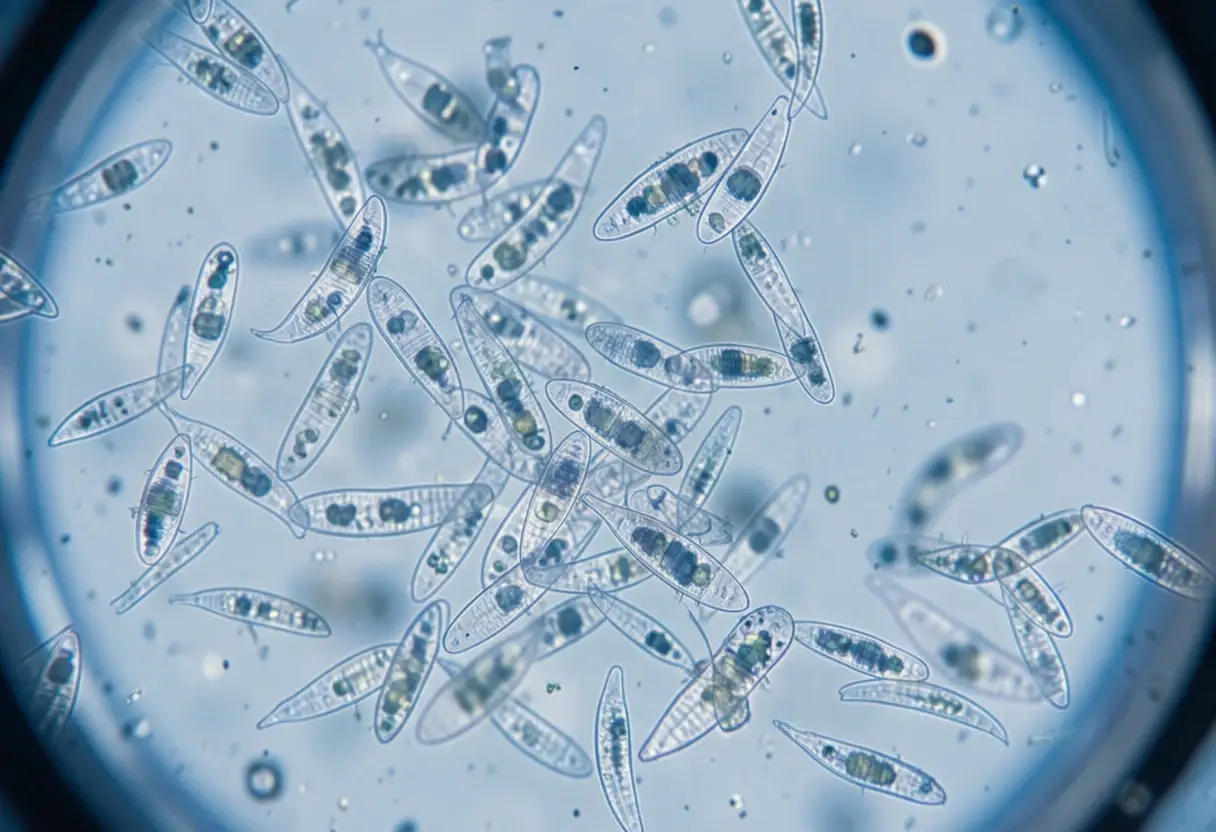
In the Pacific Arctic, dinoflagellates — a kind of single-celled algae — make up 54.4% of the diet of a zooplankton that feeds much of the ocean's fish and seabird life. That's the headline finding of a new study in Science Advances, and it comes with a warning: warming is quietly restructuring who eats what at the bottom of the marine food web.
Researchers led by Professor Kyung-Hoon Shin of Hanyang University in South Korea sampled the copepod Calanus spp. across a huge stretch of the western North Pacific, from tropical waters all the way to the Bering Strait and the southern Chukchi Sea, during summer and autumn. Copepods are tiny crustaceans. Fish and seabirds eat them in enormous quantities, which makes them a useful window into what's actually fueling the food chain.
How do you read a plankton's diary?
You check its chemistry. The team used a dual-isotope approach — measuring carbon and nitrogen isotope ratios in essential amino acids from copepod tissue. Isotopes are atoms of the same element with slightly different weights, and different food sources leave distinct isotope signatures, something like a dietary fingerprint. From those fingerprints, the researchers estimated which basal food sources — the microscopic producers and bacteria at the very base — were feeding the copepods, and which nitrogen sources supported the microalgae themselves.
Shin's objective, as he put it, was "to quantify how nutrient sources and primary-producer communities shape zooplankton diets and nitrogen transfer pathways across the dynamic western North Pacific."
What did the latitudes reveal?
The short answer: the menu flips as you move north. The findings break down along clear geographic lines:
- In the tropical and subtropical Pacific, where surface waters are strongly layered and phytoplankton is scarce, N₂-fixing bacteria contributed 19.6 ± 5.8% of the basal diet, and heterotrophic bacteria — microbes that feed on organic matter rather than photosynthesizing — contributed 30.6 ± 5.3%.
- In the subarctic Pacific, bacterial contributions dropped while eukaryotic microalgae, such as diatoms and dinoflagellates, rose.
- In the Bering Strait and Chukchi Sea, dinoflagellates alone hit 54.4 ± 10.5% of the basal diet, and total eukaryotic microalgae reached roughly 80%.
The nitrogen story shifted too. Biologically fixed nitrogen dominated in the tropics, at 29.2 ± 7.9% of the nitrogen source. In the Pacific Arctic, nitrates ruled, supplying an estimated 91.4 ± 2.3%.
The researchers also report that the estimated dinoflagellate contribution correlated strongly with the protist contribution inferred from nitrogen isotope ratios — an internal consistency check that lends the numbers some credibility.
What does this change for the oceans?
Here's the mechanism, and why it matters. Warming intensifies stratification — the layering of seawater by density, where warm water sits on top and mixes poorly with colder, nutrient-rich water below. Less mixing means fewer nutrients reach the surface, and that favors small phytoplankton adapted to nutrient-poor conditions over larger algae like diatoms. Since phytoplankton feed zooplankton, and zooplankton feed fish, changes at the base cascade upward through the entire food web.
Shin doesn't hedge much on the stakes: "Our study shows how warming-driven changes in stratification and nutrient dynamics are reshaping planktonic food webs. This will have cascading consequences for marine biodiversity, biogeochemical cycling and ecosystem resilience."
Reasons for caution
Now the skeptic's part. This is a single study, sampling two seasons across one ocean basin. The isotope method is new, and the error margins — nearly six percentage points in some estimates, over ten in the dinoflagellate figure — are not trivial. Nobody has yet shown whether these Arctic copepod diets are stable over years or shifting year to year with sea ice. The authors themselves frame the work as a foundation for future investigation, not a verdict.
Still, the tool matters as much as the result. Combining carbon and nitrogen isotopes in Calanus gives scientists, in Shin's words, "a robust framework for understanding dietary records" — a way to track food webs as oceans warm, rather than guessing at them.
The study, by Hyuntae Choi and colleagues, appears in Science Advances (DOI: 10.1126/sciadv.aed3966).
via phys.org/rss-feed/ (Source)
More from James Calloway
Show full bio
Staff writer covering regulation, policy and their impact on general science news at SciBeat.
353 articles
Nearby plates
- Fossil Teeth Suggest Some Dinosaurs Grazed on Seaweed
- 35 Years of Data Reveal How Warming Is Rewiring the Marine Food Web
- Southern Ocean Weakened Carbon Storage and Fueled Eocene Heat
- Food-Chain Index Outperforms Temperature for Lobster Forecasts
- Swimming Sea Cucumbers Intercept Sinking Carbon in the Deep Ocean