Plate Nº 23 · recorded November 11, 2026
Biology & EvolutionReported finding
Swordfish Dive Over 1,000 Meters — Possibly to Navigate the Ocean
Scientists tracked 34 North Atlantic swordfish for 3,666 days and logged 39 extreme dives past 1,000 meters, suggesting the fish sample deep water for navigation cues.
By Nathan Brooks3 min read698 words
In brief
- WHOI researchers identified 39 extreme dives in 3,666 days of satellite tag data from 34 North Atlantic swordfish.
- Extreme dives exceeded 1,000 meters (3,280 feet), well below the ~600-meter hunting depth in the twilight zone.
- The study, led by Ciara Willis, was published in Marine Biology in 2026.
- Tagged swordfish migrated thousands of miles between waters off Canada and the Caribbean.
- The findings may help predict swordfish movements as ocean conditions change.
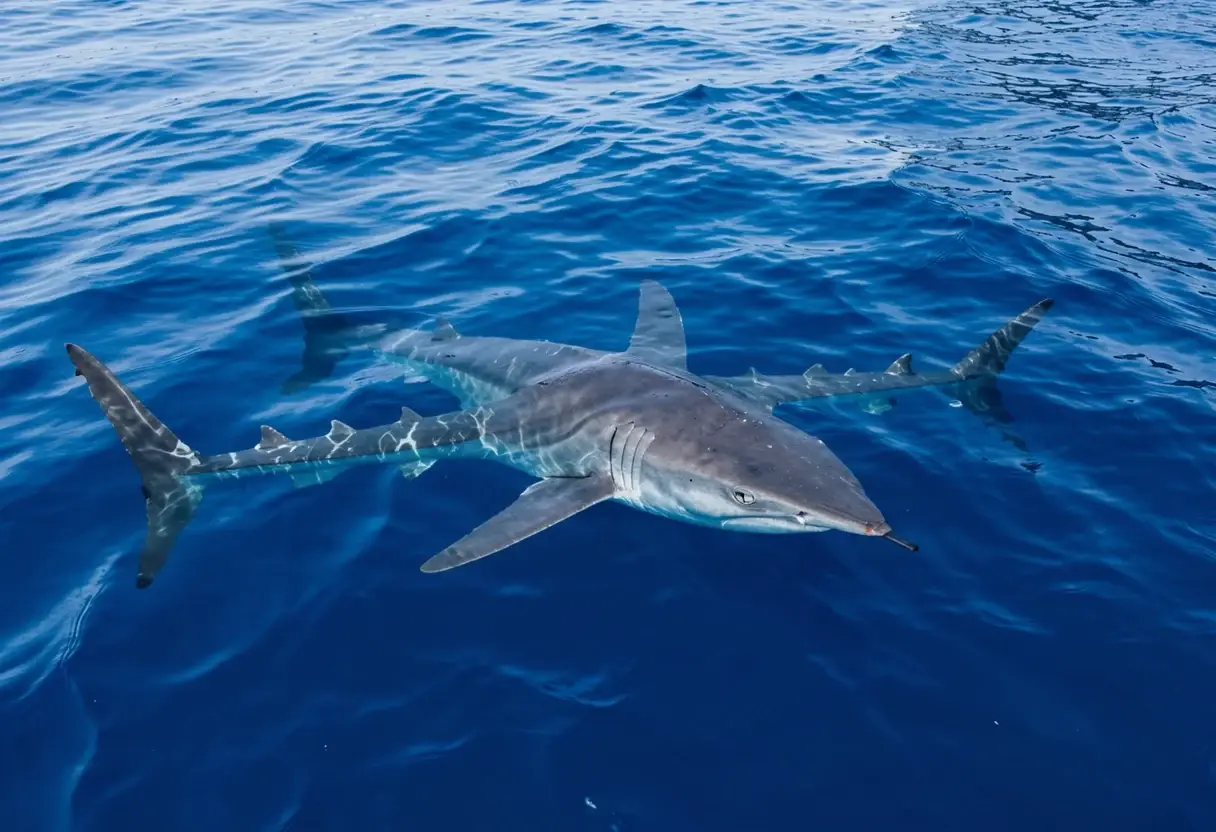
Swordfish may plunge more than 1,000 meters (3,280 feet) below the surface — nearly twice their usual hunting depth — to gather navigation cues in the open ocean. That's the central finding of a new study from the Woods Hole Oceanographic Institution (WHOI), published in Marine Biology in 2026.
Researchers tracked 34 North Atlantic swordfish with pop-up satellite archival transmitting tags, deployed for one to six months each. Across 3,666 total deployment days, the team identified 39 "extreme" dives. The fish regularly hunt around 600 meters (1,970 feet) down in the ocean twilight zone — the dim midwater layer where sunlight barely reaches — but the extreme plunges pushed well past that mark.
The study's lead author is Ciara Willis, who conducted the work as a doctoral student in the MIT-WHOI Joint Program and is now a postdoctoral investigator at the Monterey Bay Aquarium Research Institute.
Why would a swordfish dive that deep?
The researchers' working hypothesis: swordfish may be sampling their environment. By moving through different water masses and ocean features, the fish could pick up changes in ocean conditions — temperature layers, currents, eddies — that help them orient during long migrations. The tagged swordfish traveled thousands of miles, moving between waters off Canada and the Caribbean.
"They could be coming into an ocean weather system, like an eddy or a frontal system, where we have a change in water masses," Willis said. "Maybe that change in the ocean system prompts them to check out what's happening deeper in the water column — to get a sense of where they are, how deep the feature extends or answer other questions about their world that we don't even know they're asking yet."
In plain terms, an extreme dive might work a bit like a pilot descending for a better read of the terrain below.
How did the team catch such rare behavior?
Extreme dives showed up only 39 times across nearly 10 years' worth of combined tagging days — roughly one extreme dive per 94 days of tracking per fish. No single tagging operation could have produced enough data to spot the pattern.
"It wouldn't have been possible to analyze this from just a single tagging operation, or from a single lab," said Simon Thorrold, a fish ecologist at WHOI and study author. "It was necessary to pull tagging data from different studies and to begin building longer-term data sets to give us enough power to at least begin to sort of ask questions about what those dives might be for."
The data came in partnership with NOAA's Southeast Fisheries Science Center and the Massachusetts Division of Marine Fisheries. Eric Orbesen, a research fishery biologist at the Southeast Fisheries Science Center and co-author, stressed the value of pooling records over many years.
"Individual tagging projects provide important snapshots in time and space, but maintaining and combining these data sets over many years allows scientists to identify behaviors and patterns that would otherwise be very difficult to see," Orbesen said.
What don't we know yet?
Plenty, the authors acknowledge. Researchers still don't know how widely extreme diving is shared across swordfish, or how it varies among populations and life stages. They also can't yet say whether these rare dives are an occasional information-gathering trick or a core part of how these highly migratory predators navigate.
The stakes extend beyond curiosity. Swordfish support valuable fisheries and play an important role in marine food webs, so understanding how they respond to ocean conditions could help scientists predict their movements as the ocean changes.
"If we want to understand how these animals move and navigate to make use of the information in their environment, these rare behaviors can be really valuable," said Martin Arostegui, a marine biologist at WHOI and study author. "Being able to start to get at that question represents just how much more we know about what happens above the surface of the ocean than what we do under it."
Publication details: Ciara Willis et al., "Evaluating the potential role of extreme dives by swordfish (Xiphias gladius)," Marine Biology (2026). DOI: 10.1007/s00227-026-04979-3.
via phys.org/rss-feed/ (Source)
More from Nathan Brooks
Show full bio
Market editor covering companies, deals and strategy in general science news at SciBeat.
325 articles
Nearby plates
- Dive Depth, Not Duration, Sets Sea Lions' Recovery Clock
- Swimming Sea Cucumbers Intercept Sinking Carbon in the Deep Ocean
- Marine Heatwaves Hide Months of Extra Ocean Warming, Study Finds
- Fish thrive in urban waters, but their genes tell a different story
- Two-thirds of flooded coastlines could host invasive species by 2100