Plate Nº 92 · recorded November 16, 2026
Space & AstronomyReported finding
Euclid Telescope Finds First Comet Between Jupiter and Saturn Orbits
Euclid spotted its first comet, C/2026 S1, between Jupiter and Saturn roughly 1.3 billion kilometers away, suggesting a galaxy mapper may aid comet searches.
By James Calloway4 min read814 words
In brief
- Euclid’s first comet, C/2026 S1, appeared in observations from Sept. 16-24, 2026.
- The comet was about 807 million miles, or 1.3 billion kilometers, away between Jupiter’s and Saturn’s orbits.
- Software first flagged a streak, and position predictions recovered the object in five image sets.
- A fuzzy cloud indicated an active object shedding dust and gas.
- The European Space Agency launched Euclid in 2023 with NASA contributions for galaxy, dark-energy and dark-matter observations.
By James Calloway
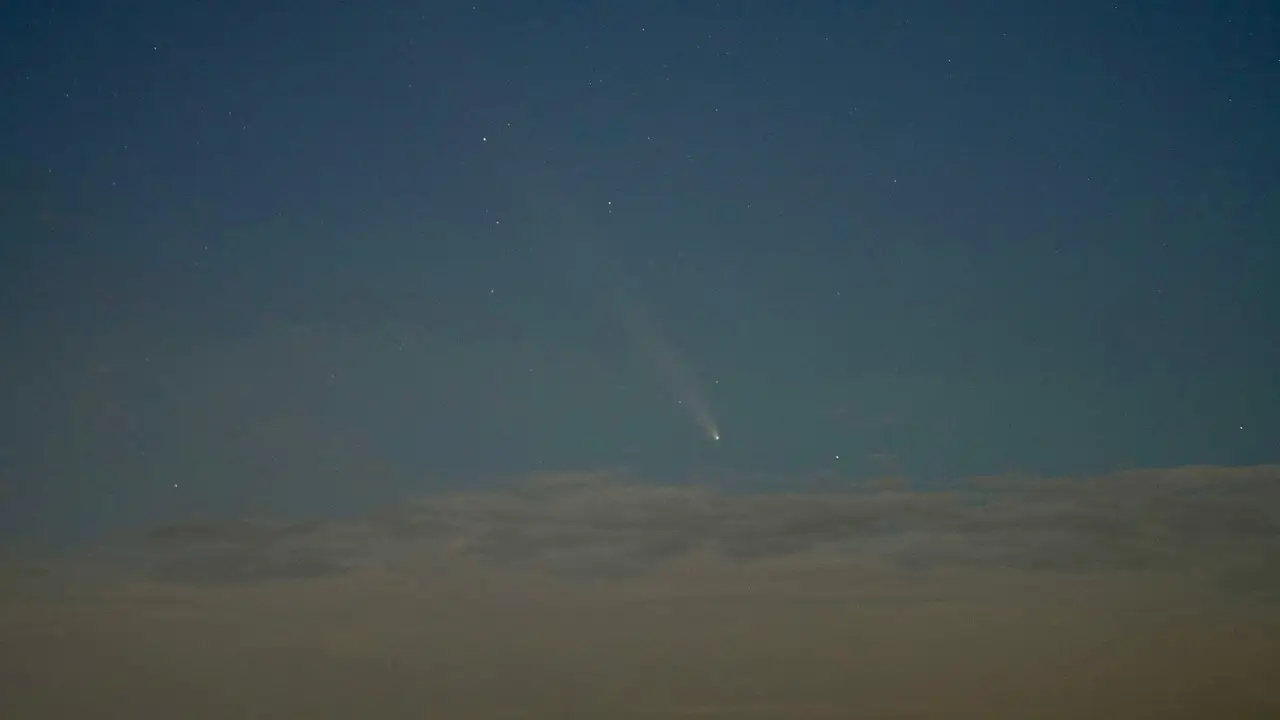
The Euclid space telescope has discovered its first comet, C/2026 S1, about 807 million miles (1.3 billion kilometers) away in images captured Sept. 16–24, 2026. Euclid caught the object between the orbits of Jupiter and Saturn, and the team found no prior record of it. That is the useful part. The caveats are quieter.
What did Euclid actually see?
Euclid’s images first registered the comet as a streak smeared across several pictures. Mikko Pöntinen, a University of Helsinki scientist and member of the Solar System Objects Science Working Group within the Euclid Consortium, made the initial discovery.
Pöntinen said: “I was excited to see my software flag a ‘streak’ smeared across several images – the result of a fast-moving object.”
By calculating where the fast-moving object should appear, Pöntinen found it in other images, for five image sets in all. Those repeat sightings gave the team positions with which to check existing comet records.
He added: “Further inspection revealed that it had a fuzzy cloud around it, indicative of an active object like a comet that is shedding dust and gas.”
The fuzzy cloud suggests an active comet shedding dust and gas, rather than a simple moving-object streak. The team then checked current records of known comets and found no match, establishing that the detection was new.
Was Euclid built to do this?
No. The European Space Agency launched Euclid in 2023, with contributions from NASA, to collect long, slow observations of deep space and distant galaxies. Scientists will use those data to study dark energy and dark matter, terms used for questions about cosmic expansion and the unseen mass that shapes galaxies. The mission did not explicitly target fast-moving comets hurtling through our Solar System.
Finding one anyway broadens the telescope’s potential uses. Scientists could someday use Euclid to target comets in the far reaches of the solar neighborhood, though the report presents that as a future possibility, not a demonstrated observing program.
Comet trails also appear as recognizable “noise” in Euclid’s field of view. Identifying them can help researchers distinguish such artifacts from genuine celestial sources, an added benefit that the mission’s designers did not originally pursue.
How strong is the evidence?
The account presents four pieces of evidence for the discovery:
- Software flagged a streak across several images and interpreted it as a fast-moving object.
- Position predictions recovered the object in five image sets.
- A fuzzy cloud indicated an active body shedding dust and gas.
- Researchers checked current comet records and found no earlier detection.
Those details support the identification, rather than an unsupported leap from one unusual image. The source gives readers more than a bare announcement.
Still, the account leaves several useful measurements unstated:
- The comet’s diameter and brightness.
- Its composition beyond the indication that it sheds dust and gas.
- Its orbital path, orbital period and closest approach to Earth.
- An independent follow-up observation or the frequency of similar detections.
That missing information tempers the larger claims. The fuzzy cloud was “indicative” of a comet, in Pöntinen’s wording, and the records check established novelty against the information then available. Neither step supplies a complete orbit or physical profile.
What does this change for comet hunting?
It gives comet hunters another route: inspect Euclid imagery for Solar System objects that its galaxy-survey design was never meant to emphasize. The first detection shows that such objects can appear in the images and be recognized afterward.
Euclid could then help search the far reaches of the solar neighborhood and identify comet trails within its wider observations. But one discovery offers no detection rate, no estimate of how many comets Euclid may have missed, and no proof that deliberate targeting will be equally productive.
A Sept. 16–24 observation window produced the first find. The broader payoff remains a testable idea, not an established survey yield. One discovery proves possibility, not frequency.
Who reported the finding?
Chelsea Gohd wrote the Nov. 16, 2026 item, presented as a Space.com space photo of the day. She returned to Space.com in 2026 after serving as a senior writer from 2018 to 2022, covering climate change, planetary science and human spaceflight in articles and on-camera videos.
Gohd holds an M.S. in biology and has written or worked for NASA JPL, the American Museum of Natural History, Scientific American, Discover Magazine Blog, Astronomy Magazine and Live Science. Outside science reporting, she writes music and performs as Foxanne. In 2021, she launched a song to space with Inspiration4. Her listed social accounts are @chelsea.gohd and @foxanne.music.
Comet Euclid is a modest but useful result: a telescope built for slow looks at distant galaxies caught its first fast-moving Solar System object. Scientists can now test whether the bonus repeats. The caveat remains attached: frequency unknown.
via space.com (Source)
More from James Calloway
Show full bio
Staff writer covering regulation, policy and their impact on general science news at SciBeat.
411 articles
Nearby plates
- Euclid Telescope Finds Its First-Ever New Comet 1.3 Billion Km Away
- Euclid Telescope Finds Comet C/2026 S1 While Mapping Dark Energy
- Euclid Telescope Maps One Billion Cosmic Objects in First Big Release
- Euclid's First Data Haul: 900 Million Galaxies in 2.5 Trillion Pixels
- Euclid's first major data release captures over 1 billion cosmic objects