Recorded November 28, 2026
Space & AstronomyReported finding
Event Horizon Telescope Reveals a Bending Black Hole Jet in 3C 279
EHT observations from 2021 map the inner jet of blazar 3C 279 at sub-parsec scales, revealing a bend toward Earth that brightens emission and slows apparent motion near an 800-million-solar-mass black hole.
By Priya Raman4 min read865 words
In brief
- The EHT's 2021 campaign mapped the jet of blazar 3C 279 at sub-parsec scales, published in Astronomy & Astrophysics in 2026.
- 3C 279 lies 538 million light-years away and its central black hole weighs about 800 million solar masses.
- The 2021 array added Kitt Peak in Arizona and NOEMA in the French Alps, the largest EHT configuration published to date.
- The jet bends toward Earth, producing brighter emission and slower apparent motion, like a car approaching head-on.
- Features near the jet's base already move at apparent speeds seen far downstream, suggesting rapid acceleration close to the black hole.
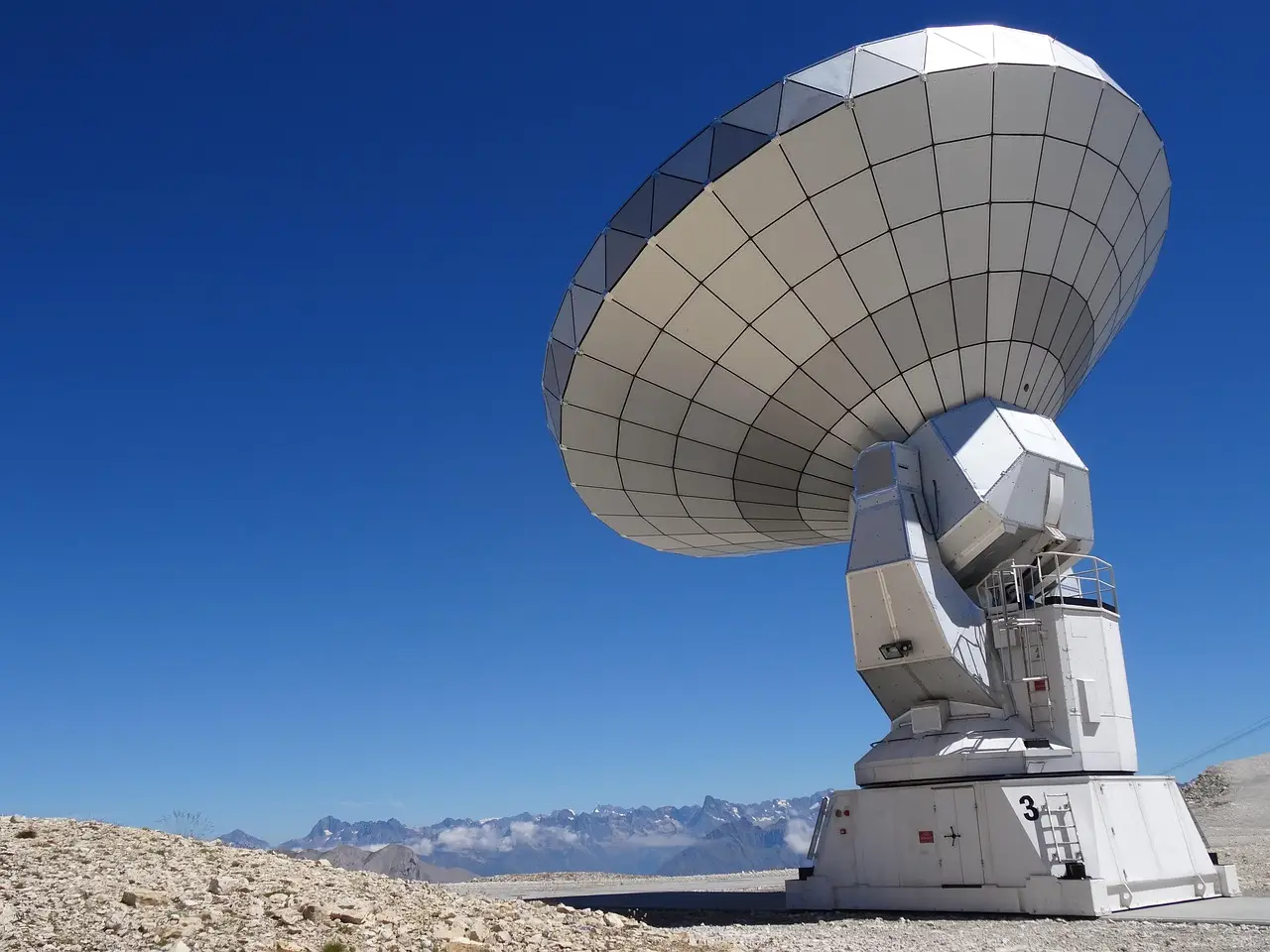
Five hundred thirty-eight million light-years from Earth, the black hole jet of the blazar 3C 279 bends toward us, and the Event Horizon Telescope has now mapped that bend in unprecedented detail. The findings, published in Astronomy & Astrophysics, come from the largest array configuration the collaboration has published to date and suggest the jet's innermost region curves so that one section points almost directly at our planet.
The Event Horizon Telescope (EHT) is a global network of radio observatories that together simulate a single, Earth-sized instrument. Its earlier milestones include the first image of a black hole — the supermassive object at the center of the galaxy M87 in 2019 — and the first image of Sagittarius A*, the supermassive black hole at the heart of the Milky Way, in 2022. Between 2024 and 2026, the array also produced detailed images of relativistic jets (streams of matter moving near light speed) flowing from the galaxies 3C 84 and M87.
What makes 3C 279 special?
Blazars are bright galaxies whose central supermassive black holes launch jets of ionized matter pointed straight at Earth. 3C 279 hosts a black hole of roughly 800 million solar masses — nearly 200 times the mass of Sagittarius A*, which weighs in at about 4.3 million. Its brightness makes it a prime target for very long baseline interferometry, the technique of combining distant antennas to achieve extreme resolution, and astronomers routinely use it for calibration.
How did the observations work?
The 2021 campaign added two new sites to the array: a 12-meter telescope at Kitt Peak Observatory in Arizona and the Northern Extended Millimeter Array (NOEMA) in the French Alps. Their positions proved crucial. As lead author Hendrik Müller, a staff scientist at the National Radio Astronomy Observatory and former researcher at the Max-Planck-Institut für Radioastronomie, explained, the distance between two antennas determines the spatial scale a baseline can resolve — the reason the Very Large Array in New Mexico sits on railway tracks. Moving antennas apart zooms into a small patch of sky; moving them closer widens the view.
The EHT's telescope positions are fixed, but Kitt Peak and NOEMA sit relatively near other array stations — NOEMA in the French Alps lies close to Pico Veleta near Granada, Spain. According to Müller, they "added information that was not available to us in previous years," providing intermediate baselines that constrained specific angular scales and allowed the team to probe both compact and extended structures in the jet.
The researchers processed the data with the Comrade, DoG-HiT, kine and Difmap software packages — the same general strategy used to reconstruct the famous M87 black hole image in 2019. Müller noted that using several packages, each built on different assumptions, builds confidence: consistency across methods strengthens the result. Many more collaborators and tools handled earlier steps such as correlation and calibration.
Why does the bend matter?
Because the jet's plasma travels close to the speed of light, its radiation concentrates in the direction of motion. When that direction aligns more closely with Earth, two effects follow: the emission appears brighter, and features in the jet appear to move more slowly across the sky. Müller compared it to a car approaching almost head-on — it can travel fast while barely shifting sideways in your field of view.
This explains what the images show farther along the inner jet: brighter emission and slower apparent motion, even if the plasma itself never slows down. It also means the brightest spot in the image can sit downstream from the black hole, where the jet points most directly at us.
The images additionally reveal that the direction of the inner jet changes over time, offering clues to what drives it. The team spotted features already moving across the sky near the apparent base of the jet at speeds comparable to those much farther downstream. "If those features travel with the plasma, that suggests the jet gains much of its speed over a short distance near its base," Müller said. As the fast flow narrows again, it may form a shock that adds to the brightness seen near the bend.
What comes next?
Decades of observations document how 3C 279's jet behaves on larger scales, but only a few images capture it at the sub-parsec level — distances smaller than about 3.26 light-years. The mechanisms driving the jet remain a mystery, and future observations could reveal unseen behaviors.
"This paper is just the beginning," Müller said. The collaboration holds EHT observations from several years plus multi-frequency data gathered close in time, all under analysis. Observing at different frequencies reveals different parts of the jet, and scheduling them together helps distinguish instrumental effects from real change. A series of results is expected over the next few years, making 3C 279 one of astronomy's best opportunities to learn how a black hole launches a jet and speeds it to nearly the velocity of light.
The paper appears as Hendrik Müller et al., Dynamics and geometry of the inner sub-parsec-scale jet in 3C 279 observed with the Event Horizon Telescope, Astronomy & Astrophysics (2026), DOI: 10.1051/0004-6361/202660360.
via phys.org/rss-feed/ (Source)
More from Priya Raman
Show full bio
Senior reporter covering people, launches and day-to-day practice in general science news at SciBeat.
611 articles
Nearby plates
- Black Hole Winds Pack 100 Times More Power Than Scientists Expected
- NASA’s 16-image gallery maps black holes, star births and collisions
- A 3.3-million-sun black hole grew faster than its galaxy's stars
- Astronomers Find First Milky Way Black Hole Jet Pointed at Earth
- First Clean X-Ray Map Reveals Supernova Remnant Near Milky Way's Black Hole