Recorded November 25, 2026
Space & AstronomyReported finding
Record-Breaking Quasar Found 630 Million Years After Big Bang
Astronomers using JWST and Euclid have found the oldest known quasar, at redshift 8.13, roughly 13.1 billion years old — and its slow growth may force a rethink of black hole models.
By Elena Vasquez3 min read646 words
In brief
- Quasar observed 630 million years after the Big Bang, ~40 million years older than the previous record holder
- Redshift of 8.13 — first quasar ever found beyond redshift 8, roughly 13.1 billion years old
- Estimated mass of 360 million suns; study published Nov. 24 in Astronomy and Astrophysics
- Object named Dún Aonghasa, after a prehistoric cliff fort on Inis Mór, Ireland
- Found using NASA's James Webb Space Telescope and ESA's Euclid Wide Survey data
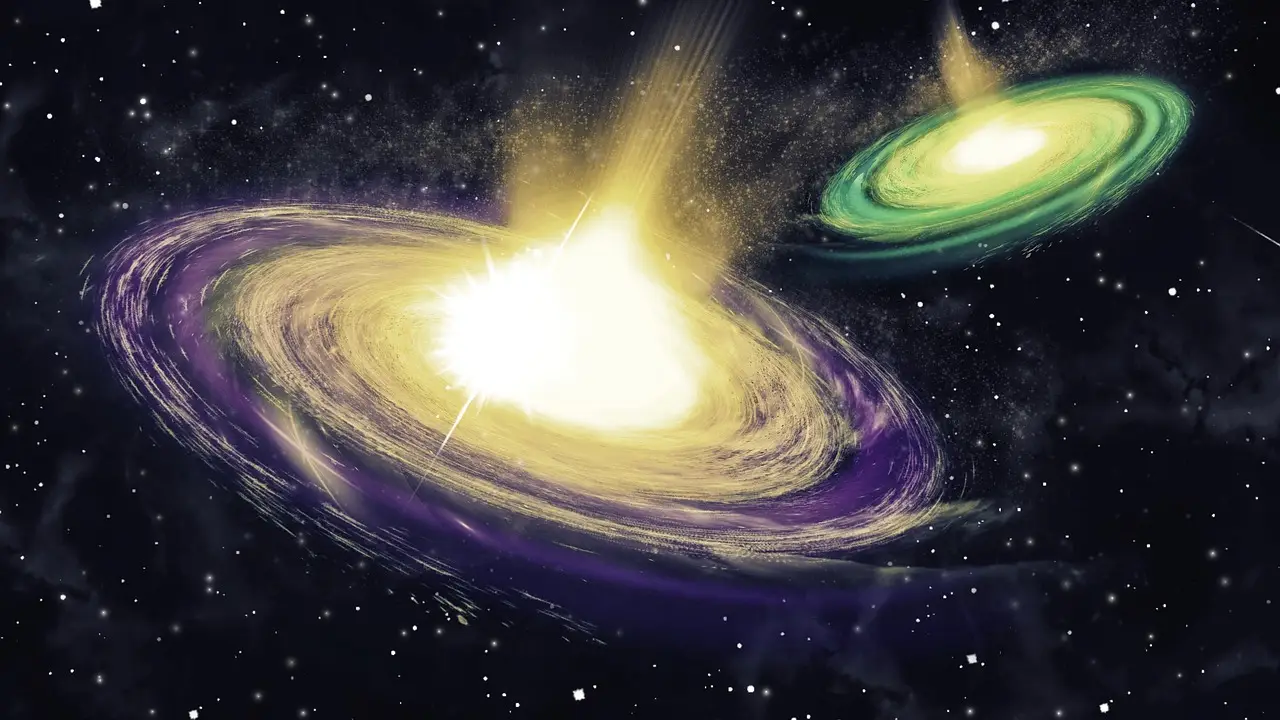
Astronomers have spotted the earliest-known quasar in the universe, observing it as it existed just 630 million years after the Big Bang — about 40 million years older than the previous record holder. The object, described in a study published Nov. 24 in the journal Astronomy and Astrophysics, could reshape how scientists think black holes grew in the infant cosmos.
The quasar carries a redshift of 8.13, making it the first such object ever found beyond a redshift of 8. That puts its age at roughly 13.1 billion years. The universe itself is about 13.8 billion years old.
Redshift is a measure of how much a distant object's light has stretched toward the red end of the spectrum as it travels across the expanding universe. The older the object, the redder its light. Because light takes time to reach us, looking at faraway galaxies is effectively looking back in time.
"Finding quasars at ever-increasing distances, at the edge of the observable universe, teaches us something about how the black holes in their centres grew," study co-author Julien Wolf, a researcher at the Max Planck Institute for Astronomy, said in a statement. "The closer to the Big Bang we find them, the faster their black holes must have grown or the more massive they must have been at birth — or both."
What did the telescopes actually find?
The team identified the quasar using data from NASA's James Webb Space Telescope and the European Space Agency's Euclid Wide Survey. The object weighs in at an estimated 360 million suns.
The researchers named it Dún Aonghasa, after a prehistoric cliff fort on the Atlantic-facing edge of Inis Mór, an island off the coast of Ireland. The name nods to the quasar's position at the very edge of our current observational frontier for the cosmos.
What is a quasar, in plain terms?
A quasar — short for "quasi-stellar radio source" — is the extremely bright core at the center of some galaxies, a region astronomers call the active galactic nucleus. It forms when a supermassive black hole, sitting at the heart of most galaxies, starts feeding heavily on nearby matter.
Swirling material piles up around the black hole, heats up and glows intensely before falling in. What distinguishes quasars from other active galactic nuclei is sheer brightness. A quasar can outshine all the stars in its host galaxy combined.
Quasars were far more common early in the universe's history than they are today. Their numbers are thought to have peaked around 10 billion years ago. Studying them gives researchers clues about how galaxies evolve and how their supermassive black holes develop.
Why is the slow growth a surprise?
Here's the puzzle. Dún Aonghasa appears to be growing more slowly than astronomers previously thought possible for an object of its size. That's an odd result for something so massive so early in cosmic history.
The finding is preliminary but potentially significant. It suggests the quasar's supermassive black hole may have undergone a massive growth spurt early on, followed by a long stretch of much slower feeding in the distant past.
If that pattern holds, it would put new constraints on black hole growth models. Those models are already under pressure: earlier James Webb observations have turned up supermassive monsters that seem to have grown too big, too fast, for their early place in cosmic history.
The researchers caution that one object doesn't settle the question. Future observations from Euclid and JWST, they say, could test whether the growth-spurt-then-slump hypothesis applies to other ancient quasars.
The bottom line
One quasar won't rewrite cosmology on its own. But the oldest one ever found — massive, distant and oddly sluggish — adds real weight to the argument that early black hole growth doesn't fit the standard picture.
via livescience.com/feeds/news (Source)
More from Elena Vasquez
Show full bio
Correspondent covering money, funding and market shifts around general science news at SciBeat.
639 articles
Nearby plates
- Quasar Dún Aonghasa sets record at 630 million years after Big Bang
- Twin Black Holes From Cosmic Dawn Break Formation Models
- Euclid telescope spots oldest known quasar, just 630 million years post-big bang
- Two Giant Quasars Test Black Hole Growth at Cosmic Dawn
- Ancient Quasar Pair Puts Early Black Hole Growth on Trial