Recorded November 25, 2026
Space & AstronomyReported finding
Moon Craters Could Shield Nuclear Reactors for Lunar Bases
Simulations show a lunar crater wall cuts reactor radiation near a moon base to near zero, saving thousands of kilograms of launched shielding — at the cost of a lethal no-go zone.
By Elena Vasquez4 min read800 words
In brief
- A 40-kW lunar reactor must weigh under 6,000 kg to fit on a rover
- A 120-m crater wall cut habitat radiation to about 0.04 rem per year
- Generic 3-m terrain barriers performed 50 times below the 5-rem safety limit
- The study, led by Los Alamos's Alex Levinsky, appeared at the NETS conference in April
- The reactor site itself becomes a lethal no-fly zone due to reflected neutrons
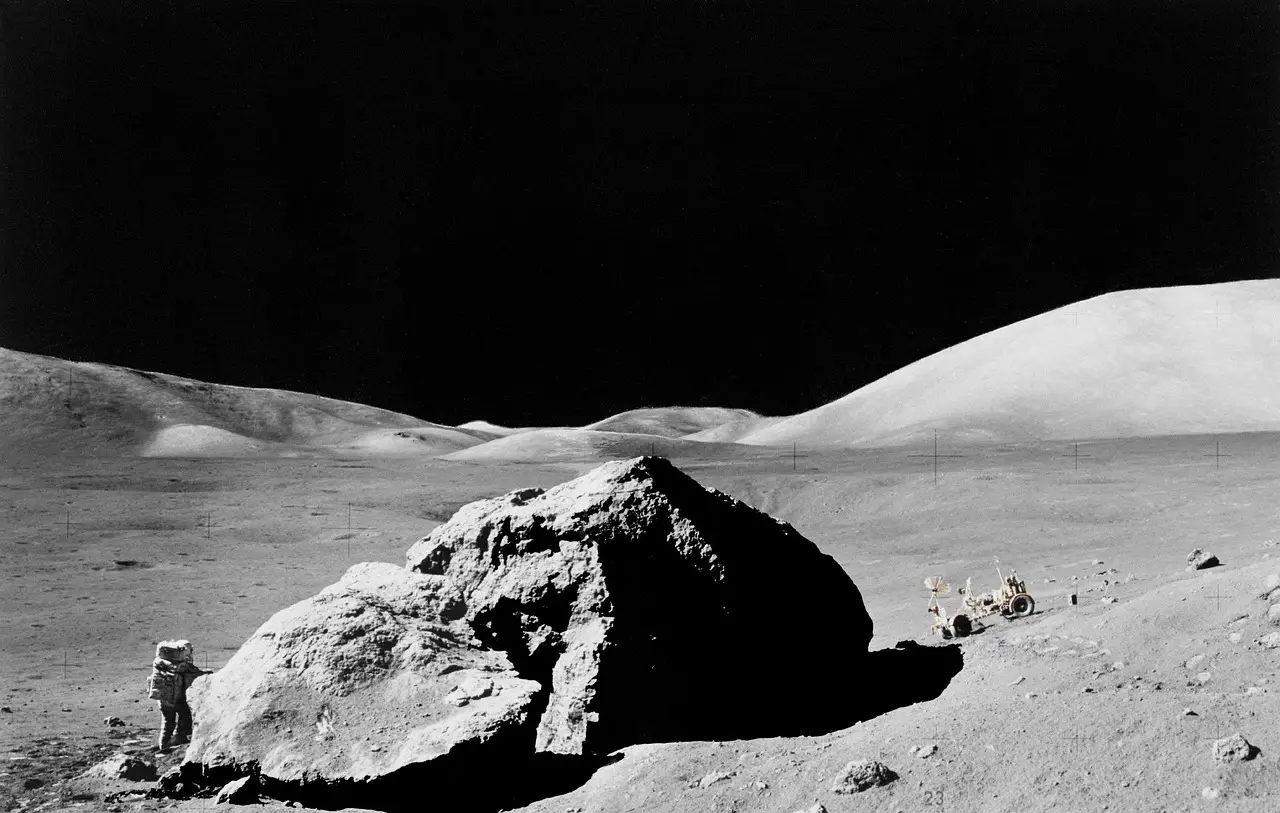
A lunar crater wall can cut radiation from a moon-base nuclear reactor to nearly zero, simulations from a multi-lab U.S. research team show, potentially solving one of the heaviest engineering problems in NASA's plan for a 40-kilowatt reactor on the moon. A natural barrier of rock and dirt dropped habitat exposure to about four-hundredths of a rem per year — 125 times below the safety limit. That's the headline finding. The trade-off: the crater itself becomes a death zone, off-limits to astronauts and, likely, to any spacecraft flying overhead.
The work comes from researchers at Los Alamos, NASA Glenn, Oak Ridge, Idaho National Laboratory and Lockheed Martin. They presented it in April at the American Nuclear Society's Nuclear and Emerging Technologies for Space (NETS) conference, under NASA's Space Power and Reactor Capabilities (SPARC) program. The team was led by Los Alamos researcher Alex Levinsky.
Why does a moon base need a nuclear reactor?
The two-week lunar night can drain batteries charged during the two-week lunar day, and those batteries may not survive the deep freeze in the first place. For decades, engineers have planned to use nuclear reactors to at least partially power any future settlement. But the SPARC design carries a hard constraint: the whole system must weigh under 6,000 kg (13,200 pounds) so a mobile rover can carry it across the lunar surface.
That's tight. Shielding is both one of the most important safety components of a reactor and one of the heaviest. So space reactor designers have long used directional "shadow shields" — lightweight, hydrogen-rich materials such as lithium hydride, paired with dense metal, placed only in the direction of sensitive components like control electronics. The rest of the surroundings stay unprotected. That's fine for an uncrewed probe. It's not fine if people live nearby: even 1 km (0.6 miles) from the reactor, radiation levels would be deadly without protection, and hauling lead or concrete shielding from Earth is extraordinarily expensive.
How did the terrain-shielding idea perform?
Levinsky's team turned to computer simulations, using software called Monte Carlo N-Particle to track millions of subatomic particles leaving the reactor core. They placed the simulated reactor 1.5 m (4.9 feet) off the ground, matching its position on the back of a wheeled rover, then modeled barriers between it and a habitat.
First tests used generic landscapes:
- A crater 3 m (9.8 feet) deep
- A gently sloping dirt hill 3 m (9.8 feet) high
Both blocked nearly all radiation, cutting dose to roughly one-tenth of a rem per year. The safety standard allows five rems per year above the moon's natural background, so the terrain performed about 50 times better than required.
Then came a real site. The team chose Connecting Ridge, near Shackleton Crater at the lunar south pole — a prime candidate for future crewed missions because it combines two scarce lunar features. Parts of the ridge sit in near-permanent sunlight, lit 80–90% of the time, while sitting beside permanently shadowed regions that hold water ice, crucial for life support and rocket fuel at any permanent colony.
Keeping the rover's slope limit of 18 degrees in mind, the researchers found a natural depression separable from a simulated base camp by a 120-m-high (394-foot) crater wall. With that barrier in place, radiation reaching the habitat fell to near zero — about 0.04 rem per year — letting the reactor's onboard shadow shield focus entirely on protecting nearby electronics.
One lunar quirk helps. The moon has no atmosphere, so there's no "skyshine" — the phenomenon where radiation bounces off air particles and rains back down on surrounding areas, a real problem for Earth-based reactors. Nothing up there reflects the radiation back. Takeaway: airlessness, usually a hazard, is a free asset here.
What's the catch?
The crater that shields the habitat becomes lethal itself. Astronauts entering the reactor's operational area during operation would immediately develop radiation poisoning. Regolith also reflects neutrons well, bouncing many of them straight into space — meaning no spacecraft or landers could fly directly over the site.
So the approach saves launching thousands of kilograms of shielding from Earth, but at the cost of a no-fly exclusion zone around one patch of the moon. For light and heat through the long lunar nights, that's a trade-off many space enthusiasts will likely accept.
Caveats apply. These are simulations, not physical tests — no mock-up reactor, no hundreds of tons of regolith. The findings, published as "Impact of Terrain on Doses for Fission Surface Power" (NETS 2026), bring continuous nuclear power on the moon one step closer. One step, not a landing.
via phys.org/rss-feed/ (Source)
More from Elena Vasquez
Show full bio
Correspondent covering money, funding and market shifts around general science news at SciBeat.
639 articles
Nearby plates
- Scientists Call for a Moratorium Before Lunar Industry Takes Off
- 20-Ton 'Mars Seed' Would Grow 870 m² of Habitat From Martian Dirt
- Scientists Call for Moratorium on Moon Mining Before It Becomes the Wild West
- NASA Books a Ride for Its $400 Million Moon Rover PROMISE
- NASA's Solid-State Batteries Survive Minus 274°F in Lunar Cold Tests