Plate Nº 33 · recorded November 11, 2026
Reported finding
First near-atomic map of babesiosis parasite's ribosome unveiled
Harvard scientists mapped the babesiosis parasite's ribosome in near-atomic 3D, finding 120 chemical marks — half at never-before-seen positions — that may become drug targets.
By Elena Vasquez4 min read896 words
In brief
- Researchers mapped the Babesia divergens ribosome at near-atomic resolution — the most detailed such map for any apicomplexan parasite.
- The team identified 120 rRNA epitranscriptomic marks; about half sit at positions never reported in human or other parasite ribosomes.
- U.S. babesiosis cases rose 9% per year from 2015 to 2022 as warming temperatures spread ticks.
- The study appears in Nature Communications (2026), led by Harvard Medical School's Mélissa Léger-Abraham.
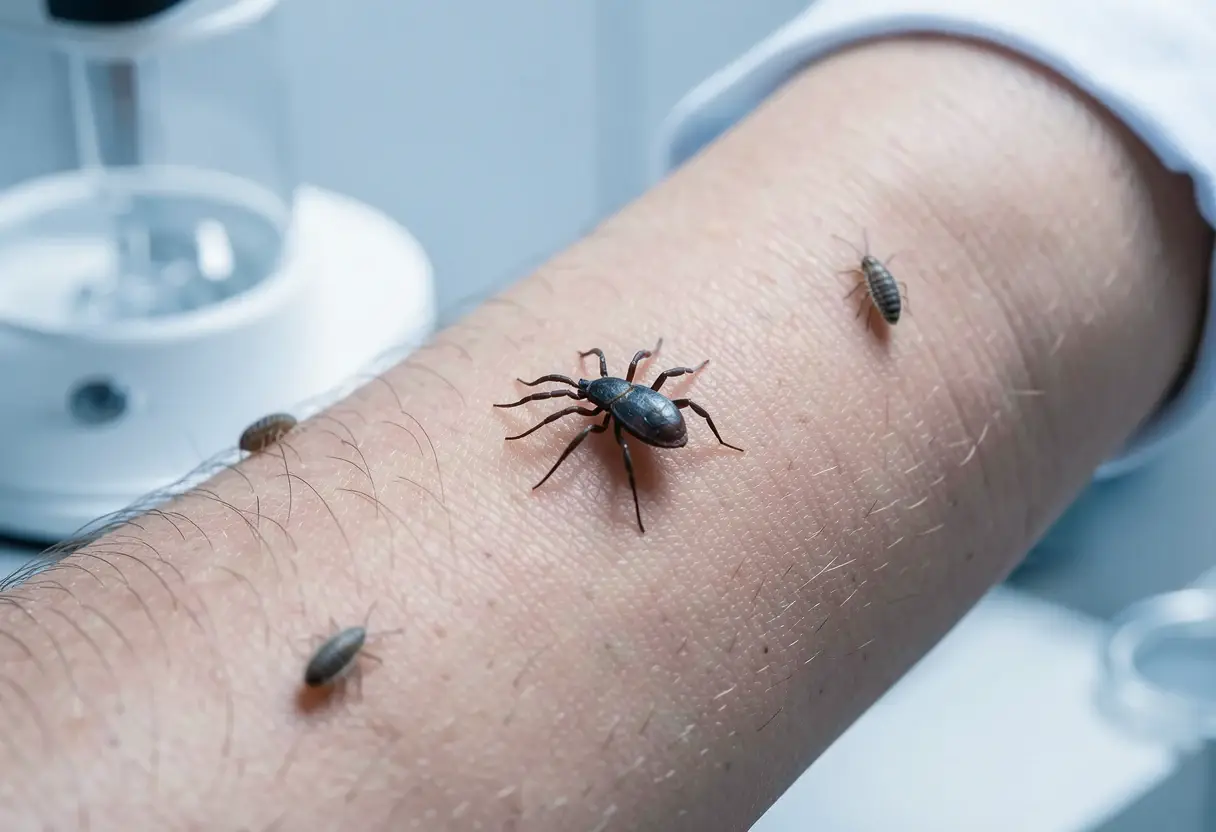
Researchers have produced the most detailed 3D map ever made of a ribosome from an apicomplexan parasite, imaging the babesiosis pathogen Babesia divergens at near-atomic resolution. The study, published in Nature Communications, identified 120 chemical modifications on the parasite's ribosomal RNA — about half of them at positions never reported in any human or other parasite ribosome.
The structure could guide development of drugs that kill the parasite without harming human cells, according to the team at Harvard Medical School.
"Having detailed images of the Babesia ribosome lays an important foundation for deepening our understanding of how the organism lives and gives us step-by-step guidance in the search for new drugs to treat babesiosis," said Mélissa Léger-Abraham, assistant professor of microbiology in the Blavatnik Institute at Harvard Medical School and senior author of the study.
Why the ribosome matters
A ribosome is a large molecular machine built from ribosomal RNA (rRNA) and ribosomal proteins. It reads an organism's genetic sequence and translates it into the proteins a cell needs to survive. More than half of antibiotics currently used against bacterial infections target this process or the ribosome itself. Mapping the ribosomes of parasites, and seeing how they differ from human ones, could point to similarly precise attacks.
"Once we can see the differences between parasite and human ribosomes, we could design drugs that interrupt the parasite's life cycle and its ability to infect humans, without interfering with any of the processes that our bodies rely on to keep us healthy," Léger-Abraham said.
The work also strengthens the knowledge base for the entire group of protozoa called apicomplexan parasites, which include the pathogens behind malaria and toxoplasmosis. Very little is known about the basic mechanisms these complex pathogens use to infect and survive across many host species, Léger-Abraham noted.
A disease on the rise
Babesia divergens is a tick-borne pathogen prevalent in Europe. It causes significant livestock loss and sometimes severe disease, even death, in humans — especially people with compromised immune systems. The disease can spread through donated blood and from pregnant mothers to their babies, and many different Babesia species infect humans.
In the United States, cases rose by 9% per year from 2015 to 2022. Blacklegged ticks carrying the related Babesia microti have expanded their geographic range and lengthened their biting season as temperatures warm.
Léger-Abraham initially wanted to image ribosomes from Plasmodium, the malaria parasite, because of its global health toll. She chose Babesia divergens instead for a practical reason: it is easy to cultivate and yields the larger quantities of material that high-resolution structural studies demand.
How the team did it
The researchers used cryo-electron microscopy, or cryo-EM. In this technique, many copies of ribosome particles are rapidly frozen in a thin layer of vitreous ice and imaged from different angles; computers then align and combine the 2D views into a 3D model. Data were collected at the Harvard Cryo-EM Center for Structural Biology at HMS.
The resulting map shows the intricate interactions between residues of ribosomal proteins and ribonucleotides of the rRNA — the most detailed map of its kind for any apicomplexan parasite. It is sharp enough to reveal chemical modifications of the ribosome that may tune its function. Think of RNA as a language: these marks work like punctuation and accents, subtly shifting the meaning of the code.
The 120 marks, known as rRNA epitranscriptomic modifications, can tweak how the ribosome assembles and how proteins get made. Most sit in regions known to carry out important work, suggesting they are biologically meaningful and, in some cases, potential drug targets, the authors said.
The team also detected variation between individual ribosomes. Babesia passes through very different environments during its life cycle, and differences in rRNA modifications from one ribosome to another could offer clues to how the parasite adapts to diverse hosts.
What comes next?
The caveats are real. The researchers have not yet run follow-up experiments to determine what the chemical marks actually do, or whether they directly affect the parasite's life cycle. "Now that we have a complete list, we can figure out which ones are crucial for infection and/or survival. After that, we can figure out if any of those rRNA modifications are good targets for drug development," Léger-Abraham said.
Another next step is imaging the ribosome of the apicoplast, an organelle that performs essential metabolic tasks for Babesia and its relatives. It arose when an ancestor of these protozoa engulfed a blue-green alga and, instead of digesting it, learned to live with it. The apicoplast keeps its own DNA and its own ribosomes. While Babesia's main cytoplasmic ribosome resembles human ones, apicoplast ribosomes are closer to bacterial ribosomes — making them a potentially rich target for antibiotic-like drugs with minimal side effects.
Léger-Abraham also stressed the value of curiosity-driven research. "There's so much data, so much biology, so much information waiting to be revealed that we can use to improve human health," she said.
The paper is Cristina Gutierrez-Vargas et al., "Ribosomal architecture and rRNA modification landscape in the tick-borne parasite Babesia divergens," Nature Communications (2026).
The takeaway: a sharper picture of the parasite's protein factory gives drug hunters a parts list — and half of the newly found marks are unexplored territory.
via phys.org/rss-feed/ (Source)
More from Elena Vasquez
Show full bio
Correspondent covering money, funding and market shifts around general science news at SciBeat.
384 articles
Nearby plates
- Evolved Enzymes Build TB Antibiotic Ingredient Without the Waste
- Resistance Gene Helps C. difficile Survive Hospital Disinfectants
- Scientists identify first PLP-dependent tRNA-modifying enzyme
- Eight-Letter DNA Works: Scientists Show Cells Can Read a Doubled Genetic Alphabet
- Scientists Capture Hidden Molecular Machine Parasites Can't Live Without