Plate Nº 84 · recorded November 12, 2026
PhysicsReported finding
Freshwater Fish Diet Makes Medieval Skeletons Look Centuries Older
Six of 27 medieval skeletons from Danish and German monasteries dated centuries before their churches existed. The culprit: a freshwater fish diet rich in ancient carbon that skews radiocarbon tests.
By Elena Vasquez4 min read821 words
In brief
- Six of 27 medieval skeletons from Danish and northern German monasteries produced radiocarbon dates incompatible with documented construction dates of their burial sites.
- Fish from the Rhine can appear up to 1,300 years older than land animals living at the same time due to the freshwater reservoir effect.
- One skeleton at Viborg dated to A.D. 775–975 although the monastery was founded in 1120.
- Richard III's initial radiocarbon dates pointed to the early 1400s until researchers accounted for his seafood diet.
- The findings appeared in the journal npj Heritage Science.
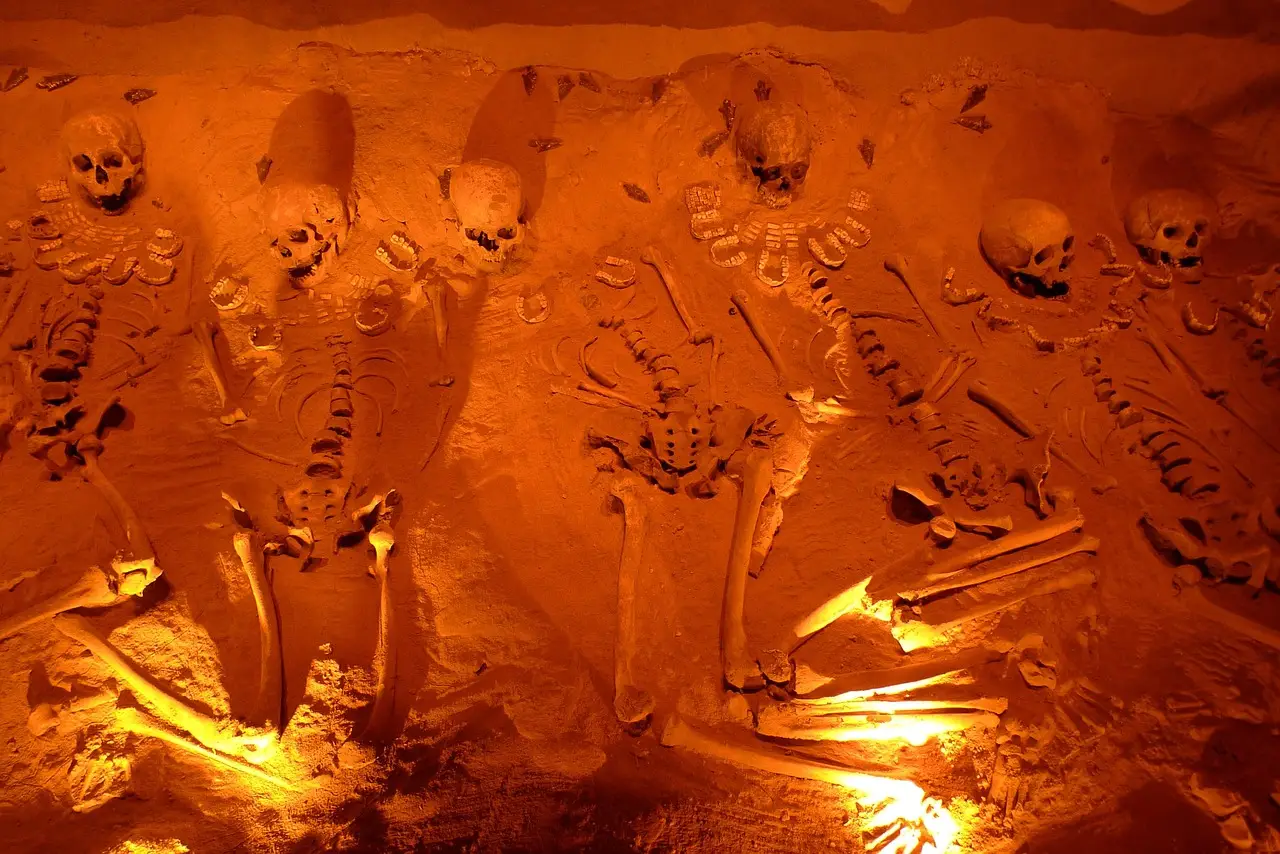
Six of 27 medieval skeletons buried inside Danish and northern German monasteries returned radiocarbon dates that flatly contradict history — and the culprit, researchers say, was dinner. A new study published in npj Heritage Science finds that a diet rich in freshwater fish can make human bones appear centuries older than they really are.
The problem surfaced in dramatic fashion in Svendborg, Denmark. Archaeologists opened a medieval grave inside a Franciscan friary church. The body lay aligned with the interior walls and cut directly into floor layers, so the burial had to postdate the building's construction in 1236. Standard radiocarbon tests disagreed. The lab placed the death between A.D. 1100 and 1155 — nearly a century before the monastery existed.
"If someone ate a lot of freshwater fish during their lifetime, their bones can appear older than they really are," said Kaare Lund Rasmussen, professor emeritus at the University of Southern Denmark and lead author of the analysis.
How can food warp a dating test?
Radiocarbon dating measures carbon-14, a radioactive form of carbon that living things absorb from their environment. While you're alive, food keeps replenishing your carbon-14. When you die, intake stops, and the trapped carbon-14 decays at a predictable rate. Scientists measure what's left to estimate the time of death.
But carbon doesn't always travel straight from the atmosphere into the food chain.
Rivers and lakes can hold ancient carbon released from geological deposits. That carbon carries little or no carbon-14, so organisms absorbing it look far older than they are. Freshwater fish accumulate it, and humans who eat those fish incorporate some of it into their bones. Two people who died the same year can yield very different dates if one ate substantially more river fish.
Scientists call this the freshwater reservoir effect. It can be enormous. In extreme cases, fish from the Rhine appear up to 1,300 years older than land animals alive at the same moment.
Saltwater fish cause a similar but tamer problem. North Sea marine organisms typically show an apparent age offset of roughly 400 years, and archaeologists know how to correct for it. Freshwater systems resist a simple fix: rushing rivers carry heavy loads of ancient rock minerals, producing dramatic shifts, while still ponds exchange carbon dioxide with the air until the error vanishes entirely.
Why were medieval monks especially affected?
Religion made freshwater fish a staple, not a treat. During Lent and other fasting periods, Christians avoided meat from land animals, but freshwater fish was permitted — and in some communities it was eaten year-round. Monks and wealthy townsfolk consumed heavy amounts of river pike and perch, loading their skeletons with ancient water-derived carbon.
Rasmussen and his colleagues, Johannes van der Plicht and Jesper Lier Boldsen, examined 27 skeletons from seven monastic burial grounds in Denmark and northern Germany. All came from spots near churches and cloisters, where burials cannot predate the buildings — foundations documented in records sometimes down to the day and month.
The mismatches were stark. At Viborg, one skeleton dated to A.D. 775–975 although the monastery was founded in 1120. Three burials at the Cistercian monastery at Øm produced similarly impossible timelines. A skeleton from Aalborg dated between 775 and 990 despite its Franciscan monastery being founded in 1240.
What did the bones themselves reveal?
All 27 skeletons showed elevated levels of nitrogen-15, a stable isotope that helps reconstruct diet. Combined with carbon isotope measurements and the archaeological context, the results pointed to people who consumed substantial amounts of freshwater protein.
The researchers went further. By cross-referencing carbon-13 and nitrogen-15 ratios against known baselines from local terrestrial plants, livestock and aquatic species, they reconstructed how much river fish each person ate. Mathematical models then calculated a customized offset for each individual — stripping out the reservoir distortion before converting radioactive decay into a true calendar date.
The authors caution that natural variation in freshwater systems leaves residual uncertainty. Still, this two-step approach — diagnosing the diet first, then modeling the offset — is archaeology's best defense against time-warping river meals.
Has this fooled researchers before?
Yes, at the highest level. When archaeologists identified the remains of England's King Richard III, killed at the Battle of Bosworth in 1485, initial radiocarbon tests suggested dates as early as the first half of the 1400s. Researchers at the University of Leicester found his diet included substantial seafood; once they accounted for it, the dates reconciled with his known death.
A 2024 study of prehistoric burials in Russia found freshwater dietary effects approaching 900 years.
None of this invalidates radiocarbon dating. Flaws and all, it remains the most reliable tool for aging organic material. The lesson is narrower and practical: account for what a creature ate before reading the number. For archaeologists studying ancient populations, overlooking the effect could place entire communities in the wrong century.
via zmescience.com (Source)
More from Elena Vasquez
Show full bio
Correspondent covering money, funding and market shifts around general science news at SciBeat.
384 articles
Nearby plates
- Medieval Bones Dated Hundreds of Years Too Old by Fish Diet
- A Famous 2-Billion-Year-Old Signal From Early Earth May Be Local, Not Global
- Animals May Have Evolved 200 Million Years Earlier Than Thought
- Animals May Have Evolved 200 Million Years Earlier Than Fossils Show
- No Male Markers in 20 Homo naledi Fossils: Was This Cave Women-Only?