Plate Nº 84 · recorded October 10, 2026
Biology & EvolutionReported finding
Green turtles rebound to 'least concern' amid steep global wildlife declines
Green sea turtles have moved from 'endangered' to 'least concern' in global rankings, a rare reversal in WWF's Living Planet Report, which documented a 73% decline in monitored wildlife populations over 53 years.
By James Calloway4 min read764 words
In brief
- Green sea turtles moved from 'endangered' to 'least concern' in IUCN rankings, a rare shift among sea turtles.
- WWF's Living Planet Report found a 73% average decline in monitored wildlife populations over 53 years.
- About 50% of the thousands of vertebrate species monitored are stable or increasing.
- Green turtle nesting at Sabah's Turtle Islands tripled since the 1970s to over 20,000 nests annually.
- Roughly one in 1,000 hatchlings survives to sexual maturity at around 20 years old.
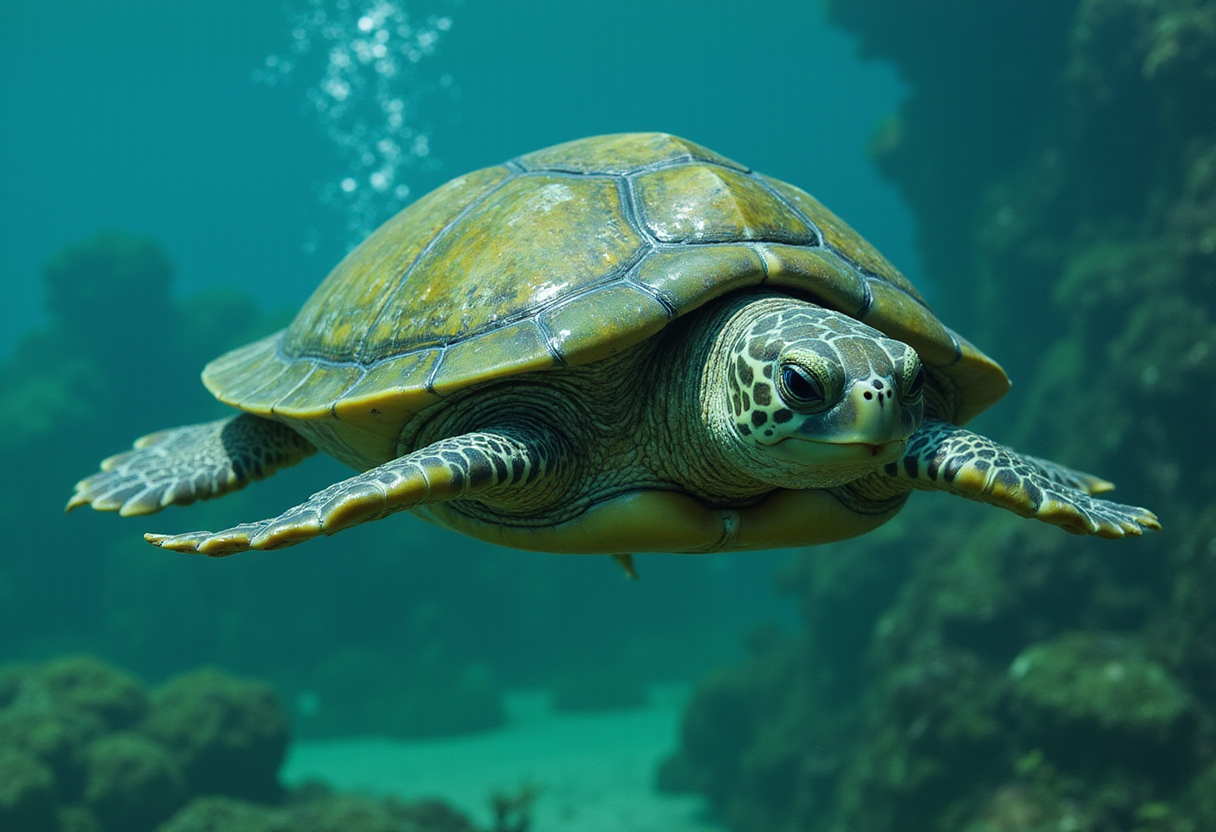
Green sea turtles have moved from "endangered" to "least concern" in global conservation rankings, a rare reversal documented by the World Wildlife Fund's biennial Living Planet Report released Thursday, which also found a 73% average decline in monitored wildlife populations over 53 years.
Why are green turtles recovering when so many species are not?
The same data set that tells this hopeful story also delivers a stark warning. The WWF report, which tracks vertebrate populations across land and sea, found that monitored wildlife populations have shrunk by an average of 73% over 53 years.
Yet roughly 50% of the thousands of vertebrate species monitored are stable or increasing. Green turtles sit firmly in that group. The shift comes after years of focused work: egg relocation, marine protected areas, and trade bans have helped populations rebound in multiple regions.
Malaysian turtle researcher Juanita Joseph remembers when that outcome seemed impossible. "Never in my mind (did I think) that one day turtles can be 'least concern,'" she said. "I cried ... I said I've done my part." Joseph is a professor at Universiti Malaysia Sabah.
What threats do sea turtles still face?
Of the seven sea turtle species, all remain vulnerable or critically endangered except the flatback turtle, whose status is unclear because of data shortages. Green turtles are hunted for food and shells, drown in fishing nets, and lose nesting beaches and feeding grounds to development and pollution.
Climate change compounds the pressure. Heat during incubation determines embryo sex, so warming beaches skew populations more female. Even within green turtles, recovery is uneven: the global "least concern" rating hides regional pockets where the species is still endangered and declining.
How did Malaysia's Turtle Islands triple their nesting numbers?
Green turtle nesting at Sabah state's Turtle Islands has tripled since the 1970s to over 20,000 nests each year. Sabah Parks director Maklarin Lakim credits more than five decades of protection. The islands have been legally shielded since 1977, and Sabah banned turtle meat and egg consumption in 1997.
"This is our heritage, this is our biodiversity," Maklarin said. "We would like to protect that as long as possible."
The work relies heavily on local women. Since 2012, a 20-member women's cooperative on Omadal island has relocated turtle eggs from open beaches to a hatchery, shielding them from predators and poachers. The cooperative started with WWF support but now funds itself, dedicating 10% of revenue from its handicraft and catering business to turtle protection.
Member Sitti Rasah Abdul, 50, lives in a fishing community that depends on the surrounding sea. "I'm already old," she said from a wooden jetty stretching from her home into aquamarine water. "But I feel a sense of responsibility to ensure that there are still turtles around for the next generation."
What role does genetic analysis play?
A 45-minute boat ride away, green and hawksbill hatchlings emerge from relocated nests at the Mataking Reef Resort. Hotel owner Sophia Sie fell for turtles decades ago when her father acquired land on Mataking island. About 10% of her staff now work on conservation. Egg collection grew from roughly 600 eggs in 2006 to about 36,000 today.
Sie considers conservation a passion and a business case. "The survival of our business here is very much dependent on the natural resources and the beauty around us," she said.
Genetic analysis fills gaps that field surveys cannot. WWF-Malaysia marine species strategy manager Gavin Jolis helped build Shellbank, the world's first global turtle DNA database. Scientists extract genetic material from tissue and shells to identify each turtle's "haplotype," a fingerprint that traces populations back to specific nesting beaches.
The approach has already linked turtles foraging in parts of Malaysia to Micronesia and identified the likely origin of turtle shell shipments intercepted in Britain. "In order to save sea turtles, we have to look at the life cycle," Jolis said. "That's where the genetic work comes in."
What are the biggest remaining unknowns?
Hatchlings released onto Mataking's beaches face brutal odds: roughly one in 1,000 will survive to sexual maturity at around 20 years old. The first decade of life is spent in the open ocean, a period researchers call the "lost years" because so little is known about where young turtles go.
Working out those migrations, and where turtles forage and breed, will determine whether the recovery holds. Jolis frames the effort as a generational commitment. "We should not look at just a short-term project," he said. "It's a long-term project."
via Phys.org Biology (Source)
More from James Calloway
Show full bio
Staff writer covering marketplaces and e-commerce at SciBeat.
205 articles
Nearby plates
- Two-thirds of flooded coastlines could host invasive species by 2100
- Rising Seas Threaten the World's Migratory Shorebirds
- Zoos Rarely Rearrange Collections When Species Risk Shifts
- Aldabra's giant tortoises near 183,000 in first rigorous atoll-wide count
- Fish thrive in urban waters, but their genes tell a different story