Plate Nº 77 · recorded November 3, 2026
Space & AstronomyReported finding
Hera Sees Two Asteroids for the First Time — and a Puzzle Worth Billions
ESA's Hera spacecraft has resolved Didymos and Dimorphos as separate objects for the first time, ahead of a crash-site investigation into NASA's 2022 asteroid impact — which worked far too well to explain.
By James Calloway3 min read677 words
In brief
- Hera resolved Dimorphos as a separate object on October 18, from about 1,280 km away.
- NASA's DART impact on September 26, 2022 shortened Dimorphos's orbit by roughly 33 minutes — far more than simulations predicted.
- First detailed images of Dimorphos are expected on November 25.
- The asteroid pair sits about 197 million kilometers from Earth.
- Hera will deploy two shoebox-sized CubeSats and may eventually attempt landings.
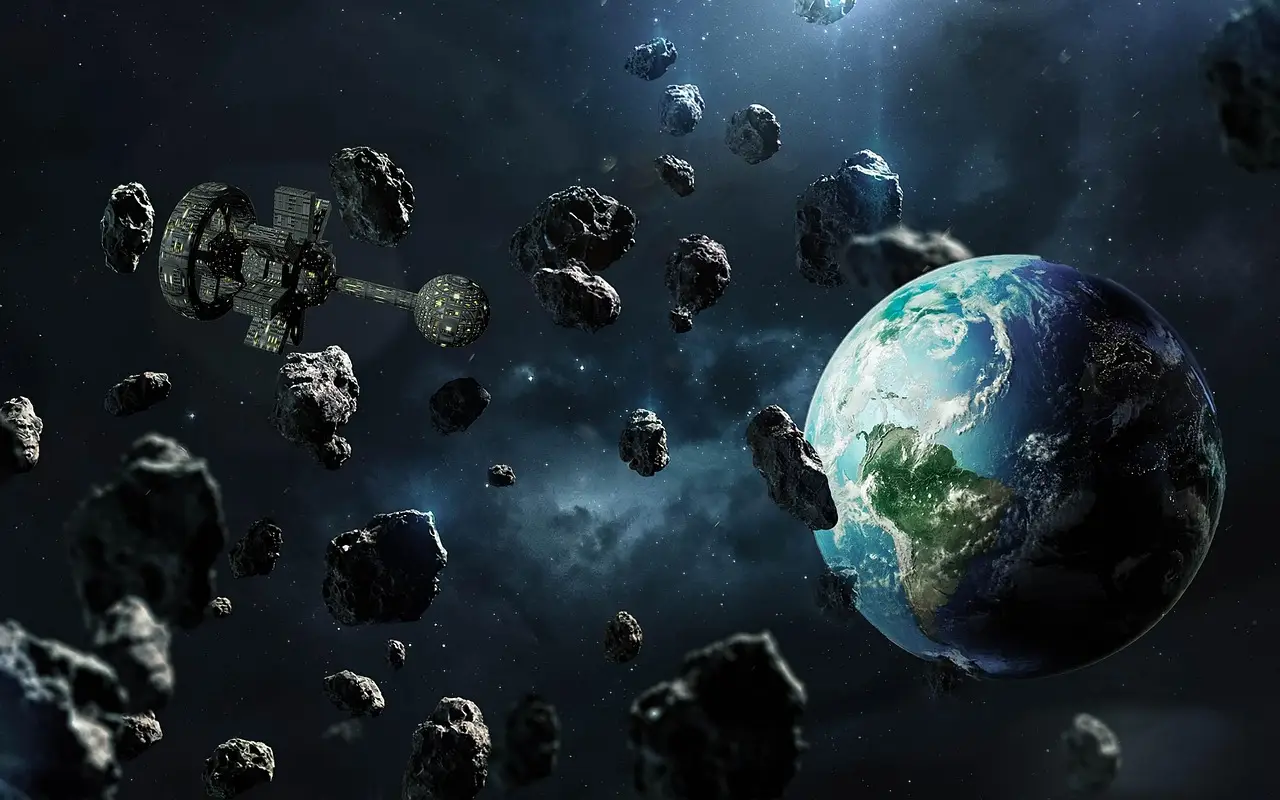
Europe's Hera spacecraft has, for the first time, seen its target as two separate asteroids rather than a single dot of light. The image, captured on the evening of October 18 from roughly 1,280 kilometers away, shows the small asteroid Dimorphos standing apart from its larger companion Didymos — even if it amounts to just one pixel. First sharp views arrive November 25.
That date matters. It's when mission managers promise the first detailed images of Dimorphos, the only object in the Solar System whose orbit humans have measurably changed. Promises in deep space come with caveats, though, and this one depends on Hera's approach going to plan.
What exactly did Hera photograph?
The asteroid pair currently orbits about 197 million kilometers from Earth. Hera's black-and-white Asteroid Framing Camera caught them after a braking campaign: the spacecraft fired its thrusters twice in early October, one week apart, cutting its relative speed to a modest 20 meters per second.
"With this image, the smaller Dimorphos asteroid becomes visible for the first time," said Michael Kueppers, Hera's interscientific coordinator. "Before this acquisition, the spacecraft was still resolving the Didymos system as a single dot."
Don't let the single pixel fool you. These are substantial rocks:
- Dimorphos measures about 151 meters across — roughly the size of the Great Pyramid of Giza.
- Didymos spans roughly 780 meters, slightly smaller than the height of Dubai's Burj Khalifa.
- Dimorphos circles its parent at an average separation of 1.15 kilometers, crawling along at about 18 centimeters per second.
"For the very first time we are seeing through Hera's own eyes the very double asteroid system that the mission was designed and built for," said mission manager Ian Carnelli. "Our views will grow much sharper as Hera comes closer."
Why is Hera there at all?
Hera is essentially a crash-site investigator, and the crash happened four years ago. On September 26, 2022, NASA's Double Asteroid Redirection Test (DART) spacecraft slammed into Dimorphos at roughly 6.1 kilometers per second. The impact flung debris as far as 10,000 kilometers into space and shortened the asteroid's orbital period around Didymos by about 33 minutes.
The test proved a spacecraft can deliberately alter an asteroid's motion. That's the headline. The fine print is messier.
The orbital change came in substantially larger than computer simulations predicted. Nobody fully knows why. Scientists still can't say whether DART left a crater, whether it reshaped the asteroid wholesale, or what Dimorphos is made of inside. They lack precise measurements of its composition, internal structure and mass.
That gap is the whole point of the mission. Until researchers understand why this particular impact overperformed, "kinetic impact" — the plain-English term for hitting an asteroid fast enough to nudge its path — remains a demonstration rather than a dependable defense strategy.
What does this change for planetary defense?
For now, nothing operational. No known asteroid currently requires deflecting. But if one ever does, the models that would guide such a mission need calibrating against reality, and Hera is the reality check.
Over the coming months, the spacecraft will run its investigation with a suite of scientific instruments. It will also release two CubeSats — satellites roughly the size of a shoebox — to observe from much closer range. ESA says the investigation should eventually include landing operations. "Eventually" is doing some work in that sentence; landing on a 151-meter rock has killed simpler plans before.
The measurements should help scientists predict how asteroids respond to high-speed impacts, and by extension, how future deflection attempts might actually behave.
For the curious, ESA offers the Hera Space Companion, an interactive platform the agency describes as more than a conventional AI chatbot, built to make its first planetary defense mission accessible to the public.
Hera's first close-up is due November 25. Whether it shows a crater, a reshaped rock, or something nobody modeled — that's the question, and for once, the honest answer is that nobody knows yet.
via scitechdaily.com (Original)
More from James Calloway
Show full bio
Staff writer covering regulation, policy and their impact on general science news at SciBeat.
270 articles
Nearby plates
- Hera spacecraft will fire 3 thrusters for 93 minutes to brake toward asteroid
- Euclid Telescope Finds Its First-Ever New Comet 1.3 Billion Km Away
- Astronomers image Betelgeuse's hidden companion after century-long search
- Euclid Telescope Finds Comet C/2026 S1 While Mapping Dark Energy
- Rubin Observatory Finds Candidate for Solar System's Sixth Dwarf Planet