Plate Nº 58 · recorded November 3, 2026
Space & AstronomyReported finding
Four Volunteers Emerge After 378 Days Inside NASA's Simulated Mars Habitat
After 378 days, four volunteers left NASA's 3D-printed Mars habitat in Houston on October 31, 2026, closing the second of three planned yearlong simulations.
By Priya Raman3 min read680 words
In brief
- Four volunteers spent 378 days in NASA's simulated Mars habitat, entering October 19, 2025 and emerging October 31, 2026.
- Communication with 'Earth' was delayed by 26 to 44 minutes during the mission.
- This was the second of three planned CHAPEA missions at Johnson Space Center in Houston.
- The habitat was built with a giant 3D printer and hosted crop-growing, Marswalks and equipment-failure scenarios.
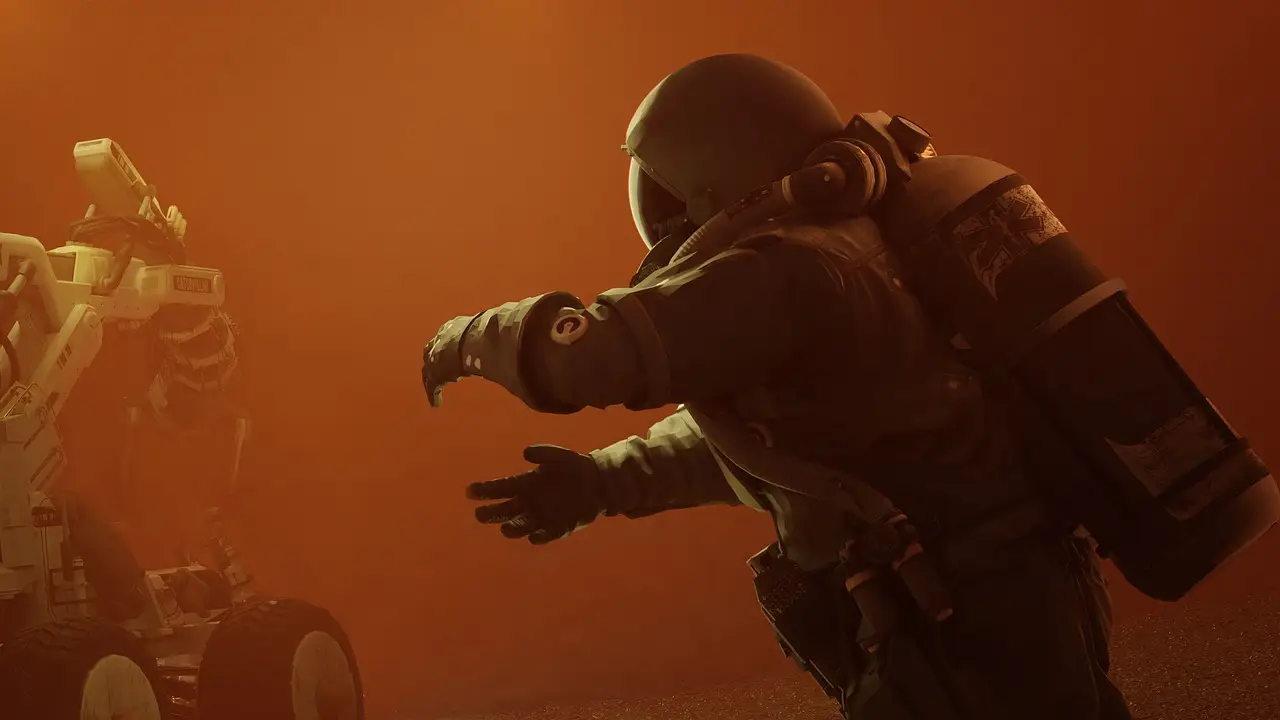
After 378 days sealed inside a simulated Mars habitat, four volunteers walked out into the Houston daylight on October 31, 2026. Ross Elder, Ellen Ellis, Matthew Montgomery and James Spicer had entered NASA's Crew Health and Performance Exploration Analog (CHAPEA, the agency's Earth-based Mars mission simulation) on October 19, 2025. They left it a year later, waving and giving thumbs-up in black jumpsuits beside a NASA water tower.
The crew carried defined roles that mirrored a real mission: Elder served as commander, Ellis as medical officer, Montgomery as science officer and Spicer as flight engineer. None of the four are astronauts. They are trained volunteers, and that distinction is precisely the point — NASA wants to understand how ordinary, well-prepared humans hold up under Mars-like conditions before it commits astronauts to the journey.
What did the crew actually do for a year?
The mission compressed the texture of a Mars expedition into a single building at Johnson Space Center. The crew:
- grew their own crops and vegetables;
- maintained their own health and the habitat itself;
- performed simulated 'Marswalks' (spacewalks on a simulated Martian surface) involving geology, building and exploration;
- practiced robotic operations and habitat maintenance;
- managed deliberately imposed stresses, including limited water supplies and staged equipment failures.
One of the most consequential tests was invisible from the outside. Every message between the crew and 'Earth' arrived with a delay of 26 to 44 minutes, mirroring the lag real signals would face traveling between Mars and home. The crew could not instantly ask for advice, and NASA wanted to learn how people cope, decide and troubleshoot when help is that far away.
What did the crew say the hardest part was?
In their first accounts after emerging, the volunteers pointed past the technical workload. Future Mars astronauts will certainly need to fix things themselves, they said, but the deeper challenge is psychological.
The interior of the habitat, they reported, was unusually quiet. Personal time was scarce. The balance between work, rest and private life emerged as a genuine strain — one that any real Mars crew would face for far longer than a year.
Throughout the mission, scientists monitored the four volunteers' mental health and the social dynamics of the group, pairing the Mars-realistic conditions with physiological, psychological and performance measurements.
Michael Stenger, chief scientist for NASA's Human Research Program, said: "This mission has been incredibly valuable in starting to teach us how to understand requirements for year-long missions, including medical and psychological care, via communication delays."
He added that combining the Mars-realistic analog with a rigorous suite of measurements in a controlled environment would let NASA "translate the knowledge from these experiences to Moon Base and beyond."
Where does this fit in NASA's plans?
NASA first unveiled the Mars habitat simulation in 2023. The mission that just ended was the second of three planned CHAPEA simulations, all housed at Johnson Space Center in Houston.
The habitat itself is an engineering experiment as much as a human one: a giant 3D printer assembled the structure layer by layer, testing a construction technique NASA could one day use to build shelters on other worlds without shipping materials from Earth.
CHAPEA sits inside a broader architecture. The Artemis program (NASA's effort to return humans to the Moon) has, in the agency's stated words, the goal to "establish a sustainable presence on the moon to prepare for human missions to Mars." The lunar surface serves as the proving ground; the lessons from a quiet building in Houston feed directly into that chain.
The findings remain preliminary in one important sense: the full value will come only after NASA completes the remaining planned simulation and compares results across crews and missions. The second crew now faces two weeks of post-mission evaluations and debriefing before reentering ordinary life.
Four people walked into a building to find out whether humans are ready for Mars. A year later, they walked out with the answer still being written — one quieter, slower and more human than anyone expected.
via nasa.gov (Original)
More from Priya Raman
Show full bio
Senior reporter covering people, launches and day-to-day practice in general science news at SciBeat.
282 articles
Nearby plates
- NASA's Simulated Mars Crew Reaches One Year Locked in Houston Habitat
- SpaceX Launches Crew-13: Fast Track to Space Station Begins
- Crew-12 Astronauts Return After 237 Days and 100 Million Miles in Orbit
- Crew-13 Launches: Four Astronauts Head to Space Station
- Four astronauts splash down in Pacific after eight-month ISS mission