Plate Nº 73 · recorded October 10, 2026
Space & AstronomyReported finding
JWST's Little Red Dots May Be Black Holes Growing Faster Than Today's
New ATERUI III simulations suggest JWST's Little Red Dots are early-Universe black holes growing dozens of times faster than modern ones, possibly solving a long-standing cosmic puzzle about supermassive black holes.
By Elena Vasquez3 min read605 words
In brief
- Study published September 17, 2026 in Nature; led by Sunmyon Chon of the Max Planck Institute for Astrophysics
- Some supermassive black holes contain up to 1 billion solar masses yet existed less than 600 million years after the Big Bang
- Simulated black holes grew dozens of times faster than modern black holes
- Simulations ran on Japan's ATERUI III supercomputer at the National Astronomical Observatory of Japan
- The model requires no exotic physics; conditions arose naturally in the early Universe
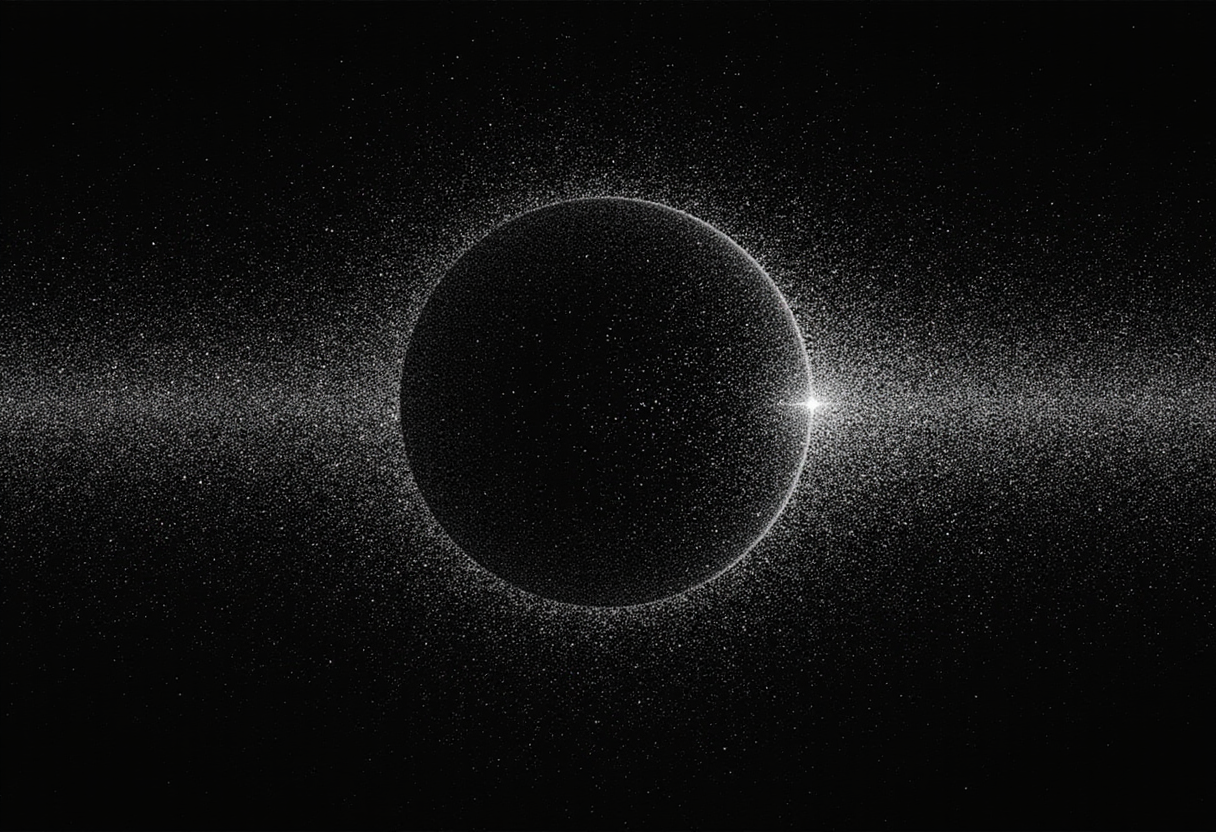
Supermassive black holes containing up to a billion times the Sun's mass already existed less than 600 million years after the Big Bang — a puzzle that has frustrated astronomers for years. A study published September 17, 2026 in Nature suggests JWST's mysterious "Little Red Dots" may be the answer: rapidly growing black holes that exploited early-Universe conditions no longer seen today.
The work, led by Sunmyon Chon of the Max Planck Institute for Astrophysics, used Japan's ATERUI III supercomputer to run some of the highest-resolution simulations of the early cosmos yet attempted.
What are the Little Red Dots?
Among the strangest discoveries made by the James Webb Space Telescope is a large population of tiny, intensely red objects researchers call Little Red Dots, or LRDs. First spotted in deep JWST surveys, they appear compact and unusually red. Their color hints at either dust-enshrouded galaxies or accreting black holes. Their true nature has remained unclear.
How did the new study tackle the mystery?
A team led by Sunmyon Chon of the Max Planck Institute for Astrophysics ran some of the most detailed cosmological simulations of the early Universe yet produced. The work used Japan's ATERUI III supercomputer at the National Astronomical Observatory of Japan. The simulation started on a young galaxy and zoomed in to individual gas clouds.
The result: simulated objects whose properties closely match the LRDs that Webb has actually observed.
How could these black holes form so quickly?
The simulations point to a two-step process. First, intense far-ultraviolet (FUV) radiation from nearby galaxies prevents ordinary stars from forming inside some gas clouds. The gas, instead of fragmenting into many smaller stars, collapses into a single supermassive star. That star then collapses to create a black hole seed — a starting point heavy enough to grow rapidly.
Second, dense gas around the seed forms a thick, radiation-trapping disk. This environment lets the black hole consume material far more efficiently than black holes can in the modern Universe, allowing growth dozens of times faster than is possible today.
Why is the early-black-hole puzzle so stubborn?
Astronomers have long struggled to explain how supermassive black holes — some containing millions or billions of solar masses — appeared so soon after the Big Bang. JWST was expected to help by detecting fainter, more distant galaxies than earlier observatories could see. The telescope's infrared sensitivity lets it peer back across most of cosmic history.
Because light travels at a finite speed, looking deep into space also means looking back in time. A galaxy 12 billion light-years away appears as it did 12 billion years ago, when the Universe was less than 2 billion years old — only a small fraction of its current 13.8-billion-year age.
Instead of immediately resolving the puzzle, JWST revealed something unexpected: thousands of tiny, extremely red LRDs scattered across the early cosmos.
Do the simulations require exotic physics?
No. Chon's team argues the model does not require unusual physics or highly unlikely events. The conditions needed to create and rapidly grow these black holes developed naturally in the young cosmos. That could explain why LRDs appear so common in JWST observations — they would be a natural byproduct of early galaxy evolution rather than a rare anomaly.
What comes next?
As JWST continues to find more LRDs and future telescopes look deeper into cosmic history, this model could give astronomers a framework for understanding how the earliest black holes formed and shaped galaxy evolution. Further observations will need to confirm whether the simulated objects truly match the real LRDs in detail.
via nao.ac.jp (Original)
More from Elena Vasquez
Nearby plates
- Millions of Planets Could Orbit Supermassive Black Holes, Simulations Show
- Simulations Reconstruct How the First Stars Forged the Universe
- Astronomers Find First Milky Way Black Hole Jet Pointed at Earth
- Webb Telescope Spots Mars-Sized Worlds Smashing Together
- A Star Is Slowly Eating Its Companion — and Could for Billions of Years