Recorded November 20, 2026
Space & AstronomyReported finding
Mercury-Bound X-Ray Telescope Passes First Space Test After 8 Years
After 8 years and 10 billion km, the Leicester-built MIXS telescope imaged the Crab Nebula — its resolution slightly better than its 2015 lab calibration. BepiColombo enters Mercury orbit Nov. 21.
By Nathan Brooks3 min read691 words
In brief
- MIXS observed the Crab Nebula, 6,500 light-years away, over 39 hours on Sept. 11–12 using 55 spacecraft slews
- Angular resolution slightly better than the 2015 laboratory calibration, after 8 years and 10 billion km traveled
- BepiColombo enters Mercury orbit on Nov. 21; science phase begins April 2027
- MIXS is the first imaging X-ray telescope on a planetary science mission and the only U.K.-led instrument aboard
- 80% of the technology on MIXS is new, according to PI Emma Bunce
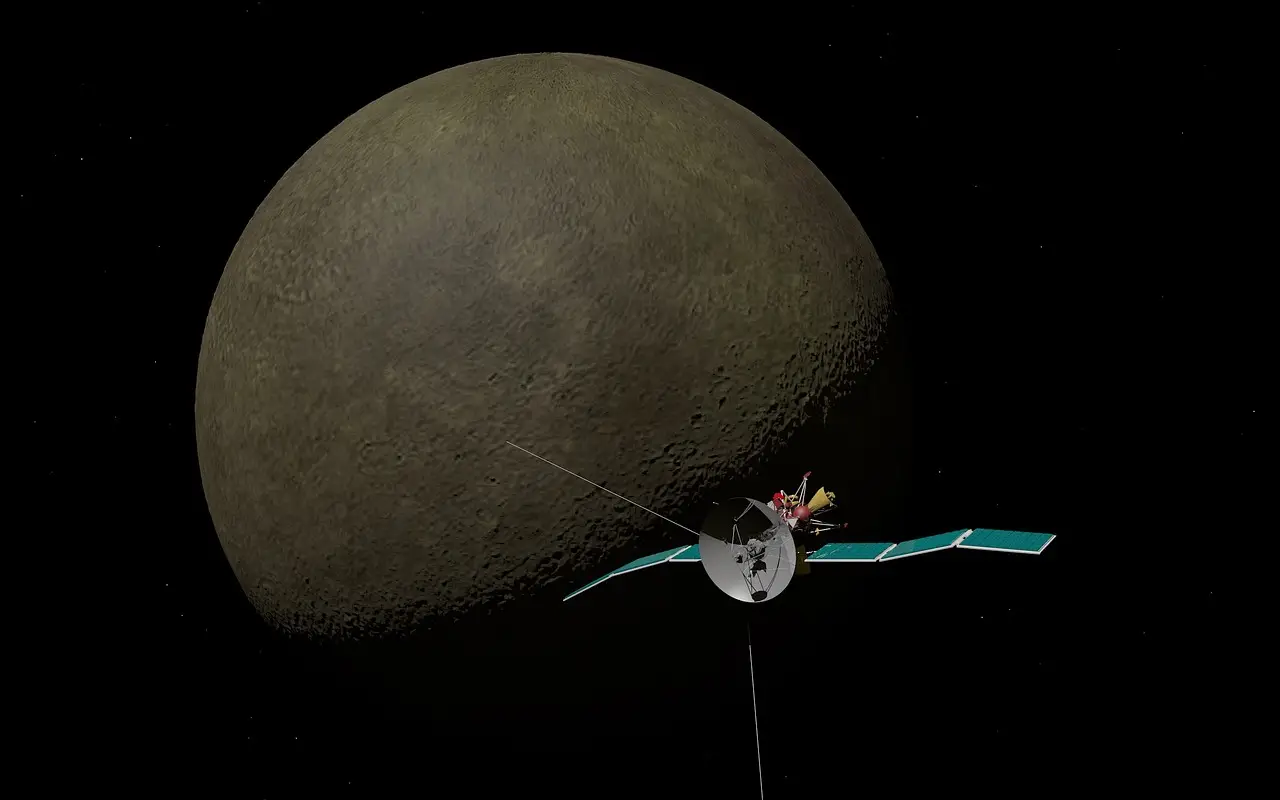
A U.K.-built X-ray telescope hurtling toward Mercury has delivered its first images of an astronomical target — and its resolution is slightly better than when engineers last tested it on the ground in 2015.
The Mercury Imaging X-ray Spectrometer (MIXS) observed the Crab Nebula, a well-studied X-ray source 6,500 light-years away, during a 39-hour campaign on Sept. 11–12. The campaign ran aboard the ESA/JAXA BepiColombo spacecraft, which begins its orbital insertion at Mercury on Nov. 21.
A team led by the University of Leicester has monitored MIXS throughout its eight-year cruise, but the instrument could only see into space after the mission's transfer module separated from the two science orbiters in September. That separation cleared the telescope's view for the first time since launch.
What did the measurements show?
The observation sequence consisted of 55 spacecraft slews. By measuring how much the Crab Nebula's image spreads across MIXS's detector, scientists determined the instrument's angular resolution — essentially, how sharply it can distinguish fine features. That figure came out slightly better than the laboratory calibration from 2015, despite eight years in space.
The health check brought welcome news on several fronts. Emma Bunce, MIXS principal investigator and director of the Institute for Space at the University of Leicester, said: "We have waited a long time to make measurements with MIXS and it is fantastic to see it operating brilliantly in space."
The team found:
- No "stray light" effects — unwanted optical photons leaking into the optics
- No radiation damage to the detector after eight years in space
- Known cosmic-ray effects that can be filtered out
- Some self-fluorescence when sunlight hits the optic, which won't affect planned dayside observations of Mercury's surface
"Eighty percent of the technology on MIXS is new!" Bunce added. She noted the team is still studying some instrument effects and expects to fine-tune MIXS during the Mercury commissioning phase before science operations begin.
Why map Mercury with X-rays?
MIXS rides on BepiColombo's Mercury Planetary Orbiter (MPO) and was built by a Europe-wide consortium led by Leicester. It's the first imaging X-ray telescope ever flown on a planetary science mission, and the only U.K.-led science instrument on BepiColombo, supported by the UK Space Agency.
Its job is unusual: the instrument will measure fluorescent X-rays — light emitted by Mercury's surface rocks after high-energy solar X-rays strike them. Working with a companion sensor called SIXS, MIXS will help produce a global map of the planet's surface atomic composition in unprecedented detail. It will also watch X-rays on Mercury's nightside, produced by particles from the planet's magnetosphere, to probe how the space environment interacts with the surface.
The mission itself targets bigger questions. BepiColombo will study Mercury — the smallest and least explored rocky planet in our solar system — and scientists hope the data will clarify how a planet forms and evolves so close to its parent star, and what that reveals about the solar system's overall history.
A 20-year road to first light
The instrument has been more than two decades in development. Adrian Martindale, MIXS instrument scientist at Leicester's School of Physics and Astronomy, joined the mission in 2003 as an undergraduate student.
"These first data are mind-blowing to me," Martindale said. "After a rocket launch, eight years in space and 10 billion kilometers (6.2 billion miles) traveled, it looks just the same."
MIXS also carries a personal legacy. Professor George Fraser, the original principal investigator and the designer of the instrument's novel optics, died in March 2014. "We are thinking of George as we operate MIXS fully in space for the first time," Bunce said, "and know that he would be very, very proud of the team."
BepiColombo's arrival phase began Sept. 3 with the transfer module's separation. The composite spacecraft enters Mercury orbit on Nov. 21; the two orbiters, MPO and Mio, separate on Dec. 9–10. The full science phase is set to begin in April 2027.
via phys.org/rss-feed/ (Source)
More from Nathan Brooks
Show full bio
Market editor covering companies, deals and strategy in general science news at SciBeat.
563 articles