Recorded November 25, 2026
Earth & ClimateReported finding
Myanmar's 2025 M7.8 quake shows fault memory can forecast slip
Simulations of the 2025 M7.8 Mandalay quake, which killed over 3,700 people, show fault strain buildup set a reliable lower bound on slip — a clue for the San Andreas.
By Priya Raman4 min read830 words
In brief
- The 2025 M7.8 Mandalay earthquake killed more than 3,700 people and produced one of the longest strike-slip ruptures ever documented.
- The study, published in Nature Communications in October 2026, found slip matched or exceeded strain built up since the last large quake — 'minimal slip predictability'.
- The southern San Andreas fault has not had a major earthquake in about 300 years, meaning a larger future rupture is possible.
- Simulations ran on TACC's Frontera and Vista, and will run on Horizon, which entered early operations in November 2026.
- The rupture was supershear, propagating faster than its shear waves, like a supersonic aircraft.
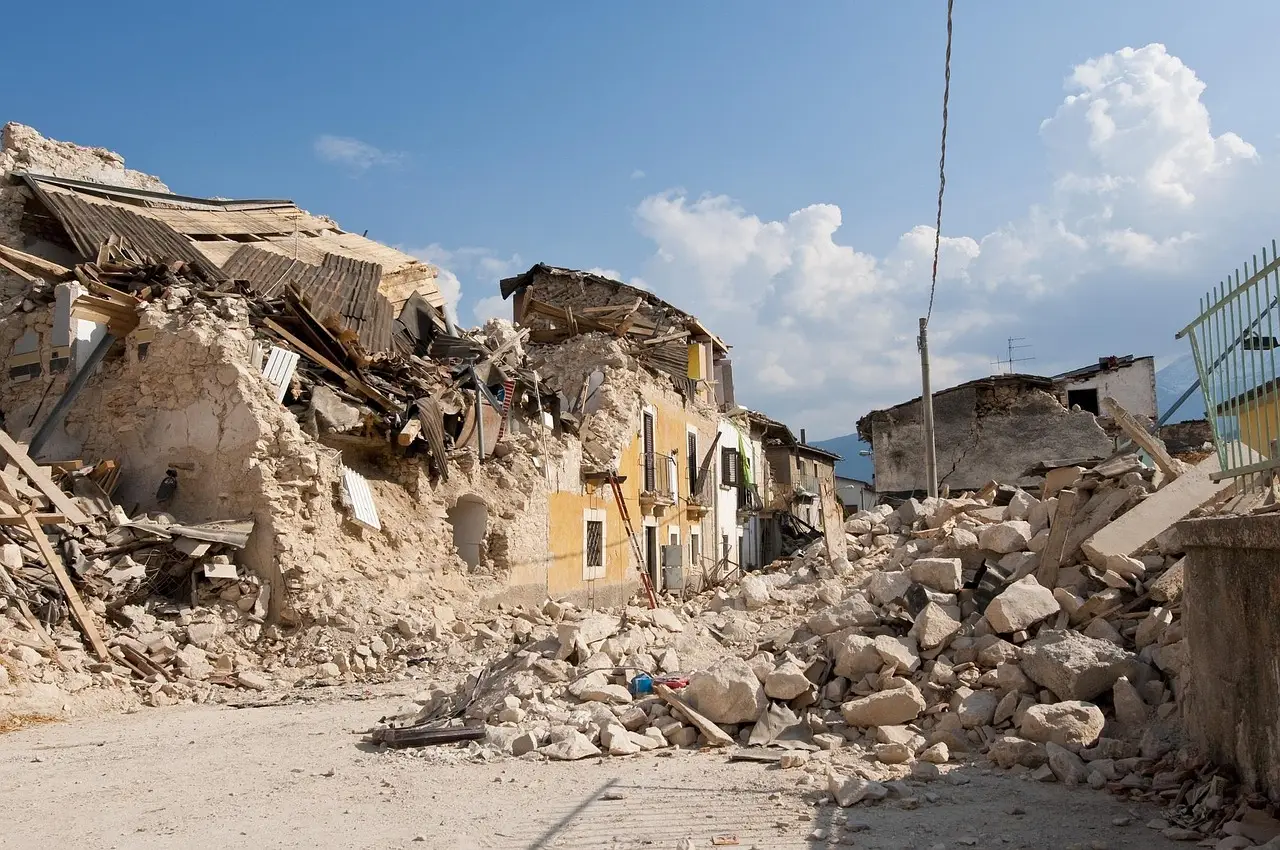
The 2025 M7.8 earthquake in Mandalay, Myanmar, slipped roughly as much as had accumulated on the quietest parts of the fault — a finding, published in Nature Communications in October 2026, that suggests scientists can partly anticipate future earthquakes even though exact timing remains out of reach.
The quake killed more than 3,700 people and produced one of the longest strike-slip ruptures (a rupture in which two crustal blocks slide horizontally past each other) ever documented. Alice-Agnes Gabriel, an associate professor at the Scripps Institution of Oceanography, UC San Diego, led an international team from the U.S., Europe and Myanmar in building an ensemble — a set of hundreds of candidate models — of 3D dynamic rupture simulations of the event.
"We can make predictions about some aspects of future large earthquakes such as how much slip to expect, which part of the fault will move the most, and even how fast it will rupture, to some extent," Gabriel said.
"Whenever one of these events happens, it's devastating. But it's also an opportunity for our field to improve our fundamental understanding, and then to think about what we can learn to be better prepared for future earthquakes," she added.
How did the team reconstruct the quake?
The researchers combined high-performance computing with an unusually rich data set:
- long-term GPS measurements of ground movement;
- space geodesy, the measurement of the Earth's shape from satellites;
- seismograms recorded around the globe;
- and the first known video of a fault slipping at the surface, captured by a CCTV security camera.
The team calculated, from GPS data and the record of past earthquakes, how much slip had built up on each segment of the fault since its last large earthquake. That accumulated strain served as a proxy for how far the ground might rebound when the fault finally broke.
"We try to predict from data collected before the earthquake and test it against what was recorded," Gabriel explained. The team ran hundreds of physics-based simulations of the earthquake and seismic wave propagation, validating each against the data until one best matched reality.
What is minimal slip predictability?
The result surprised the researchers. Where the fault had been quiet longest — including a known seismic gap — the earthquake slipped about as much as had built up. Elsewhere, it slipped even more. Accumulated strain, in other words, acted as a reliable lower bound on future slip. The team calls this property minimal slip predictability.
A similar pattern turned up in the 2023 earthquakes in Türkiye, and the group now plans to test the hypothesis on more large earthquakes.
The Mandalay quake was also a supershear rupture: it propagated faster than the shear waves it generated, the same effect as an airplane breaking the sound barrier. "That can change how much shaking we expect," Gabriel noted.
Which machines ran the models?
The simulations ran on an arsenal of supercomputers: Frontera and Vista at the Texas Advanced Computing Center (TACC), plus systems at NASA, the Gauss Centre for Supercomputing, EuroHPC and the Institute of Geophysics of LMU Munich. The team's open-source code, SeisSol, is one of the National Science Foundation's Characteristic Science Applications selected to help design TACC's Horizon supercomputer, the centerpiece of the NSF Leadership-Class Computing Facility, which entered early operations in November 2026.
Vista's AI-focused graphics processors proved especially useful. "It's a race against time when we're performing these rapid-response studies, so it's been very helpful to have access to the newest hardware. It's basically a game changer," Gabriel said.
What does this mean for California?
The southern San Andreas fault has not produced a major earthquake in roughly 300 years. If minimal slip predictability holds there, the next big one could be larger than its predecessors.
In October 2026, millions of Californians practiced "Drop, Cover, and Hold On" in the Great California ShakeOut drill, built on a hypothetical M7.8 San Andreas scenario that scientists at a Statewide California Earthquake Center workshop are now updating with SeisSol-based dynamic rupture simulations. ShakeOut Scenario 2.0, which held its first workshop at the University of Southern California that month, will run its ground-motion computations on Horizon.
"These scenario simulations are informing engineers, social scientists, decision makers, emergency managers and even local governments for hazard mitigation and preparedness," Gabriel said.
Next, the team aims to scale up ensemble simulations on GPUs and to use scientific machine learning — surrogate models trained on high-resolution simulations — to deliver faster shake maps and early-warning estimates, though the underlying physics simulations, Gabriel cautioned, remain necessary to train those tools.
The paper is Thomas Ulrich et al., "On predictability of slip, rupture geometry, and speed of the 2025 M7.8 Mandalay, Myanmar, earthquake," Nature Communications (2026), DOI: 10.1038/s41467-026-77203-x.
For now, the timing of the next big one stays unknown — but its size is starting to look predictable.
via phys.org/rss-feed/ (Source)
More from Priya Raman
Show full bio
Senior reporter covering people, launches and day-to-day practice in general science news at SciBeat.
581 articles
Nearby plates
- Southern California Faults Hit 1,000-Year Stress High, Study Finds
- Study links distant earthquakes to lingering fault weakening
- 362 Hidden Earthquakes Detected Under Antarctica's Doomsday Glacier
- Türkiye’s faults reveal missing shearing and earlier extension
- Lab Tests Overestimate Volcanic Tsunamis, Stromboli Study Finds