Plate Nº 53 · recorded November 14, 2026
Space & AstronomyReported finding
Nov. 13, 1971: NASA's Mariner 9 Became First Craft to Orbit Mars
On Nov. 13, 1971, NASA's Mariner 9 became the first spacecraft to orbit Mars, mapping 85% of the surface and discovering Olympus Mons and Valles Marineris.
By Nathan Brooks4 min read725 words
In brief
- Mariner 9 entered Mars orbit on Nov. 13, 1971, beating the Soviet Mars 2 despite an 11-day head start for the Soviets.
- The spacecraft mapped 85% of Mars and took 7,329 photos at 1-2 km resolution.
- It discovered 20 giant volcanoes, including Olympus Mons, the tallest in the solar system.
- Valles Marineris, mapped by the probe, runs 2,500 miles long — five times the Grand Canyon.
- NASA shut the mission down in October 1972 after its nitrogen thruster supply ran dry.
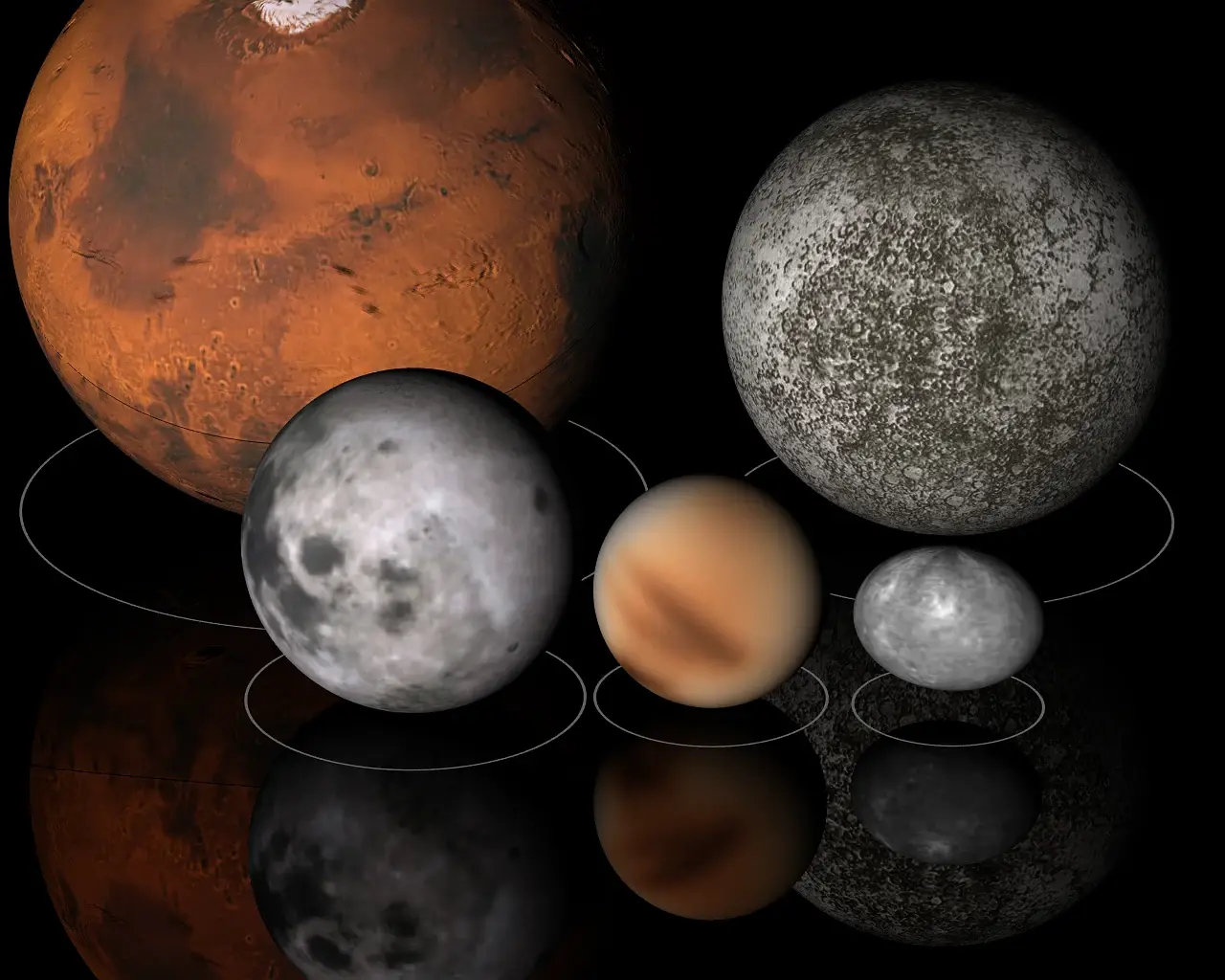
On Nov. 13, 1971, NASA's Mariner 9 became the first spacecraft ever to enter orbit around Mars — and the images it sent back rewrote everything scientists thought they knew about the Red Planet.
The mission mapped 85% of the Martian surface over nearly a year in orbit, according to NASA. It snapped 7,329 photos of Mars, plus at least 80 more of the planet's two small moons, Phobos and Deimos. Before Mariner 9, Mars was mostly a mystery. After it, Mars had become what NASA describes as a full world for humans to explore.
Why did Mariner 9 surprise scientists so much?
In the years before 1971, NASA had flown several missions past Mars without stopping. Those flybys showed a cratered surface, and some scientists concluded that Mars looked essentially like the Moon — a dead, pockmarked ball of rock. Mariner 9 blew their minds, as the mission's history now puts it.
The spacecraft arrived in the middle of a global dust storm, its view of the surface almost entirely blocked. But it could see tall structures poking through the clouds. When the dust finally settled, the images revealed what those structures were: the summits of enormous volcanoes.
One of them was Olympus Mons, the tallest volcano in the solar system. Mariner 9 went on to discover 20 giant volcanoes on Mars in total.
The probe also spotted a canyon system of staggering scale. Valles Marineris stretches 2,500 miles (4,000 kilometers) across the Tharsis region and runs 120 miles (200 km) wide — roughly five times longer than the Grand Canyon in Arizona. "The canyon was named in honor of Mariner 9," NASA said in a mission overview.
How did Mariner 9 beat the Soviets?
Mariner 9 wasn't the only spacecraft racing to Mars that November. The Soviet Union's Mars 2 probe "had an 11-day head start," NASA said in a mission description. Mariner 9 got there first anyway, entering orbit on Nov. 13, 1971.
Mars 2 still earned its own footnote in history: it became the first human-built craft to reach the surface of Mars when it crashed into the planet. But an orbiting mission can study a world for months; a crash gives you one moment of data. The lasting scientific legacy of 1971 belonged to Mariner 9.
What instruments did the spacecraft carry?
Mariner 9 carried four primary instruments, each suited to a different job:
- A camera system for imaging the surface
- An ultraviolet spectrometer, which measures light at wavelengths shorter than the eye can see
- An infrared spectrometer, which reads heat-carrying wavelengths to identify surface materials
- An infrared radiometer, which measured temperatures across the planet
With that toolkit, Mariner 9 mapped Mars down to a resolution of between half a mile and one mile (1-2 km). That means every pixel in its maps represented a patch of ground no bigger than a city block — crude by today's standards, but revolutionary at a time when scientists weren't sure whether Mars was just a Moon lookalike.
How did the mission end?
Mariner 9 worked in orbit for about one year. By February 1972, its supply of gaseous nitrogen — the fuel that fed its attitude control thrusters, the small engines that keep a spacecraft pointed in the right direction — had run dry.
NASA finally shut the mission down in October 1972. When the spacecraft ran out of gas, there was nothing left to steer with, so engineers on the ground turned it off for good.
The probe itself almost certainly remains in orbit around Mars today, silent but still circling. Even so, NASA counts it among the most famous Mars voyagers of all time.
Why does it still matter?
Mariner 9 established the template that every Mars orbiter since has followed: go, circle, map, and stay long enough to watch the planet change. Its discovery of Olympus Mons and Valles Marineris proved Mars was a geologically dramatic world, not the static moon-like disc that flyby images had suggested.
The numbers tell the story of that shift. Eighty-five percent of the planet mapped. Twenty giant volcanoes catalogued. A canyon system 2,500 miles long that now carries the spacecraft's own name. Fifty-plus years later, every Mars mission stands on what Mariner 9 saw from orbit between 1971 and 1972.
via space.com (Source)
More from Nathan Brooks
Show full bio
Market editor covering companies, deals and strategy in general science news at SciBeat.
360 articles
Nearby plates
- Mars' Grand Canyon Is Still Tectonically Active, Study Finds
- Perseverance rover uncovers three water histories in Jezero Crater
- Simulated collisions show how Phobos could preserve Martian rocks
- NASA Joins Japan's MMX Mission to Bring Home a Piece of Phobos
- First Phobos sample mission launches 19 October, JAXA confirms