Plate Nº 10 · recorded October 15, 2026
Space & AstronomyReported finding
NASA Joins Japan's MMX Mission to Bring Home a Piece of Phobos
NASA is supplying instruments, a pneumatic sampler and 10 scientists to Japan's MMX mission, which launches Oct. 19 and aims to return Phobos material to Earth in 2031.
By Nathan Brooks4 min read823 words
In brief
- MMX launches from Tanegashima Space Center at 3:41 p.m. EDT on Oct. 19 (4:41 a.m. JST Oct. 20).
- The spacecraft arrives at Mars in August 2027 and collects a Phobos sample no earlier than December 2028.
- Samples reach Earth in 2031; NASA curates about 15% of the total at Johnson Space Center in Houston.
- NASA's contributions include the MEGANE spectrograph, the P-Sampler, Deep Space Network support and 10 funded U.S. scientists.
- The mission aims to determine whether Phobos and Deimos formed from a Mars impact or are captured ancient asteroids.
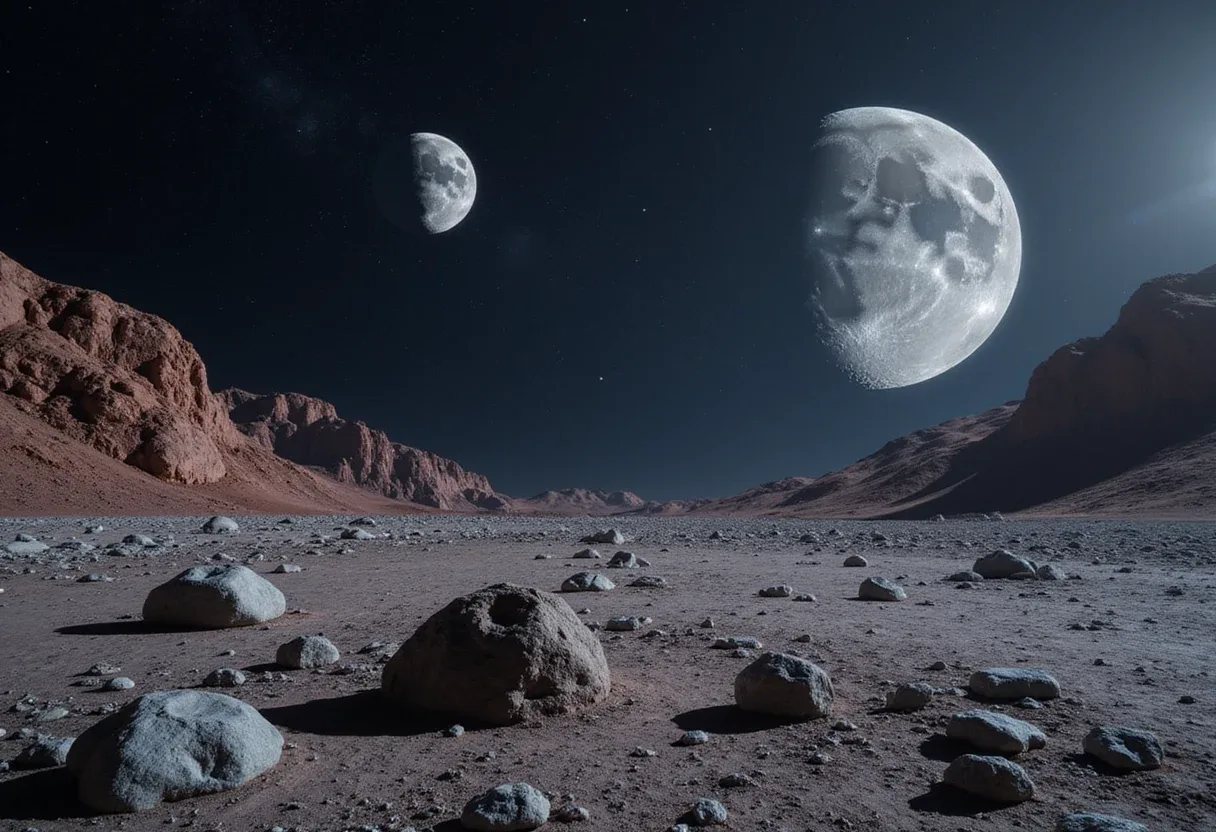
A spacecraft is scheduled to lift off from Japan on Monday, Oct. 19, at 3:41 p.m. EDT, carrying NASA-built hardware on a mission to grab the first-ever sample of a Martian moon.
The spacecraft belongs to MMX — short for Martian Moons eXploration — run by JAXA, the Japan Aerospace Exploration Agency. It will launch from JAXA's Tanegashima Space Center, which is 4:41 a.m. local time on Tuesday, Oct. 20, in Japan. NASA is supplying instruments, a sampling device, communications support and U.S. scientists for the mission's science team.
The payoff, if everything works: roughly a decade-long effort that ends with material from Phobos, the larger of Mars' two moons, delivered to laboratories on Earth in 2031.
"The samples from MMX will bring forth paradigm-shifting science on the Mars system for generations to come, especially as NASA prepares to send the first humans to Mars," said Nicky Fox, associate administrator of NASA's Science Mission Directorate in Washington.
Why fly all the way to a Martian moon?
Scientists have argued for years about where Phobos and Deimos came from, and the two leading ideas couldn't be more different. Either the moons formed from debris blasted into orbit by a massive impact on Mars, or they're captured asteroids trapped by the planet's gravity billions of years ago.
The answer matters beyond Mars itself.
"Phobos and Deimos may be the remains of a massive impact on Mars that sent material into orbit around the planet, or they could be ancient asteroids that were captured by Mars' gravity billions of years ago," said Tom Statler, MMX program executive and program scientist at NASA Headquarters. "Having the answer will help illuminate that early era when Earth and the other inner planets may have been acquiring much of their water and organic compounds."
In other words, a lumpy moon orbiting Mars could tell us something about how our own planet picked up the ingredients for life.
What exactly is NASA contributing?
NASA's role in MMX breaks down into four parts:
- MEGANE — a spectrograph (pronounced meh-GAH-nay, the Japanese word for eyeglasses) that "sees" what Phobos is made of by measuring neutrons and gamma rays from its surface. The instrument was built by the Johns Hopkins Applied Physics Laboratory.
- P-Sampler — a pneumatic sampler mounted on a landing leg that collects surface material using bursts of high-pressure nitrogen gas. Honeybee Robotics, a Blue Origin company, built it.
- Deep Space Network — NASA's antenna array will provide communications and navigation support.
- Scientists — NASA funds 10 U.S. researchers on the MMX science team.
NASA developed its contributions under the Discovery Program, managed by the Marshall Space Flight Center in Huntsville, Alabama.
How will the sampling work?
The P-Sampler complements JAXA's own C-Sampler. Think of it as two scoops at different depths: NASA's device brushes the surface with gas puffs, while JAXA's tool drills cores from a few inches deeper down.
That division of labor gives scientists both exposed material and material sheltered from space weathering — a useful cross-check when piecing together the moon's history.
NASA will receive and curate about 15% of the total returned sample at the Johnson Space Center's Astromaterials Lab in Houston. That stash, roughly one-seventh of the haul, will stay available for research for decades — the same model that let generations of scientists keep finding new things in Apollo moon rocks.
"The NASA-JAXA sample curation partnership is extremely valuable, and I am proud that NASA Science is supporting MMX sample curation and will be sharing portions of these samples for study as we continue to expand humanity's understanding of the universe for the benefit of all," Fox said.
What's the timeline?
The schedule runs well past the end of this decade:
- October 2026 (launch window opening Oct. 19): liftoff from Tanegashima Space Center.
- August 2027: arrival at Mars and the start of the survey of Phobos and Deimos.
- No earlier than December 2028: sample collection from Phobos, following a detailed survey.
- 2031: sample delivery to Earth.
What are the caveats?
All of this is preliminary scheduling, not a guarantee. Space missions slip, and "no earlier than December 2028" is mission-speak for: this date can move. The launch time itself is precise to the minute — 3:41 p.m. EDT — because planetary alignments dictate tight windows.
There's also the science to hedge. Whether the samples settle the origin debate depends on what Phobos is actually made of, and researchers won't know that until MEGANE's measurements come in and the material reaches labs.
Still, the mission follows a proven playbook. JAXA has returned samples from an asteroid before, and NASA's curation infrastructure has handled extraterrestrial material since Apollo. If MMX sticks its timeline, 2031 is when the first grains of a Martian moon land in Houston.
via nasa.gov (Original)
More from Nathan Brooks
Show full bio
Market editor covering companies, deals and strategy in general science news at SciBeat.
232 articles
Nearby plates
- First Phobos sample mission launches 19 October, JAXA confirms
- NASA Details Its Role in Japan's Mission to Mars's Moons
- A Giant Crater May Reveal Whether Phobos Is a Captured Asteroid
- NASA Picks Three Missions to Find Caves, Ice and Hazards for First Moon Base
- Eight Years in Space, and the Hard Part Starts Now