Plate Nº 45 · recorded September 29, 2026
Space & AstronomyReported finding
No Jupiter-Sized Planets Found in Historic Nearby Binary System
A record-sensitive survey of the binary system 70 Ophiuchi AB rules out Jupiter-mass planets near its stars, blaming stellar surface activity for a century-old wobble while leaving smaller worlds possible.
By Nathan Brooks4 min read753 words
In brief
- The study rules out planets of Jupiter's mass or larger within 5 astronomical units of 70 Oph A and within 0.5 astronomical units of 70 Oph B.
- 70 Ophiuchi AB, about 16 light-years away, became the first official exoplanet candidate system in 1855 after a claim by British astronomer William Jacob.
- A century of data plus new observations from Chile's Magellan Clay Telescope and Texas's Harlan J. Smith Telescope showed the stars' radial-velocity wobble comes from stellar surface variations, not a planet.
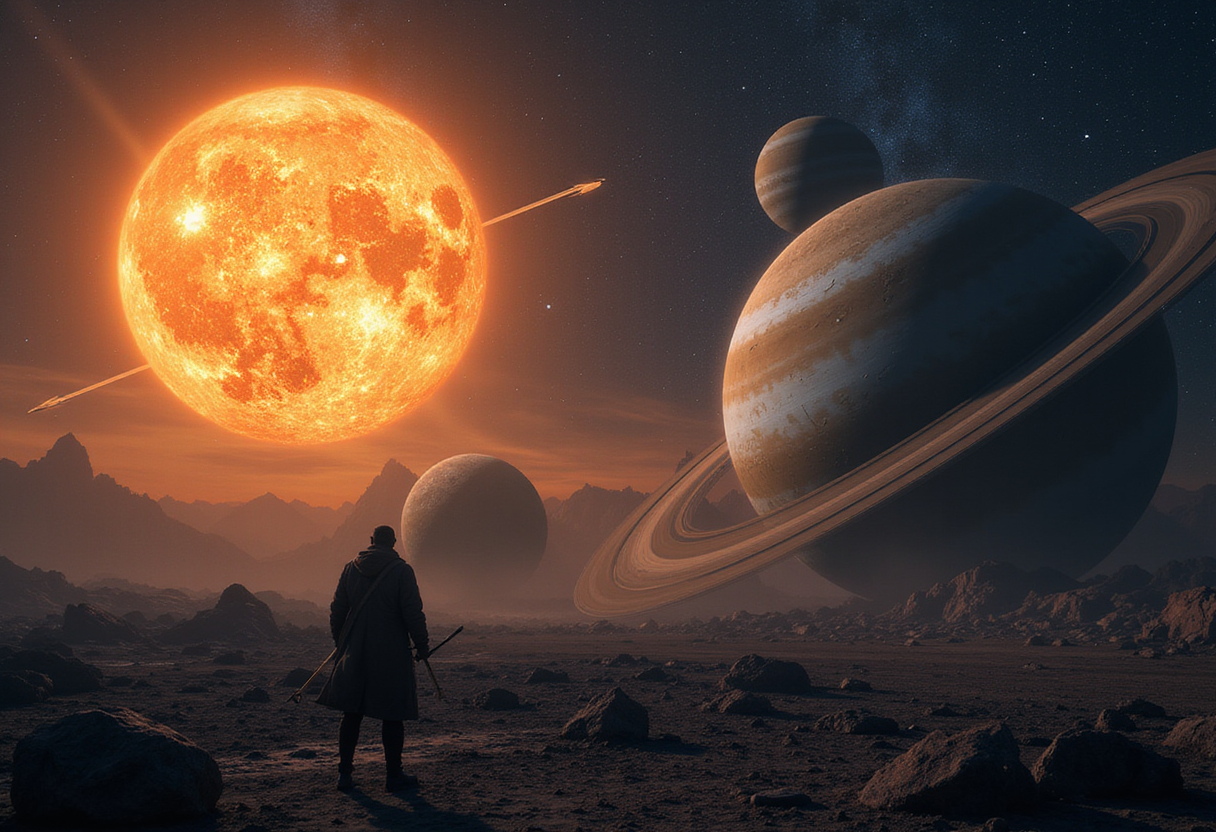
A team led by the University of Michigan has completed the most sensitive modern search for giant planets in a nearby two-star system known as 70 Ophiuchi AB, or 70 Oph AB. The search came up empty. And that absence, the researchers say, is itself a meaningful result.
With some important caveats, the study rules out planets with the mass of Jupiter or larger in the system's inner regions. The work, supported in part by NASA, was not designed to detect smaller planets, so worlds the size of Saturn or smaller could still orbit within the system's habitable zone—the region where temperatures would allow liquid water, a key ingredient for life as we know it, to exist on a rocky planet's surface.
"It's a mix of disappointment and excitement," said Yiting Li, a postdoctoral researcher in the university's Department of Astronomy. "We're finding out that there isn't a Jupiter-sized planet, but we're also opening the latest chapter on this historic system."
A planetary claim from 1855
That history runs deep. In 1855, the British astronomer William Jacob claimed that 70 Oph AB hosted a planet, making the system the first-ever official exoplanet candidate. Jacob's claim did not survive scrutiny. Yet the broader possibility of planets there has endured ever since, and the new study published in The Astrophysical Journal represents its latest chapter.
The system is a compelling target. While our solar system contains a single star, roughly half of the stellar systems in the Milky Way have at least two. Astronomers view these binaries as promising places to learn how planetary systems form, evolve, and perhaps support life.
70 Oph AB sits about 16 light-years from Earth. That makes it the third-closest binary system to us, behind only Alpha Centauri at 4.2 light-years and 61 Cygni at 11.4 light-years. With the new observations, the orbits of its two stars, 70 Oph A and 70 Oph B, now rank among the best characterized in the sky.
"The new limit enables us to design optimum search strategies in the future," said Michael Meyer, a senior co-author of the study and chair of the Michigan astronomy department. He noted that the university belongs to a team studying a proposed space mission called SHERA, which will focus on binaries and includes 70 Oph AB among a handful of targets. "70 Oph AB will certainly be a target of flagship missions, such as NASA's Habitable World Observatory."
Stellar activity explains the wobble
The research team included experts from more than a dozen institutions, among them NASA's Jet Propulsion Laboratory and IPAC at the California Institute of Technology. Their analysis rules out Jupiter-mass or larger planets within 5 astronomical units of 70 Oph A—one astronomical unit is the distance between Earth and the sun—and within half an astronomical unit of 70 Oph B.
The result settles a long-standing ambiguity. Although Jacob's original 1855 claim failed, more sophisticated measurements over the following 171 years had never ruled out Jupiter-sized planets in the system's inner regions. Even modern measurements of the stars' radial velocity—their speed toward or away from Earth—showed a "wobble" that could, until now, be explained by the gravitational tug of a Jupiter-sized planet, Li explained.
The team's analysis combined a century's worth of archived data with new observations from the 6.5-meter Magellan Clay Telescope at Las Campanas Observatory in Chile and the 2.7-meter Harlan J. Smith Telescope at McDonald Observatory in Texas. That sensitivity allowed the researchers to show the wobble stems from changes on the surfaces of the stars over time, not from an orbiting planet.
"Yiting assembled an absolutely huge amount of data from all over the world and carefully explored all possibilities," Meyer said. "It's a cautionary tale about how stellar activity can mimic planet signals using the radial velocity."
Smaller planets remain possible
The researchers stress that the study sets a boundary, not a verdict, on planets in this historic system. The findings should be read with caution, since the search targeted only giant planets and stellar activity remains a complicating factor in radial-velocity measurements.
"The study sets an upper limit, not a ban, on planets," Li said. "Given how prevalent planets are in our universe and in the Milky Way, I would wager that we'll find there are other planets there."
via Phys.org Space & Astronomy (Source)
More from Nathan Brooks
Nearby plates
- Two Suns, One Earthlike Planet? Nearby Star System Might Allow It
- Astronomers May Have Found a Planet Orbiting the Hottest Star Yet in Its Habitable Zone
- Earth and Mars Were Built From Different Cosmic Recipes
- Webb Telescope Witnesses Planet-Smashing Collisions Around Young Stars
- Simulations Reconstruct How the First Stars Forged the Universe