Plate Nº 24 · recorded October 2, 2026
Earth & ClimateReported finding
Two Suns, One Earthlike Planet? Nearby Star System Might Allow It
UC Riverside astronomers modeled the binary system 70 Ophiuchi and found an Earth-mass planet could hold a stable orbit in the habitable zone of one of its two stars.
By James Calloway4 min read772 words
In brief
- Researchers at UC Riverside published peer-reviewed simulations on September 29, 2026, in The Astrophysical Journal.
- The binary system 70 Ophiuchi lies about 16 light-years away, and an Earth-mass planet could remain stable in the habitable zone of its primary star.
- Around 85% of sun-like stars in the Milky Way have one or more stellar companions, making binary systems prime targets in the search for habitable worlds.
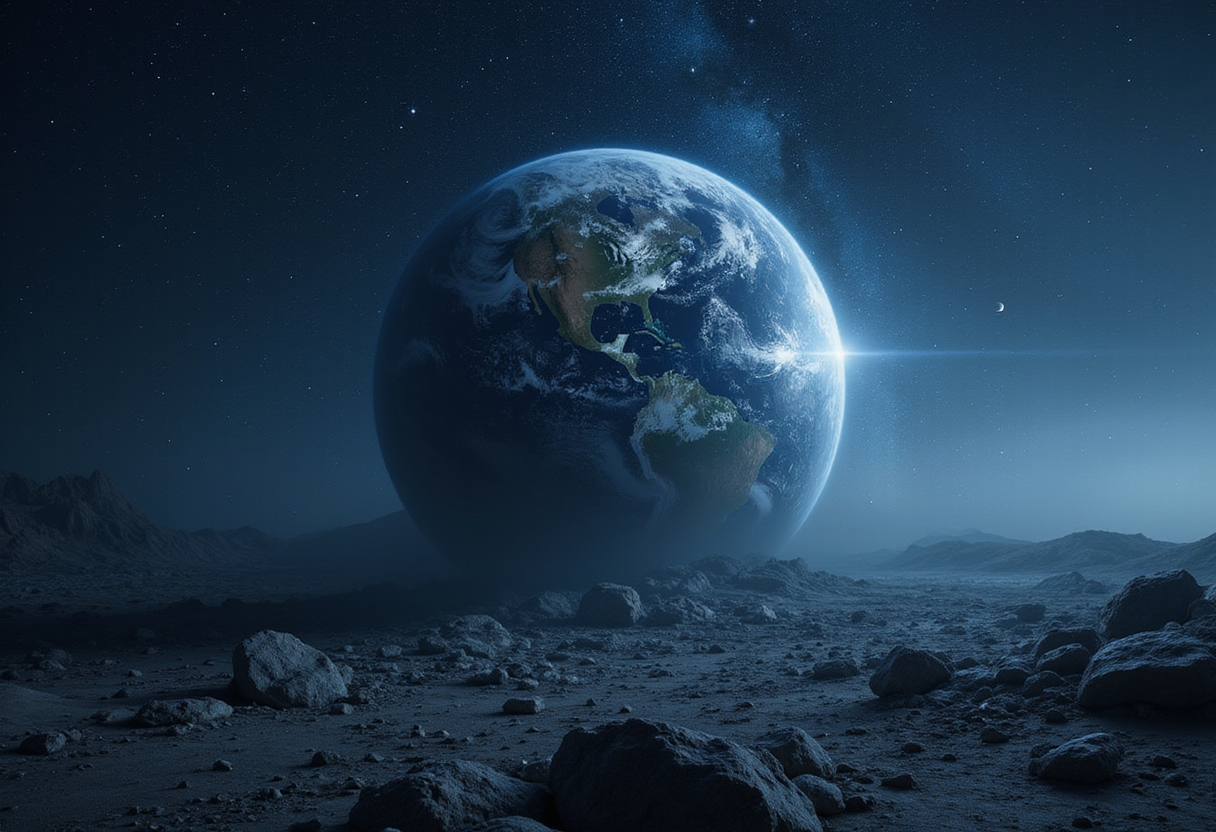
A planet with two suns sounds like science fiction — think Tatooine in "Star Wars" or Trisolaris in "The Three-Body Problem." But new research suggests such a world could exist just 16 light-years from Earth, orbiting one member of a nearby two-star pair.
On September 29, 2026, astronomers at the University of California, Riverside, announced that computer simulations of the binary system 70 Ophiuchi show an Earth-sized planet could hold a stable orbit within the habitable zone of one of its stars. The habitable zone is the region around a star where temperatures allow liquid water to remain stable on a planet's surface. The team published its peer-reviewed results the same day in The Astrophysical Journal.
Nobody has detected a planet in this system yet. The study does not claim one exists. What it shows is more modest but still significant: an Earth-mass planet could survive there in a stable orbit without being ejected or thrown into a lethal trajectory by the gravity of the second star.
A well-studied nearby pair
70 Ophiuchi sits in the constellation Ophiuchus the Serpent Bearer, close enough that observers at a dark-sky site can see it as a single dim point of light, shining at roughly magnitude 4. Both of its stars are slightly smaller and cooler than our sun, and astronomers have been watching the pair for decades — an early image of the system comes from the U.S. Naval Observatory in 1937.
That long observational record gave the researchers solid data on the stars' movements. From it, they built a computer model of the system and then did something simple in concept: they placed a hypothetical Earth-mass planet at various distances and let the simulation run.
"We calculated the boundaries of the habitable zone around the primary star," said co-author Skylar D'Angiolillo of UC Riverside. "Then I tested whether an Earth-mass planet could maintain a stable orbit at different distances within that zone."
The result surprised even the researchers. "What we found is that stable orbits are possible in the habitable zone of the primary star," D'Angiolillo said. "You might expect the second star to disrupt those orbits, but that isn't necessarily what happens."
The reason is orbital shape. "You can think of Earth's orbit as being fairly circular," D'Angiolillo explained. "An unstable planet's orbit can become increasingly elongated until eventually the planet is essentially flung away from the system. By repeating the simulation at different locations, we can identify regions where an Earth-sized planet could remain stable."
Why our sun is the oddball
The finding matters because single stars like our sun are the exception, not the rule. Roughly 85% of all sun-like stars in the Milky Way have one or more stellar companions. If habitable planets can form in binary systems, then potentially life-friendly worlds could exist around the most common types of stars in the galaxy.
"Having a 2nd sun may sound exotic, but we need to consider worlds that could be habitable without necessarily looking like Earth's neighborhood," said co-author Stephen Kane of UC Riverside.
The work also has a practical purpose. Before spending scarce telescope time on direct observations, astronomers can first ask a cheaper question: is a given system even capable of hosting a habitable planet?
"There are a lot of steps we can take before trying to directly observe a planet," D'Angiolillo said. "We can ask first: Is this system even capable of hosting a potentially habitable planet?"
She noted that this kind of dynamical vetting could prove useful for NASA's Habitable Worlds Observatory, a mission planned for the 2040s that will search for potentially habitable worlds. Many other binary systems could benefit from the same screening approach as scientists weigh possible targets.
Caveats and next steps
The results come from simulations, not detections. A stable orbit is a necessary condition for habitability, not a guarantee of it — the planet's atmosphere, composition, and history would all matter too. And no planet has yet been confirmed around either star in 70 Ophiuchi despite decades of monitoring.
Still, Kane remains optimistic that a real discovery could arrive sooner rather than later. "Who knows?" he said. "We might actually discover an Earth-size planet in the habitable zone that Skylar has predicted could be there even before the Habitable Worlds Observatory launches."
The team plans to keep investigating 70 Ophiuchi in the meantime. If a planet does turn up, it would give scientists their nearest confirmed example of a rocky world living under two suns.
via en.wikipedia.org (Original)
More from James Calloway
Nearby plates
- No Jupiter-Sized Planets Found in Historic Nearby Binary System
- Astronomers May Have Found a Planet Orbiting the Hottest Star Yet in Its Habitable Zone
- Webb Telescope Witnesses Planet-Smashing Collisions Around Young Stars
- Earth and Mars Were Built From Different Cosmic Recipes
- Faint Young Stars Suggest Messier 74 Is Nearly Twice as Large as Thought