Plate Nº 48 · recorded November 13, 2026
Biology & EvolutionReported finding
Parrots' Bright Feathers Fall Apart Fastest Under Bacterial Attack
A Princeton-led study in the Journal of Experimental Biology finds parrots' vivid psittacofulvin-pigmented feathers degrade fastest under bacterial attack, overturning a 2010 hypothesis.
By Marcus Bennett3 min read648 words
In brief
- The study tested thousands of parrot feathers against Bacillus licheniformis and published in the Journal of Experimental Biology (2026), DOI 10.1242/jeb.252685.
- Red, orange, yellow and green feathers containing psittacofulvins degraded most; black feathers with melanin degraded least.
- The results contradict a 2010 study that found red parrot feathers resisted bacterial attack.
- Lead author Jarome R. Ali is now a postdoctoral researcher at New York University; senior author Mary Caswell Stoddard is a Princeton professor.
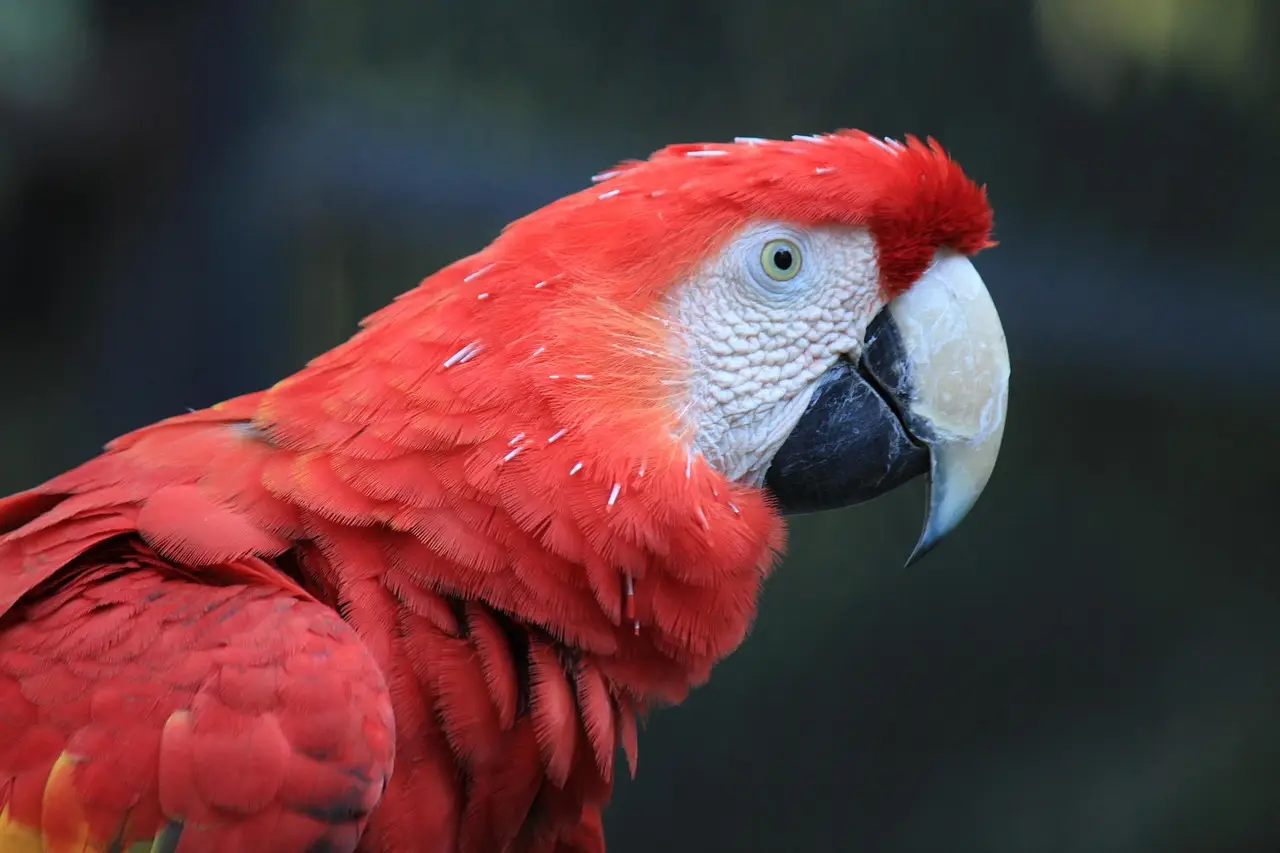
Brightly colored parrot feathers degrade faster under bacterial attack than drab ones, according to a new study in the Journal of Experimental Biology. Red, orange, yellow and green feathers—the ones packed with parrots' signature pigments—broke down the most, while black feathers resisted damage best.
The finding overturns a widely cited hypothesis from 2010, which proposed that psittacofulvins, the pigments unique to parrots, protected feathers from keratin-eating bacteria. Keratin is the protein that feathers are built from.
What did the researchers actually do?
Lead author Jarome R. Ali, a former Princeton graduate student now at New York University, and colleagues sampled thousands of feathers from a broad range of parrot species. They placed the feathers in a solution inoculated with Bacillus licheniformis, a bacterium common in wild birds. As the bacteria digest keratin, they release small proteins into the liquid—giving the team a measurable signal of how much each feather has broken down.
By using feathers from closely related species, the researchers controlled for other feather properties that could skew the comparison. The scale of the sampling went well beyond the 2010 study, which relied on a relatively small sample and reported that red feathers, rich in psittacofulvins, resisted bacterial attack much like black feathers.
The new, broader test found the opposite pattern.
- Black feathers, full of the pigment melanin, degraded least—as expected.
- Red, orange, yellow and green feathers, all containing psittacofulvins, broke down the most.
- Blue, white, black and gray feathers, which lack psittacofulvins, fared substantially better.
"We thought psittacofulvins would combine with melanin to protect feathers," Ali said, "so our findings were entirely unanticipated."
"The red feathers should have been intact, but they had totally fallen apart, while other colors, like blue, seemed mostly unbothered," he added. "Parrots often seem to break the rules. In retrospect, we shouldn't be surprised that they surprised us."
Why do vivid pigments fail to protect?
The researchers offer a mechanical explanation: incorporating psittacofulvins into feather keratin may slightly destabilize its structure, leaving it open to the enzymes bacteria use to break the protein down.
That trade-off carries evolutionary weight. Most birds produce bright red, yellow, orange and pink plumage with carotenoid pigments obtained from their diet. Parrots evolved psittacofulvins—found in no other animals on Earth—to produce the same hues. If those pigments weaken feathers, parrots must be gaining something substantial in return.
"Our results suggest that the pressures favoring the evolution of the vibrant colors in parrots outweigh the potential negative effects of bacterial degradation," said senior author Mary Caswell Stoddard, professor of ecology and evolutionary biology at Princeton. "In other words, beauty over bacteria: parrots are often red, orange, yellow and green even though these colors are quite susceptible to bacterial attack."
Psittacofulvins might also have a role nobody has found yet. Their chemical structure resembles some known antimicrobial and antifungal compounds, so they could defend feathers against microorganisms other than the single species tested here.
What remains open?
The authors flag a key limitation: the experiments ran in a lab, and whether bacteria pose a serious threat to feathers in the wild remains an open question.
"Our findings really highlight the array of factors influencing feather coloration. It's not just about being bright," said co-author Alexander Downie, a postdoctoral researcher at the Max Planck Institute for Evolutionary Anthropology and former Princeton graduate student.
For Ali, the surprise result opens new doors. "This beauty and the bacteria story motivates us to ask new and exciting questions," he said. "Parrots have much to teach us about evolution and the natural world. I can't wait to learn more from them."
The study appears as Jarome R. Ali et al., "Colourful psittacofulvin-containing parrot feathers do not resist bacterial degradation," Journal of Experimental Biology (2026), DOI: 10.1242/jeb.252685.
In parrots, the showiest colors may be the most fragile ones.
via phys.org/rss-feed/ (Source)
More from Marcus Bennett
Show full bio
News editor covering regulation, policy and their impact on general science news at SciBeat.
391 articles
Nearby plates
- 99-Million-Year-Old Feather in Amber Rewrites Flight Evolution Story
- 66-Million-Year-Old Feather in Dinosaur Poop Sheds Light on Bird Survival
- Hummingbird Feathers Use a Hidden Layer to Make Magenta
- Amber Feather Shows Flight Features Evolved in Separate Steps
- Blue Light Kills Every Strain of Chicken Food-Poisoning Bug Tested