Plate Nº 72 · recorded November 11, 2026
Biology & EvolutionReported finding
Hummingbird Feathers Use a Hidden Layer to Make Magenta
An intermediate layer averaging 189 nanometres helps Anna’s hummingbirds turn red and blue reflections into magenta. Plasma tests support the mechanism, but not its evolutionary purpose.
By James Calloway4 min read834 words
In brief
- The intermediate feather layer averaged 189 nanometres, between surface structures at 108 nanometres and deeper ones at 222 nanometres.
- Reflected throat-feather light showed a dominant red peak at about 632 nanometers, nearly three times as strong as the blue peak.
- After 60 seconds of oxygen-plasma treatment, magenta shifted toward reddish-orange; after 120 seconds, it appeared yellowish-orange.
- A 2020 PNAS study found wild hummingbirds could distinguish ultraviolet-plus-green and other non-spectral combinations.
- The 2026 study did not establish that the melanosome arrangement evolved specifically for mating success.
By James Calloway
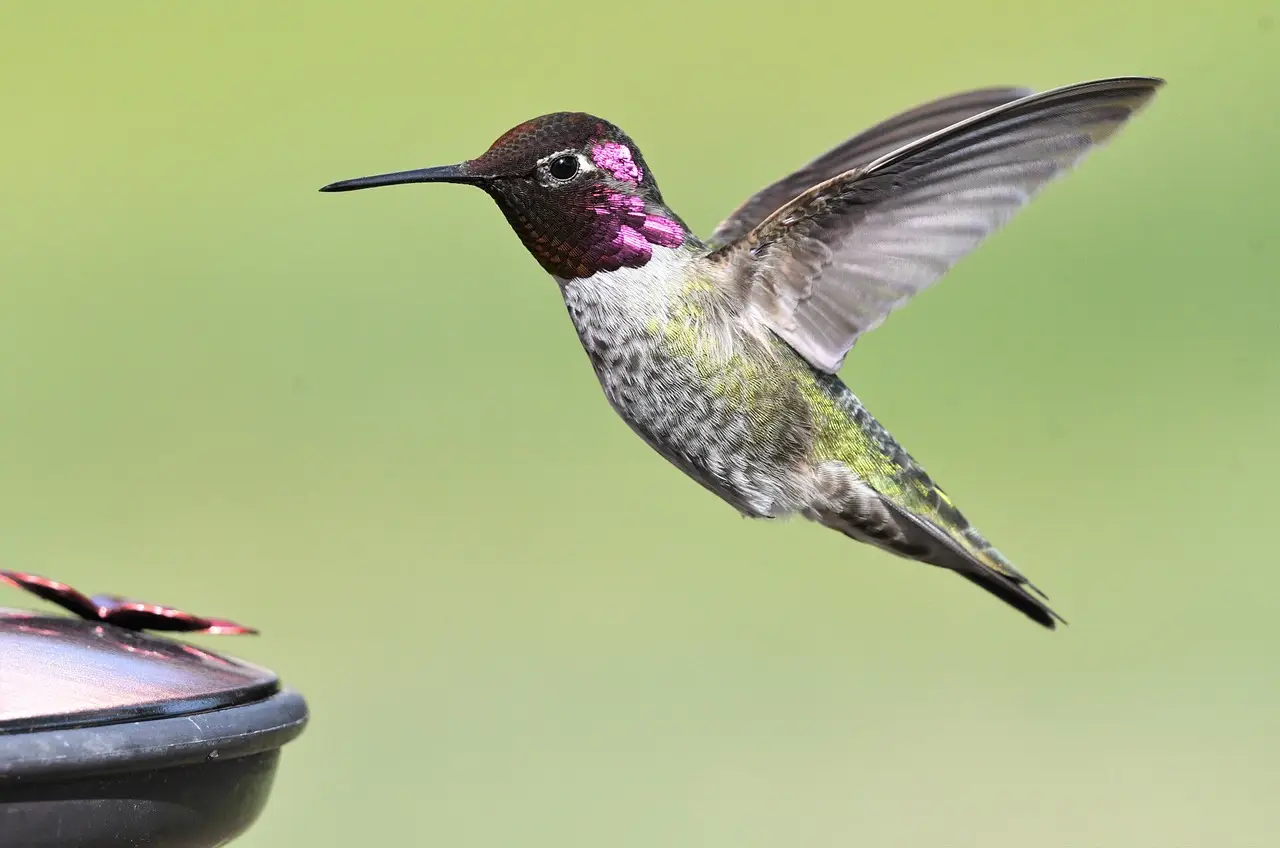
An intermediate layer averaging 189 nanometres thick helps male Anna’s hummingbirds produce vivid magenta by reflecting red and blue light together, without magenta pigment.
The 2026 finding by Sangyeop Kim and colleagues, “Multi-periodic photonic mechanism for non-spectral magenta coloration in Anna’s hummingbird (Calypte anna) feathers,” identifies a previously overlooked part of the birds’ feather optics. It appeared in the Journal of the Royal Society Interface under DOI 10.1098/rsif.2026.0601.
Their experiments show why stripping away the top layer weakens the blue reflection and shifts the color. That matters because magenta is not just another bright shade. It is a color our eyes assemble from two separate parts of the spectrum.
Why doesn’t magenta appear in a rainbow?
A rainbow contains red, orange, yellow, green, blue and violet, plus the colors between them. Each corresponds to a range of light wavelengths. Magenta has no single wavelength. Our visual system creates it when red and blue light arrive together, so scientists call it a non-spectral color.
Male Anna’s hummingbirds wear reddish-pink feathers on their crowns and throats. The species is common along North America’s Pacific Coast. Turn a male’s head slightly, though, and the magenta can look almost black before flashing back into view.
That angle-dependent flash, called iridescence, also occurs in peacocks and starlings. Microscopic structures selectively reflect different wavelengths, rather like the shifting colors in soap bubbles and oil slicks.
Much of the general physics was already understood. The open question was how these hummingbirds could reflect two separated parts of the visible spectrum at once, and so produce such intense magenta.
How does the feather build that color?
Researchers from Yonsei University in South Korea and Ghent University in Belgium measured light reflected from throat feathers. A dominant peak appeared at about 632 nanometers, firmly in the red. Another peak supplied blue light.
That red peak was nearly three times as strong as the blue peak, accounting for the resulting color’s distinctive reddish-pink appearance.
Electron microscopy, which produces images using a beam of electrons, and three-dimensional imaging revealed the machinery. Tiny branches extending from individual feather barbs, called barbules, contain flattened melanosomes. These pigment-carrying organelles hold melanin, a substance responsible for many dark colors in animals.
Hummingbird melanosomes are unusual: tiny platelets with air-filled cavities, stacked in overlapping layers within a protein matrix. Boundaries among air, melanin and protein change how light travels. Some wavelengths reinforce each other; others cancel through destructive interference.
Earlier studies generally recognized small melanosomes near the surface and larger ones deeper down. Kim’s team found a third category: two intermediate layers sandwiched between them.
- Surface melanosomes averaged 108 nanometres thick.
- Intermediate melanosomes measured approximately 189 nanometres.
- Deeper melanosomes averaged 222 nanometres thick.
For scale, a human hair is tens of thousands of nanometres wide.
Computer simulations showed that neither the surface layer nor the intermediate layer produced the distinct blue peak alone. The blue appeared when their optical effects interacted.
The combined arrangement acts as a highly selective natural reflector, sending strong red and weaker blue light toward the viewer.
Does removing the top layer break the trick?
The team also put the mechanism to a physical test. They used oxygen plasma to strip away the top layer gradually, in stages.
- After 60 seconds, the original magenta began shifting toward reddish-orange.
- After 120 seconds, the feathers appeared yellowish-orange.
Across the treatment, the blue reflectance peak weakened and eventually disappeared, while the dominant red peak shifted toward shorter wavelengths.
That is a direct check rather than a computer-only result. The color follows the structure as the structure comes apart.
What might another hummingbird see?
Humans have three types of color-sensitive cone cells in their eyes. Birds typically have four, including one sensitive to ultraviolet light. That extra channel lets birds perceive color combinations that people cannot directly experience.
A 2020 study in PNAS showed that wild hummingbirds could distinguish several non-spectral combinations, including ultraviolet plus green and ultraviolet plus red. Even so, human-visible reflectance alone cannot tell us exactly what Anna’s magenta looks like to another hummingbird.
Males use those iridescent throat feathers in courtship displays, even orienting their dives relative to the Sun so the plumage flashes toward a potential mate.
The new study explains the physical machinery, not its evolutionary purpose. It does not establish that this particular arrangement of melanosomes evolved specifically to improve mating success. Mechanism, not motive.
What does this change for engineered materials?
Engineers are already interested in structural color, which comes from designed microscopic structures rather than conventional dyes. The hummingbird’s layered reflector could inform new optical coatings and materials that produce complex colors.
The practical answer is a possible blueprint, not a proven commercial product. The work tests the biological mechanism; possible benefits for engineered coatings remain untested by this study.
For now, nature still has a considerable head start.
via zmescience.com (Source)
More from James Calloway
Show full bio
Staff writer covering regulation, policy and their impact on general science news at SciBeat.
346 articles