Recorded November 23, 2026
Space & AstronomyReported finding
Phobos 2's "Alien Mothership" Shadow Had a Mundane Cause
Soviet probe Phobos 2 vanished at Mars on March 27, 1989, after imaging a cigar-shaped shadow. A 1991 NASA study traced it to the moon Phobos, not aliens.
By Marcus Bennett4 min read806 words
In brief
- Phobos 2 launched July 12, 1988, and captured more than three dozen images of the Martian moon Phobos.
- Ground control lost contact on March 27, 1989, most likely due to an onboard computer failure.
- A 1991 NASA-led study attributed the cigar-shaped shadow to Phobos's own shadow and instrument effects.
- ESA's Mars Express captured similar elongated Phobos shadows with its HRSC camera in 2005.
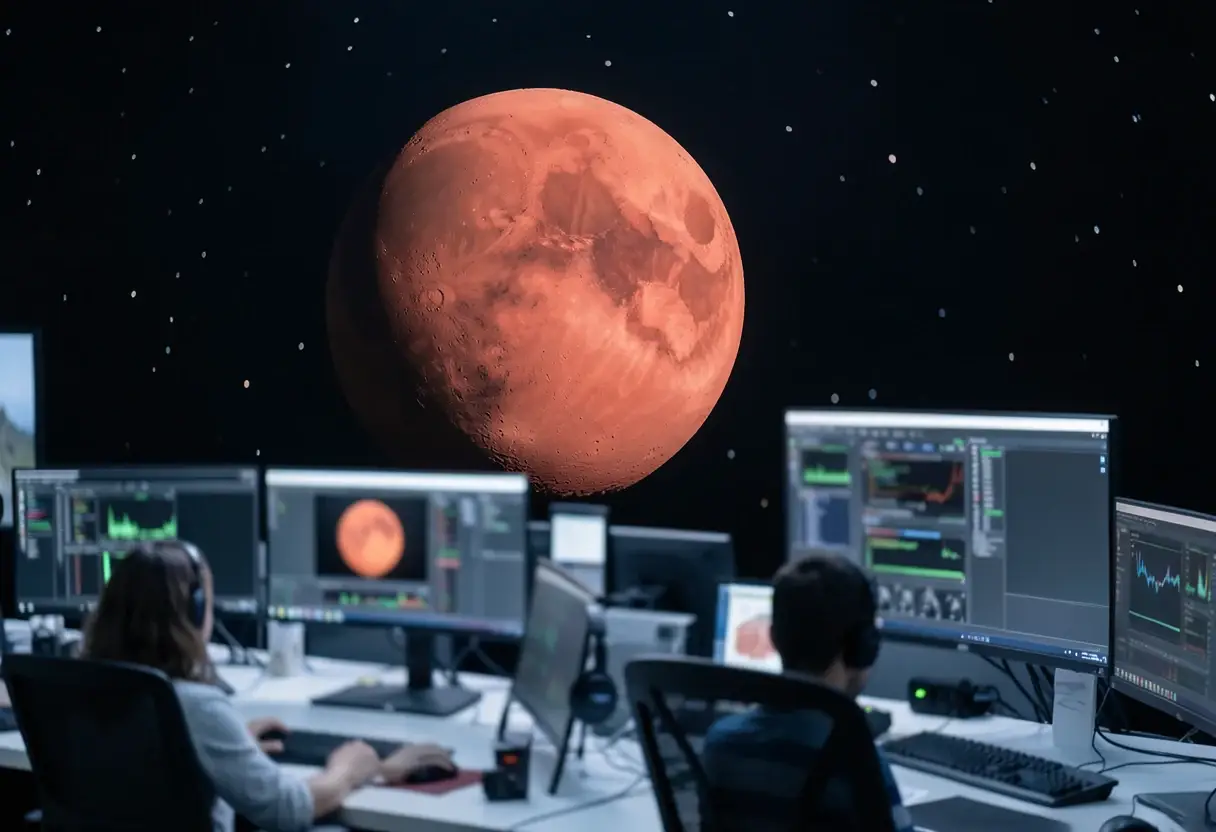
A 1991 NASA-led study concluded that the elongated, cigar-shaped "object" in the final images from Phobos 2 — the Soviet Union's last deep space probe — was almost certainly the shadow of the Martian moon Phobos itself, distorted by the spacecraft's instruments and motion. That finding has not stopped decades of conspiracy theories claiming the probe was destroyed by an alien craft.
What happened to Phobos 2?
The Soviet Union launched Phobos 2 from Baikonur Cosmodrome on July 12, 1988, aboard a Proton rocket. Its mission: study Mars and its largest moon, Phobos, including a planned close approach and the deployment of landing probes. Over several months, the spacecraft captured more than three dozen images of the Martian moon.
The stakes were high from the start. The probe's predecessor, Phobos 1, had gone silent on September 2, 1988, after a faulty command sequence fired while it cruised toward Mars. When Phobos 2 reached Martian orbit on January 30, 1989, controllers found one of its three flight-system processors already offline and a second experiencing technical problems.
Despite those setbacks, the probe recovered. By March 1989, all science instruments were functioning normally, and the two remaining processors kept the spacecraft under ground control.
The end came on March 27, 1989. To photograph Phobos during a pass, the probe had to angle itself toward the moon — pointing its communications antennas away from Earth. The imaging sequence appeared to go smoothly, but controllers could not reestablish contact afterward. A few fleeting radio signals followed, suggesting the spacecraft may have begun spinning uncontrollably. Without reorienting its solar panels toward the sun, it would have lost all power. Investigators identified an onboard computer failure as the most probable cause, but the exact sequence of events remains unknown.
Takeaway: The probe most likely lost attitude control during a routine imaging turn and drained its batteries.
What might have caused the failure?
Several theories have emerged over the years. Authors Paolo Ulivi and David M. Harland noted one early candidate: damage from an impact with material orbiting the Martian moon. Later modeling by Soviet engineers and NASA's Jet Propulsion Laboratory appeared to rule that out.
A more likely scenario involves the failure of the second attitude control computer — the one already misbehaving when the probe arrived in orbit. With two of three processors offline, the remaining computer could not control the spacecraft alone. Battery drain while the solar arrays pointed away from the sun likely compounded the problem, since the probe had no failsafe to power down non-critical systems.
Takeaway: A cascading computer failure plus battery drain fits the evidence best.
What was the shadow in the final photos?
Some of the probe's last images showed an elongated shadow that fueled the most unusual theory of all: that an alien spacecraft had disabled the probe.
The most prominent proponent was Marina Popovich, a former experimental pilot and the first Soviet woman to break the sound barrier, who set over 100 world aviation records. At a 1991 press conference at the Soviet Consulate in San Francisco, she claimed a cigar-shaped object photographed near the Martian moon was an alien mothership.
The actual explanation is more mundane. The spacecraft and Phobos moved in nearly the same orbit at very similar speeds. As Ulivi and Harland note, under those conditions the probe's Termoskan multispectral imager — a scanning instrument that images in multiple wavelength bands — often captured "the shadow of the moon on the planet's surface as a dark oblong cigar-shaped feature."
The 1991 NASA-led study attributed the shadow's strange appearance to several factors acting together:
- quirks of the scanning instrument itself;
- the spacecraft's near-co-orbital motion alongside Phobos;
- the probe's viewing direction;
- a slight rocking motion the spacecraft likely exhibited;
- the oblique angle at which the moon's shadow strikes the Martian surface.
That last factor alone produces elongated shadows. The ESA's Mars Express spacecraft captured similar elliptical shadows with its High-Resolution Stereo Camera in 2005.
Takeaway: Ordinary orbital geometry and instrument behavior fully account for the image.
What did the mission leave behind?
The failure carried political and scientific costs. John M. Logsdon, director of the Space Policy Institute at George Washington University, told the Los Angeles Times the situation was "just horrible" and expected to fuel "a first-rate bureaucratic struggle" amid the Soviet Union's political restructuring. Scientists from more than a dozen nations, whose instruments cost an estimated several million dollars, "must be counted among the losers," the paper reported.
The missions still returned data on Mars and Phobos that, according to Ulivi and Harland, exceeded the total from all previous Soviet missions to the Red Planet. The unanswered questions, though, keep the speculation alive — a reminder of how quickly the unknown invites imaginative explanations.
via space.com (Source)
More from Marcus Bennett
Show full bio
News editor covering regulation, policy and their impact on general science news at SciBeat.
597 articles
Nearby plates
- Simulated collisions show how Phobos could preserve Martian rocks
- A Giant Crater May Reveal Whether Phobos Is a Captured Asteroid
- First Phobos sample mission launches 19 October, JAXA confirms
- NASA Details Its Role in Japan's Mission to Mars's Moons
- NASA Joins Japan's MMX Mission to Bring Home a Piece of Phobos